
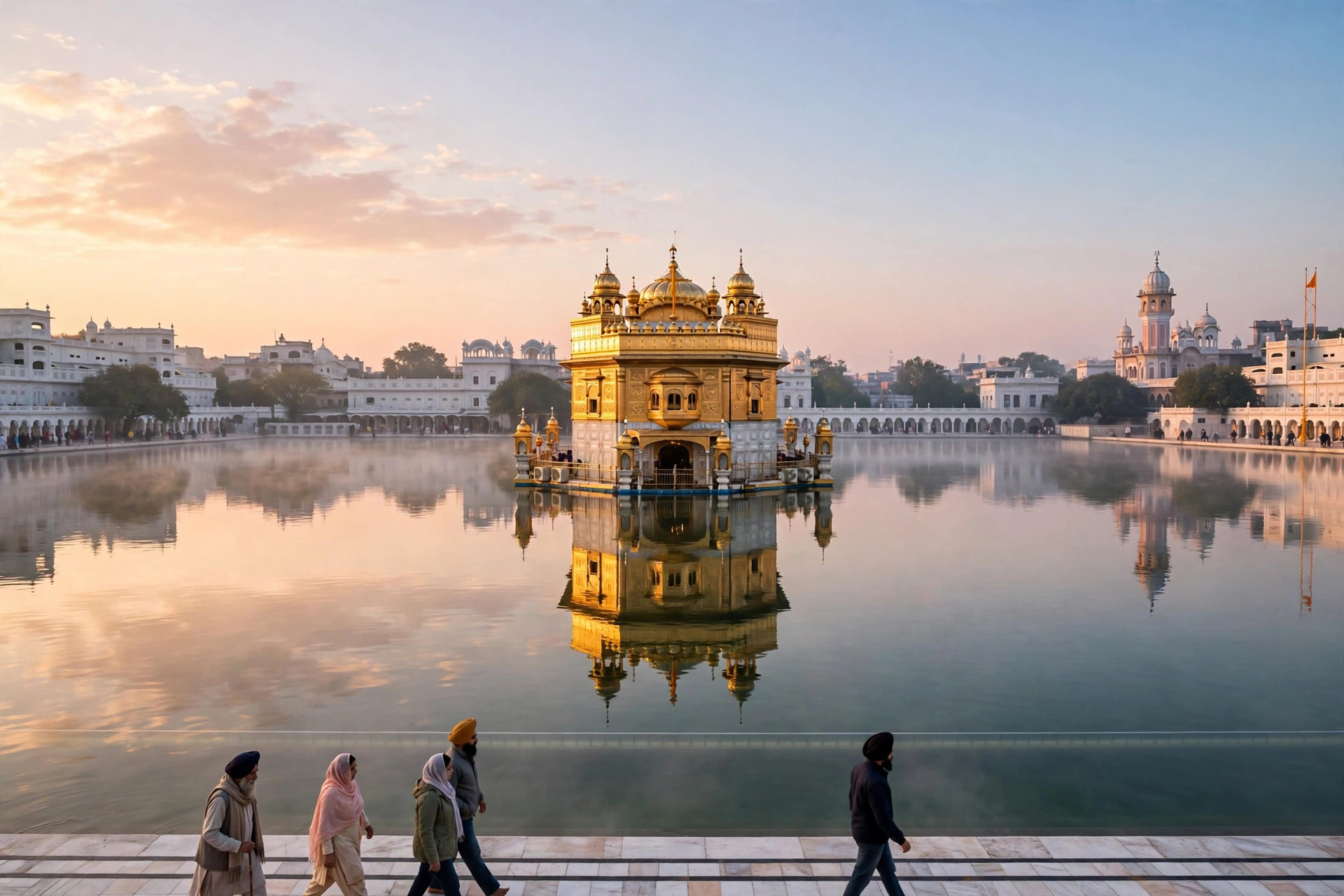
Photo: Wikimedia Commons
Yatra Guides
Golden Temple Amritsar for International Visitors: An Honest First-Timer's Guide — Guru Nanak Jayanti in Three Days, the Kitchen That Feeds 100,000 Free, and the Queue That Triples by 10 AM
Golden Temple guide for foreign visitors: the 5 AM queue, free SGPC stay, langar, Wagah timing and Guru Nanak Jayanti 2026 — checked 21 Nov 2026.
Quick answer: The Golden Temple is the most welcoming sacred place on earth for a first-timer: free entry, no ticket, open 24 hours, and a free meal for everyone. The catch is the queue — 20 minutes at 5:30 AM, three hours by 10 AM — and Guru Nanak Jayanti on Tuesday 24 November 2026 will make this the busiest week of the year, so set the alarm, stay near the temple, and do not pay anyone for anything the temple gives free.
Complete yatra blueprint
3-Day Golden Temple Amritsar for International Visitors — Complete Blueprint
Built for a first-time visitor from the US, UK or EU who has never been to Amritsar and wants the honest version: the queue, the free stay, the free food, and the festival week. Prices checked 21 November 2026; conversions at ₹88 to the dollar and ₹96 to the euro. If you are coming for Guru Nanak Jayanti, arrive by 22 November and read the festival box in the guide first.
Arrive in Amritsar → Evening Parikrama → Langar → Early Night
🛕 Temples & darshan
Golden Temple — Evening Parikrama · Sri Harmandir Sahib, in the Amrit Sarovar, at the end of Heritage Street
Do the slow walk around the pool first, before any queue. The marble is cool, the gold is lit, and the kirtan carries across the water. This is the hour that makes people understand why the temple is famous — not the gold, but the calm. Save the sanctum queue for dawn tomorrow.
Guru ka Langar — First Meal · Guru Ram Das Langar Hall, inside the complex
Your first dinner in Amritsar should cost nothing. Sit in the rows on the floor, eat the dal, sabzi and roti that is served, and wash your plate on the way out. It is the largest free kitchen in the world, and it is also the best introduction to what this place is.
🏨 Where to stay
Sri Guru Ram Das Niwas (SGPC)
Free, plus a ₹100 refundable deposit (about $1.15)
The oldest and largest niwas, two minutes from the temple. Rooms are allotted to families first, with a short maximum stay of two to three nights, and valid ID is required. Book only through sgpc.net — copycat booking sites with QR codes exist. In Gurpurab week, walk in at odd hours rather than counting on an online slot.
Ramada by Wyndham Amritsar
From about ₹5,793/night (about $66)
Google 4.2/5 (1,699 reviews); TripAdvisor 4.6/5 (4,688 reviews). Four-star, in Hall Bazar, a 14-minute walk from the temple, with a pool and fitness centre. The practical choice for the 5 AM queue: you can walk to the gate in the dark without a taxi.
Taj Swarna, Amritsar
From about ₹4,996/night (about $57)
Google 4.7/5 (723 reviews); TripAdvisor 4.8/5 (4,168 reviews). Five-star on Basant Avenue, about 5 km from the temple, with a pool and spa. The calmest bed in the city after a 4 AM start — book early, because November is the year's busiest month.
🍽 Where to eat
Guru ka Langar, Golden Temple
Free
Must try: The free meal itself — dal, sabzi, roti, sometimes kheer, eaten sitting on the floor
On night one, this is dinner. No ticket, no donation expected, no questions asked. It is the single most useful fact in this guide for a budget traveller.
Kesar Da Dhaba
About ₹500 for two (about $5.70)
Must try: Slow-cooked dal makhani with laccha paratha, finished with firni
Google 4.3/5 (2,538 reviews); TripAdvisor 4.1/5 (2,391 reviews). Serving since 1916 at Chowk Passian, near the Telephone Exchange, open 12:30 PM to 11 PM. Expect a queue at dinner — it is worth it.
- Stay within walking distance of the temple if you can. The 5 AM queue is the reason to pay for location, not luxury.
- Do not plan anything for the morning after your flight. Land, walk the parikrama, eat at the langar, sleep early. The dawn darshan is tomorrow.
- Carry cash in small notes. The dhabas, the auto drivers and the small shops around the temple all prefer it.
Dawn Darshan at 5 AM → Jallianwala Bagh → Partition Museum → Old-City Food Walk → Temple by Night
🛕 Temples & darshan
Golden Temple — Dawn Darshan · Sri Harmandir Sahib, through the causeway from the Darshani Deori
This is the day. Prakash, when the scripture is carried to the sanctum, happens around 4:00 to 4:30 AM in winter, and the queue at 5 AM is 15 to 30 minutes on a weekday. By 10 AM the same queue is two to three hours. Stand on the causeway as the light comes up, listen to the kirtan, and then walk the parikrama again when it is empty.
Jallianwala Bagh · About 400 m from the clock-tower entrance of the temple, on Heritage Street
The walled garden where British troops fired on a crowd on 13 April 1919. The bullet holes are still visible in the walls, and the well into which people jumped is still there. It takes twenty minutes and it changes the rest of the day. Go in the morning, when it is quiet.
The Partition Museum · The restored red-brick Town Hall, on Heritage Street, a 5–7 minute walk from the temple
The world's only museum devoted to the 1947 Partition: letters, photographs, refugee belongings, and more than a hundred recorded survivor interviews. It is the one paid sight in the old city, and it is worth the ticket. Allow at least an hour — the testimony room is the part people remember.
🏨 Where to stay
Same base — do not change hotels
One base for all three nights beats repacking
Stay where you are. Day two starts at 4:30 AM and ends after 9 PM, and the only thing that matters is that your bed is a short walk from the gate.
🍽 Where to eat
Gian Di Lassi
About ₹80–120 per glass (about $0.90–1.35)
Must try: Peda wali lassi — thick curd churned with crushed peda and crowned with malai
Google 4.7/5 (60 reviews); TripAdvisor 4.5/5 (141 reviews). Serving since 1921 on Golden Temple Out Road, near the Regent Cinema, open 6 AM–9:30 PM. One glass is a meal — do not order it after a full breakfast.
Bharawan Da Dhaba
Amritsari kulcha ₹150–180 (about $1.70–2.05)
Must try: Amritsari kulcha with chole, and the chur chur naan
Google 4.0/5 (4,264 reviews). Near Town Hall, open 7 AM–midnight, pure vegetarian. The food is the draw; reviews are split on the washrooms, so go for the kulcha, not the ambience.
Guru ka Langar, Golden Temple
Free
Must try: Dinner in the langar hall after the night parikrama
End the day where you started it. The hall is quieter after 10 PM, even in festival week, and the meal is the same one served to a hundred thousand people.
- Eat breakfast after the dawn darshan, not before it. A full stomach and a three-hour queue do not mix, and the lassi can wait until 8 AM.
- The Partition Museum is closed on Mondays. If day two of your trip is a Monday, swap the museum to day three and do Gobindgarh Fort instead.
- Do the night parikrama again on day two, after 9 PM. The crowd thins, the gold reflects in the water, and it is a different temple from the one you queued for at dawn.
Durgiana Temple → Gobindgarh Fort → Wagah–Attari at 4:30 PM → Sukhasan and Depart
🛕 Temples & darshan
Durgiana Temple · In the city, a short auto ride from the old city
The Silver Temple — a Hindu temple built in the same style as the Golden Temple, standing in its own tank. It is the quieter sibling, and the place to go when you want the architecture without the queue. Most first-timers never hear of it, which is exactly why it is worth the morning.
Wagah–Attari Beating Retreat · Attari village, on the Grand Trunk Road at the India–Pakistan border
The daily flag-lowering ceremony: soldiers from both sides marching in step, the crowd chanting, the gates closing at sunset. It runs every evening and has done so since May 2025. The current start time is 4:30 PM, in force since 16 November 2026 — but the time has moved twice in five weeks, so confirm it the week you go. Foreign passport holders get a free separate enclosure with a fast-track queue.
Golden Temple — Sukhasan and Night Parikrama · Sri Harmandir Sahib
Back at the temple for the closing: the scripture is carried back to the Akal Takht around 9:30 to 10:30 PM, and the parikrama empties out. If you are leaving tonight, this is the goodbye. If you are staying for Gurpurab, this is the rehearsal.
🏨 Where to stay
None — depart on day three, or stay for Gurpurab
Check out by 11 AM; most hotels hold luggage for a late departure
If you are staying for Guru Nanak Jayanti on 24 November, do not check out — rebook now. The city fills completely for the festival, and rooms booked on the day do not exist.
🍽 Where to eat
Kesar Da Dhaba
About ₹500 for two (about $5.70)
Must try: The thali — dal fry, channa, raita, salad and two plain parathas
Google 4.3/5 (2,538 reviews). Lunch before Wagah, not dinner after it: you will be back late, and the kitchen closes at 11 PM.
Guru ka Langar, Golden Temple
Free
Must try: A last free meal before you leave
If you are back from Wagah in time, eat at the langar rather than hunting for a restaurant at 9 PM. It is open, it is hot, and it costs nothing.
- Leave for Wagah by 2 PM even though the ceremony is at 4:30 PM. The road, the parking, the security queue and the walk to the stands eat the afternoon.
- Do not try to cross the border. The Wagah and Kartarpur crossings are closed to travellers; the ceremony is a performance you watch, not a crossing you make.
- If you are flying out of Amritsar the next morning, keep your last night in the same hotel rather than moving closer to the airport. The airport is 11–12 km away and the morning traffic is light.
The Golden Temple is the easiest holy place in the world to enter and one of the hardest to do well. There is no ticket, no booking, no queue for a ticket, no permit, and no fee. Anyone can walk in, of any faith or none, at any hour of the day or night, and be fed for free. That is the whole pitch, and it is true. What the pitch leaves out is the queue for the sanctum itself, which is 20 minutes at 5:30 in the morning and three hours by 10, and the fact that the week you are reading this is the busiest week of the year.
Guru Nanak Jayanti falls on Tuesday 24 November 2026, three days from now. The three-day arc starts tomorrow: the Akhand Path begins on 22 November, the Nagar Kirtan moves through the old city on 23 November, and the main day brings the pre-dawn kirtan, the evening illumination and the fireworks over the sarovar. If you are coming for it, you are already late to book. If you are coming next week, you will miss the festival and keep the temple. Either way, this guide is written for a first-timer from the US, the UK or the EU who has never been to Amritsar, and it tells you what the other guides leave out: the hour-by-hour queue, the free stay nobody mentions, the Wagah time that every guide quotes differently, and the scams that cost first-timers money for things the temple gives away free. Prices and timings were checked on 21 November 2026.
Can a foreigner or non-Sikh enter the Golden Temple?
Yes. This is the first question, and it is also the shortest answer in this guide. The Golden Temple — Sri Harmandir Sahib, the holiest shrine in Sikhism — is open to everyone. There is no ticket, no booking, no entry fee, no declaration to sign, no permit to arrange, and no dress you have to buy in advance. You walk in like everyone else, because the temple was built that way: four doors, open to all four directions, so that nobody has to ask permission to enter.
That is not a slogan. It is the practical difference between this temple and almost every other famous shrine in India. At Tirupati you sign a declaration and book a ticket three months ahead. At Puri you cannot enter at all if you are not Hindu. Here, the door is open, the meal is free, and the only thing the temple asks of you is the same thing it asks of every Sikh: cover your head, take off your shoes, wash your feet, and behave quietly inside.
A few numbers, so you know the scale of what you are walking into. The shrine stands on a 67-foot-square platform in the middle of the Amrit Sarovar, the pool of nectar, joined to the shore by a 202-foot causeway. The city around it was founded by Guru Ram Das in 1577. On Google the temple sits at 4.9 out of 5 across more than 200,000 reviews, which is the highest rating of any major shrine in India and the least surprising number in this guide. It is also open 24 hours a day, 365 days a year, which matters more than it sounds: the queue you cannot face at 10 AM does not exist at 5 AM, and the temple never closes to stop you using that fact.
What do I actually do at the gate?
The sequence takes five minutes and it is the same for everyone, so learn it once and you will never feel lost.
First, the head covering. It is mandatory for men, women and children, and a hat or cap does not count. Free scarves and bandanas are handed out at the entrances, so you do not need to buy one, but if you bring your own — a scarf, a bandana, a dupatta — it will feel less borrowed. Put it on before you reach the gate, not at it.
Second, the shoes. Take them off at the Joda Ghar, the free shoe counter, and hand them over. Use the numbered cloakroom for your bag too, not the loose shoe pile outside, which is where things go missing. Keep your passport and phone on you; everything else can wait in the cloakroom.
Third, the foot wash. Before you step onto the marble, you walk through a shallow foot bath. It is part of the ritual and part of the hygiene, and everyone does it, barefoot, in the same water. It is cold in November. That is normal.
Fourth, the dress. Shoulders and knees covered: no shorts, no sleeveless tops, no short skirts. The rule is enforced at the gate, and the staff do turn people away. If you are wearing the wrong clothes, the shops on Heritage Street sell a kurta or a scarf for a few hundred rupees, and it is cheaper to sort it out there than at the gate.
Fifth, the rules inside. No alcohol, tobacco or other intoxicants anywhere in the complex, and no non-vegetarian food. The whole old city around the temple is vegetarian and alcohol-free, so do not go looking for a beer with dinner near the shrine — you will not find one, and asking for one marks you out as someone who has not read the room. Speak softly inside, and keep your phone in your pocket once you are past the parikrama.
Photography is the one point where the guides contradict each other, so here is the honest version. Photos around the sarovar and on the parikrama are taken by everyone, all day, and nobody stops you. Photography inside the sanctum is not allowed, and flash is out of the question. One older guide claims photography was banned across the complex in 2019; another claims it is permitted even inside the sanctum, which is almost certainly wrong. The rule that works is the simple one: photograph the outside, put the camera away at the sanctum door, and follow what the sevadars tell you on the day. They, not the blogs, decide.
What time should I go?
This is the question that decides the trip, and it has a number attached to it. The only hour-by-hour queue table anyone has published for the Golden Temple puts it like this: 5:00 to 6:00 AM, 15 to 30 minutes. 8:00 to 10:00 AM, 45 to 90 minutes. 10:00 AM to noon, two to three hours. Weekends and festival days add 50 to 100 percent to every one of those estimates. The best days are Tuesday and Wednesday. Avoid 10 AM to 2 PM any day.
Read that again, because it is the whole trip in four lines. The same Wednesday at 5:30 in the morning means twenty minutes in the queue, kirtan drifting across the water, marble cool under your feet, and the sanctum almost to yourself. The same Saturday at 10 in the morning means three hours of shuffling through barriers in the sun, and a darshan that lasts seconds at the end of it. The temple is open 24 hours, so the pre-dawn window is always available. Use it.
The daily routine underneath the queue is worth knowing, because it tells you what is happening while you wait. In winter, Prakash — the scripture being carried in procession from the Akal Takht to the sanctum — happens around 4:00 to 4:30 AM. Kirtan runs continuously from about 4:30 AM to 9:30 PM. Sukhasan, the closing, when the scripture is carried back, happens around 9:30 to 10:30 PM, and the sanctum then closes for cleaning until about 3 AM, though the complex itself stays open. Every one of those hours moves a little with the season and a lot on gurpurabs, so treat them as "around" and check the notice board when you arrive.
One more timing point, for the week you are reading this. Guru Nanak Jayanti week is not a normal week. The queue estimates above are for ordinary days. On 23 and 24 November, expect the streets around the temple to be partly closed, the queue to run longer at every hour, and the evening parikrama to move at a shuffle. If you are here for the festival, that is the point. If you are not, come next week.
What is the langar, and can I really eat free?
Yes, and it is not a gimmick. The Guru ka Langar is the largest free kitchen in the world, and it is the reason a traveller with almost no money can spend three days in Amritsar and eat better than a tourist with a budget.
The meal is simple: dal, a seasonal sabzi, roti, sometimes rice and kheer. You sit in rows on the floor — pangat — shoulder to shoulder with everyone else, and volunteers serve you. When you finish, you wash your own steel plate at the troughs on the way out. Nobody asks for a ticket, a donation or your religion. Nobody asks for anything.
The scale is where the sources argue, so here is the range rather than one number. Most guides put it at 50,000 to 100,000 meals a day. The festival and weekend figure runs to 150,000, and one timings site puts the festival-day top end at 200,000. State it as 50,000 to 100,000 on an ordinary day, rising sharply on festivals, and you will be right. The kitchen runs around the clock — four independent sources now agree on that, and the older claim that it closes at 10 PM is outweighed. The quietest sittings are early morning, 3 to 6 AM, and mid-afternoon, 2 to 5 PM. Festival-week mid-mornings and after 10 PM are the easiest times to get a seat without a wait.
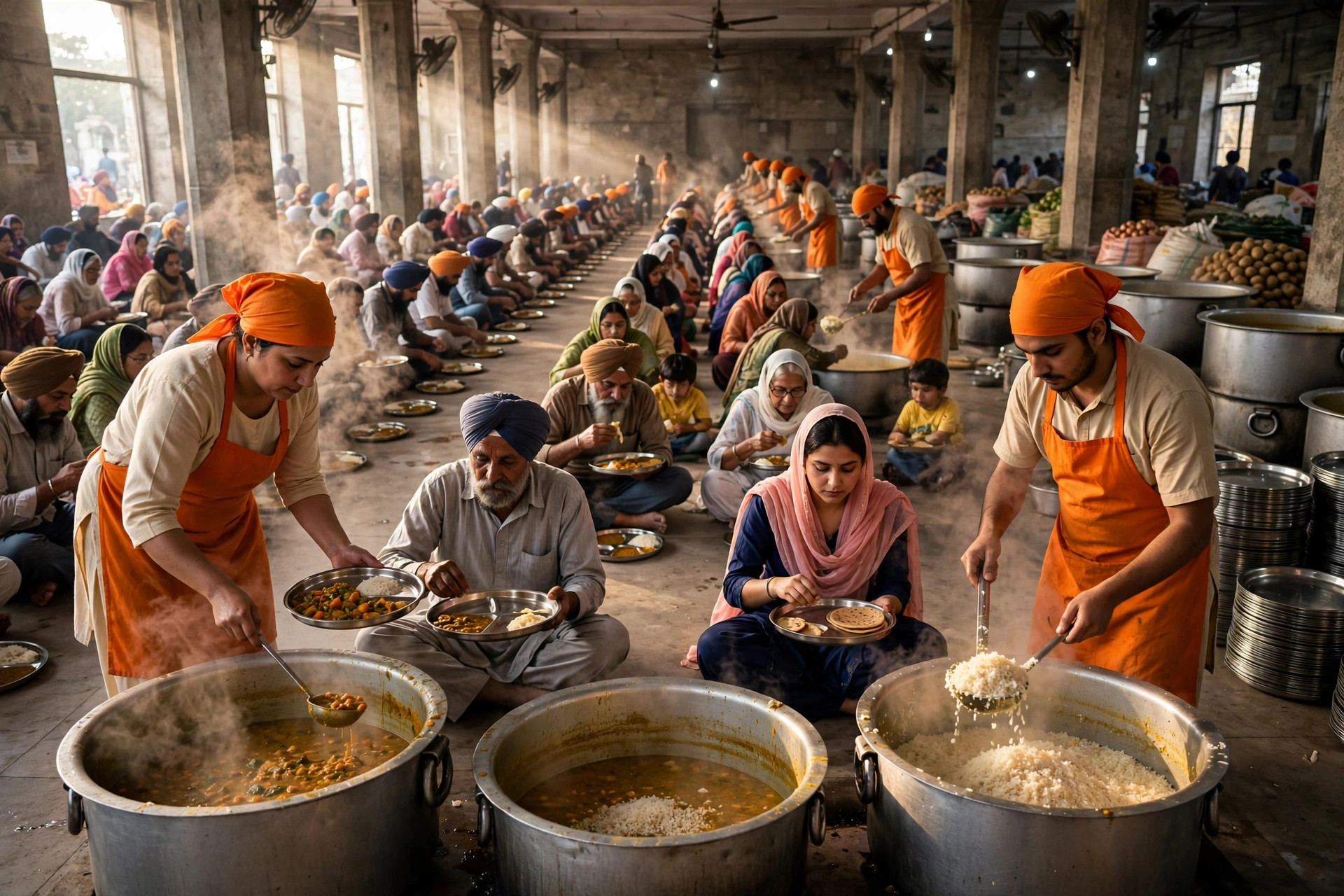
Seva — volunteering — is the part most visitors never try, and it is the part worth trying. Walk in and ask any sevadar. Chopping vegetables, rolling rotis, serving food, washing dishes: shifts run about two hours, there is no registration, and there is no fee. It is the fastest way to stop being a tourist in the complex and start being a participant, and it is also the best story you will take home. Two practical notes: wear clothes you do not mind getting flour on, and wash your hands at the stations provided before you touch anything.
What is Guru Nanak Jayanti, and should I come for it?
Guru Nanak Jayanti — Gurpurab — is the birth anniversary of Guru Nanak Dev Ji, the founder of Sikhism, and in 2026 it falls on Tuesday 24 November, Kartik Purnima, the full moon of Kartik. It is the 557th Prakash Utsav. The Purnima tithi runs from 11:42 PM on Monday 23 November to 8:23 PM on Tuesday 24 November, which is why one Nanakshahi listing prints 23 November. The SGPC and Harmandir Sahib go by Kartik Purnima, the 24th. If a site tells you the festival is on the 23rd, it is reading the wrong calendar.
It is not a one-day event. It is a three-day arc, and if you only arrive for the main day you miss the half that locals care about most.
Two days before, Sunday 22 November: the Akhand Path begins. A continuous, unbroken reading of the whole Guru Granth Sahib, running for roughly 48 hours inside Harmandir Sahib, reaching its bhog — its conclusion — on the morning of the 24th. The reading never stops, day or night, and you can walk in at 3 AM and hear it going.
The day before, Monday 23 November: the Nagar Kirtan. By early afternoon the procession leaves from Sri Akal Takht Sahib: the Panj Pyare, the Five Beloved Ones, walking in front in saffron, then the palki carrying the Guru Granth Sahib on a flower-covered float, then gatka troupes, school bands and kirtani jathas on trucks. The route loops through the walled city and returns by evening. The best watching spots are near Hall Gate and the Heritage Street plaza, where the procession slows. Get there by 2 PM. The streets will be partly closed, so do not plan a Wagah trip for this day — the roads are blocked anyway.
The main day, Tuesday 24 November: from Asa di Var to the fireworks. Prabhat Pheris — small groups walking the neighbourhoods singing shabads — start before dawn. Inside, Asa di Var kirtan begins around 3 AM, and the Akhand Path reaches its bhog in the morning. Through the day there are kirtan diwans and a palki procession. After Rehras Sahib at sunset the lights go on, diyas are set along the marble, and fireworks go off over the sarovar, usually between 7 and 8 PM. On Gurpurab evening the parikrama holds more people than it was built for, and movement is one slow clockwise shuffle. That is the point. Do not fight it.
Should you come for it? If you want the Golden Temple at its brightest, yes, and this is the year to do it. But come with your eyes open. Book the stay now — the city fills completely, and rooms booked on the day do not exist. Arrive by 22 November, not on the 24th. Expect road closures on 23 and 24 November, and expect the queue to run longer at every hour. And if you are not coming for the festival, come the week after, when the lights are down and the queue is back to twenty minutes at dawn.
How do I get there?
Start with the visa, because it is the one thing you cannot fix at the airport. Most visitors from the US, UK, EU, Canada and Australia apply online for an e-Tourist Visa at indianvisaonline.gov.in, the only official site, run by the Ministry of Home Affairs. Apply between 4 and 120 days before travel; most approvals arrive by email within 72 hours, but allow a week, and longer before the December peak. Your passport needs six months of validity left.
The fee depends on your passport and your dates, and most blogs quote one number for everyone, which is wrong. The official fee table dated 8 September 2026 puts the 30-day e-Tourist Visa at $25 from July to March and $10 from April to June, plus a 3 percent bank charge, for US, UK, Canadian, Australian and most EU passports. The one-year visa is $40. The five-year visa is where the trap is: most sites quote $80 for everyone, but the fee is reciprocal by passport — $160 for a US passport, $484 for a UK passport. If you are a British citizen of Indian origin who visits often, an OCI card is cheaper than a single five-year visa. Check your own fee on the portal before you pay, because the number on the blog is probably not your number. And pay only inside indianvisaonline.gov.in: any site that adds a "service fee" on top is an agent, not the government.
From Delhi, Amritsar is about 450 km up NH 44. The flight takes about 1 hour 10 minutes to 1 hour 45 minutes, and one-way fares run ₹2,800 to ₹9,500, with the cheapest fares three or more weeks out. The train is the better journey: the Vande Bharat 22487 leaves Old Delhi at 15:15 and reaches Amritsar at 20:45, five and a half hours, in Chair Car at ₹1,300 or Executive Chair Car at ₹2,345, meal included, every day except Friday. The Shatabdi 12029 leaves New Delhi at 07:20 and arrives 13:30, six hours ten minutes, from about ₹1,285. Book trains on IRCTC; the Vande Bharat has no dynamic fare, so the price does not rise as seats fill, but the seats do sell out in festival week.
Sri Guru Ram Dass Jee International Airport is about 11 to 12 km from the temple, and Amritsar Junction railway station is about 2 km. Use the prepaid taxi counter inside the airport terminal, not the drivers outside it.
From London, the honest answer is messier than the airline pages admit. Air India lists a direct service — one weekly flight, with its own site saying one direct from Gatwick and a fares site saying one weekly from Heathrow on Mondays — while Google Flights and KAYAK currently show no nonstop options at all, only connections via Delhi, with the cheapest return around £607 on Air India. The direct service exists on paper and moves with the seasons. Do not build your trip around it. Plan on a connection through Delhi, and treat any direct flight you find as a bonus to confirm on the day you book, not a promise.
Where should I stay — near the temple or in the city?
Near the temple, if you can. The whole argument for paying for location is the 5 AM queue: a hotel fourteen minutes' walk from the gate means you can leave at 4:30 in the dark and be in the sanctum by 5:15. A hotel five kilometres away means a taxi in the dark, a driver who may or may not come, and a queue that has already doubled by the time you arrive.
The cheapest bed in the city is also the one most guides never mention. The SGPC — the Shiromani Gurdwara Parbandhak Committee, which runs the temple — operates eight pilgrim lodges, called niwas, around the complex. Sri Guru Ram Das Niwas, built in 1931, is the oldest and largest of the lodges, and it charges no rent at all: only a refundable security of ₹100. The niwas with attached bathrooms, geyser and air conditioning — Guru Arjan Dev, Guru Hargobind and Mata Ganga Ji — charge ₹500 a night plus a ₹1,000 refundable deposit. Saragarhi Sarai, newer, runs about ₹1,000 a night. Book through the official SGPC sarai page or at the round-the-clock counter in Guru Arjan Dev Niwas, and book only through sgpc.net: copycat booking sites with QR codes exist, and they have already duped pilgrims.
Three rules govern the sarais, and they catch people out. Rooms are allotted to families first — not to groups of unrelated men or women travelling together. The maximum stay is short, two to three nights depending on the niwas. And you need valid ID; foreign visitors carry their passport. Online bookings are limited and go within minutes in Gurpurab week, so walking in at odd hours is often the realistic route. Solo travellers are usually given dormitory space rather than a private room, so do not count on a room to yourself. One honest conflict to state: one forum lists Guru Ram Das Sarai at ₹500 to ₹1,000 a night, while the SGPC's own table and two independent guides say free plus a ₹100 deposit. The free rooms exist. If anyone at a counter asks you for more than the deposit, confirm at the SGPC desk and never pay a middleman.
If the sarai does not work for you, the mid-range choice is the Ramada by Wyndham Amritsar, in Hall Bazar, a fourteen-minute walk from the temple: Google 4.2 out of 5 across 1,699 reviews, TripAdvisor 4.6 out of 5, from about ₹5,793 a night, with a pool and fitness centre. At the top end, the Taj Swarna on Basant Avenue runs from about ₹4,996 a night — Google 4.7 out of 5 across 723 reviews, TripAdvisor 4.8 out of 5 — and the Hyatt Regency on Grand Trunk Road runs from about ₹6,164 a night, Google 4.2 out of 5, TripAdvisor 4.5 out of 5, with a free scheduled shuttle to the temple. November is the year's busiest month, and festival week is its peak: the city's average hotel price is about ₹5,284 on weekdays and ₹5,391 on weekends, and Gurpurab week runs above that. Book now, and check the live rate the week you travel rather than trusting any price printed here.
One small thing worth doing in any hotel room, in Amritsar or anywhere else on a trip: take two minutes to check the room when you arrive. A quick look behind the television, at the smoke detector and at any small device facing the bed costs nothing and catches the one thing nobody wants to find later. If you want a tool for it, the Hidden Camera Detector: NoPeek app on Google Play does a Wi-Fi camera scan, a flashlight lens-glare test and an infrared check, and it works offline. It is a paid app with a lifetime option or a seven-day trip pass, no ads and no account. Use it once on arrival and forget about it.
What does a darshan day actually look like?
It starts early and it is mostly waiting, so it helps to know that in advance. Leave the hotel by 4:30 AM. Walk to the gate in the dark — the streets are already busy, and the tea stalls are already open. Cover your head, leave your shoes at the Joda Ghar, wash your feet, and join the queue.
With a 5 AM start, the wait is 15 to 30 minutes on a weekday. The compartments move in fits and starts, and the kirtan is audible the whole way in. The darshan itself lasts seconds: you are moved along a line, you see the Guru Granth Sahib in the sanctum, and you are out. That is normal, and it is not a disappointment once you know to expect it. The queue is the pilgrimage. The seconds are the reward.
After darshan, do not leave. Walk the parikrama again, slowly, now that the light is up. Then eat at the langar — it is the best breakfast in the city and it costs nothing. By 8 AM you will have done the thing people queue three hours for, and you will have the rest of the day free. That is the whole trick of this temple, and it is why the alarm matters more than the itinerary.
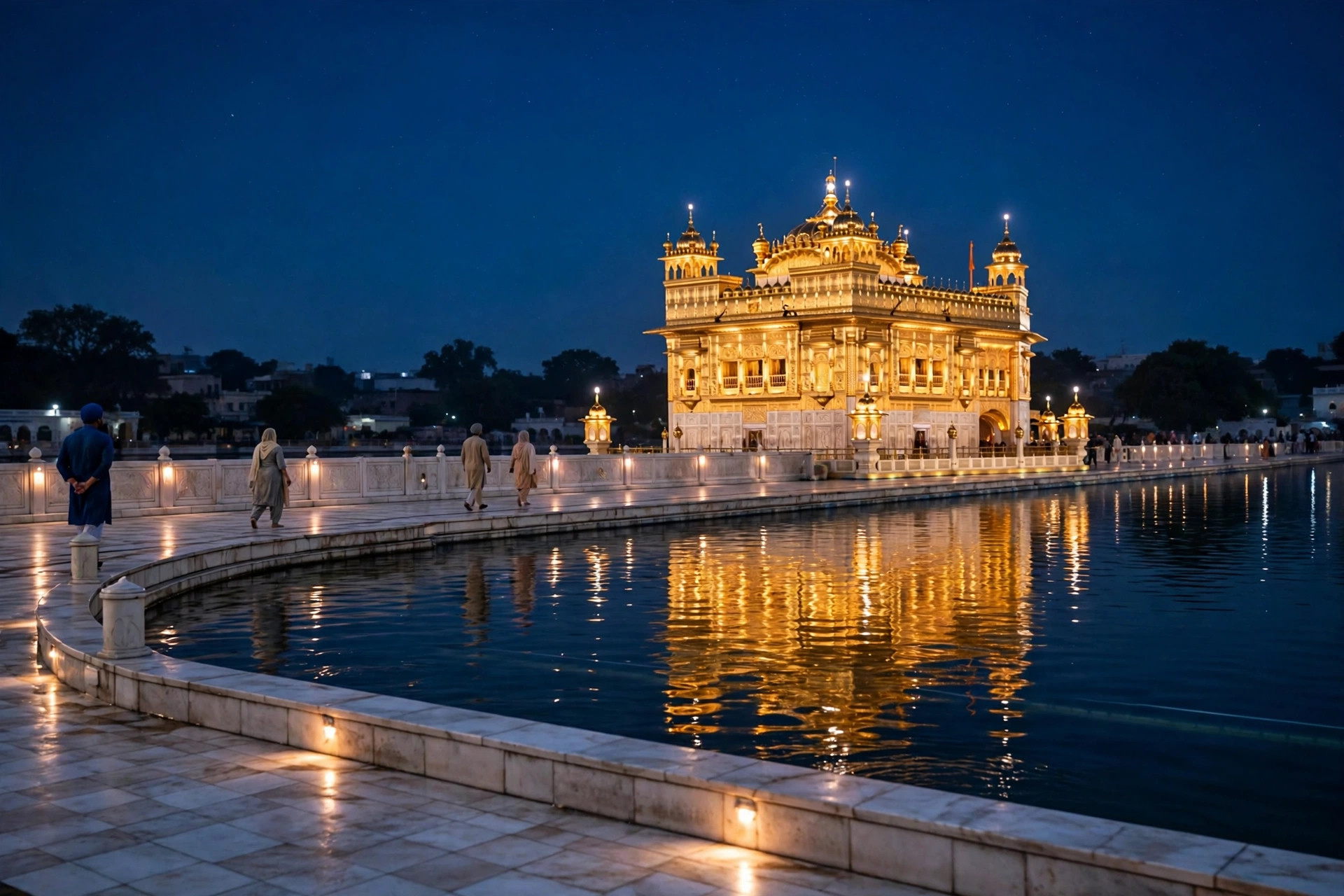
The evening is the second half of the day, and it is worth staying up for. Come back after 9 PM, when the crowd thins and the gold reflects in the water. The parikrama at night is a different temple from the one you queued for at dawn: quieter, slower, and the hour when the place finally feels like it belongs to the people walking it rather than the queue. Sukhasan, the closing, happens around 9:30 to 10:30 PM. After that the sanctum closes for cleaning until about 3 AM, though the complex stays open.
Where do I eat?
The whole old city around the temple is vegetarian and alcohol-free, and that is a gift, not a limitation. You never have to ask whether something is veg. You only have to ask whether it is good. One correction for anyone arriving with a picture of "Punjabi food" in their head: here it does not mean butter chicken. It means kulcha, dal, lassi and paratha, cooked in desi ghee, eaten standing up or sitting on the floor. The meat restaurants are outside the temple zone, on the roads away from the shrine.
Start with the free one, because it is also the best one. The langar serves dal, sabzi, roti and sometimes kheer to everyone, all day and night, and the meal you eat sitting on the floor with a hundred strangers is the meal you will remember. For a budget traveller, this is the single most useful fact in the whole guide.
Then spend real money on the two dhabas every local names. Kesar Da Dhaba, serving since 1916 at Chowk Passian near the Telephone Exchange, does the slow-cooked dal makhani with laccha paratha and firni — Google 4.3 out of 5 across 2,538 reviews, TripAdvisor 4.1 out of 5, about ₹500 for two, open 12:30 PM to 11 PM. Go at lunch if you can; the dinner queue is long, and the thali — dal fry, channa, raita, salad and two plain parathas — is the order. Bharawan Da Dhaba, near Town Hall, open 7 AM to midnight, is the kulcha stop: Amritsari kulcha with chole for ₹150 to ₹180, and the chur chur naan that regulars argue about. Google 4.0 out of 5 across 4,264 reviews. The food is the draw and the reviews are split on the washrooms, so go for the kulcha, not the ambience.
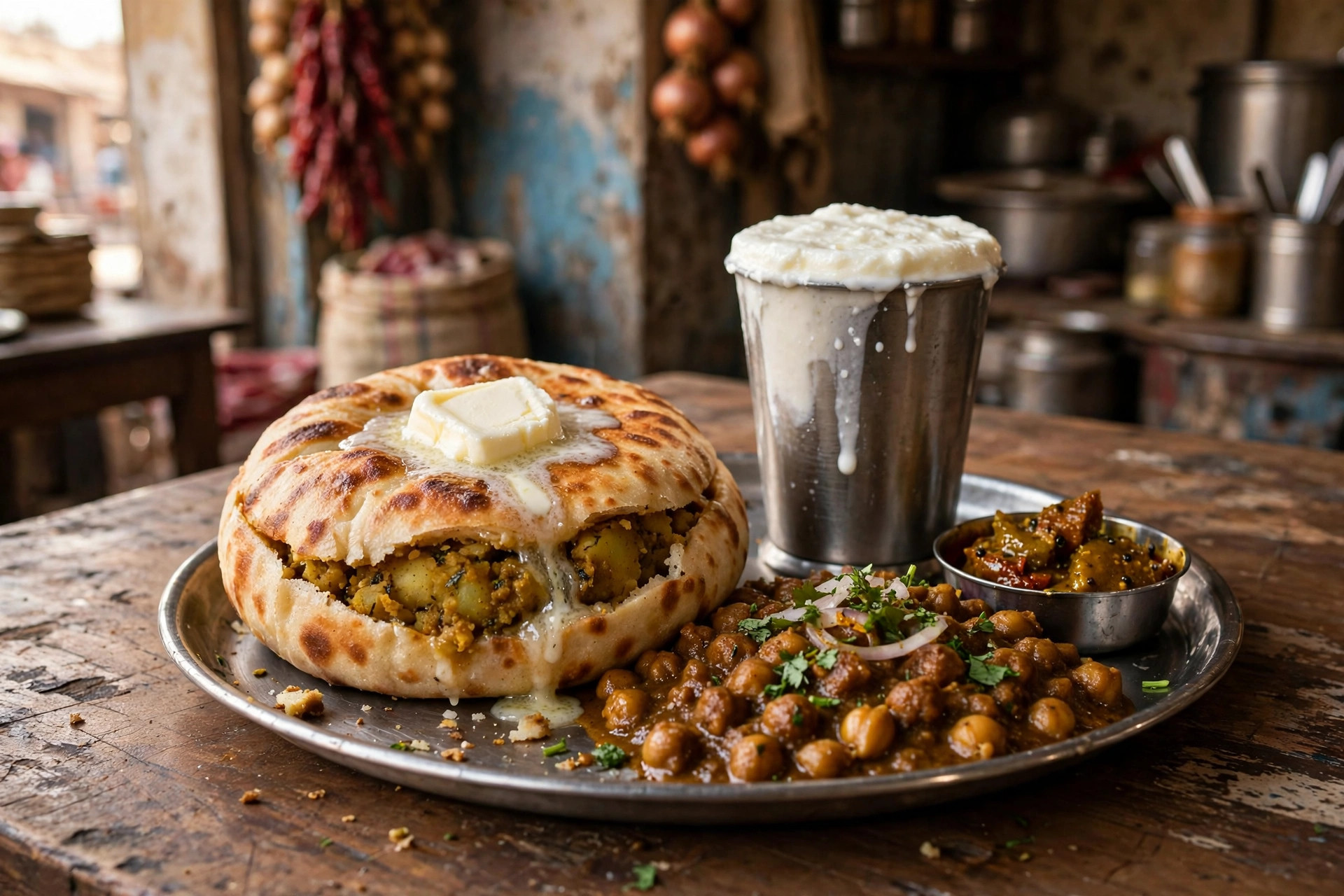
And then the lassi. Gian Di Lassi — Gian Chand Milk Bhandar — has been serving on Golden Temple Out Road since 1921, open 6 AM to 9:30 PM. The peda wali lassi is thick curd churned with crushed peda and crowned with malai, about ₹80 to ₹120 a glass. Google 4.7 out of 5 across 60 reviews, TripAdvisor 4.5 out of 5. One glass is a meal. Do not order it after a full breakfast, and do not try to finish it standing up in the sun. Sit down. Take your time. It has been the same glass for a hundred years, and it is in no hurry.
What about Wagah?
The Beating Retreat at Attari–Wagah is the one half-day trip every Amritsar itinerary includes, and it is also the one whose timing every guide quotes differently. Here is the honest version, with the dates attached.
The ceremony is held at Attari village, 28 to 30 km west of Amritsar on the Grand Trunk Road, at the only road crossing between India and Pakistan. It resumed for the public around 20 to 21 May 2025 and has run every evening since. The ceremony itself lasts about 30 minutes, ending as the flags come down at sunset, with music and crowd chants starting well before.
The start time moves with the seasons, and it has moved twice in five weeks. The slot was 5:30 to 6:00 PM until about 15 October. On 16 October the BSF moved it to 5:00 to 5:30 PM. On 16 November it moved again, to 4:30 PM. That is the current time, confirmed by Amar Ujala on 14 November and by two further reports on 20 November, and it is the time to plan around. But the BSF announces changes only a day or two ahead in the local Punjab press, so treat any printed time — including this one — as a guide and confirm it the week you go. The rule that never changes: leave Amritsar by 2 PM either way, and arrive one to two hours early. The road, the parking, the security queue and the walk to the stands eat the afternoon.
Entry is free. There is no ticket and no online booking required, though the BSF portal (attari.bsf.gov.in) lets you book a seat up to 48 hours ahead with photo ID. The grandstands hold up to about 25,000 people, first come first served. Foreign passport holders get a free separate enclosure with a fast-track queue — carry your passport, and do not leave it at the hotel for this. No bags are allowed inside; lockers cost about ₹50. VIP passes are issued by the BSF. Anyone selling "VIP tickets" is running a scam.
Two things to know before you go. First, the ceremony is not a crossing. The Wagah and Kartarpur crossings are closed to travellers, and the UK Foreign Office — updated 27 October 2026 — advises against all but essential travel within five miles of the India–Pakistan border, with the Grand Trunk Road to Wagah as an exception. You go, you watch, you come back. Second, do not plan Wagah for 23 November. The Nagar Kirtan closes the roads that day, and you will spend the afternoon in traffic instead of at the border.
Is Amritsar safe for solo women, and what scams should I watch for?
Amritsar is a temple city, and it behaves like one. The streets around the temple and Heritage Street are busy late, the crowds are families, and the temple complex itself is one of the most heavily attended public spaces in India. Solo women travel here constantly. The practical advice is the same as anywhere in India: stay near the temple or on a main road rather than down an unlit lane, dress to the temple code — which also means you blend in rather than stand out — keep your phone and cash in a bag you can close, and take a prepaid taxi or an auto rather than walking alone after dark. In the sarais, note that rooms go to families first; a solo traveller is usually given dormitory space, so do not count on a private room.
The scams are specific, and they are all avoidable. First, paid "VIP darshan". There is no VIP darshan at the Golden Temple. The SGPC sells none, and anyone in the lanes outside offering to sell you one is selling something that does not exist. Second, paid Wagah seats. Entry is free, the foreigners' enclosure is free, and the VIP passes are issued by the BSF. Third, fake sarai booking sites. Book only through sgpc.net; the copycat sites with QR codes have already duped pilgrims, and the SGPC has warned about them in the press. Fourth, fake guides outside the gates. The temple needs no guide — the sequence is shoes, feet, head cover, queue — and anyone who insists otherwise is selling you a walk you can do alone. Fifth, the taxi trap at the airport and the station. Use the prepaid counter inside the terminal. The driver outside who quotes you double is not your friend, and the one who offers a "package" with a guaranteed darshan is selling you the first scam with a car attached.
One more thing, for the evenings. November in Amritsar is the year's worst month for air quality, because of stubble burning, and the air is unhealthy for sensitive people. The mornings are clearest. If you are sensitive to smoke, carry a mask and plan the outdoor hours for the morning. No guide that hides that is honest, and no mask that you leave in the hotel helps you.
What does it cost?
Prices checked 21 November 2026, conversions at ₹88 to the dollar. International flights are not included, because they vary too much to be useful. This is the cost on the ground in Amritsar, per person, for three days.
| Item | Budget | Comfort |
|---|---|---|
| e-Visa, 30-day | $25 (about ₹2,200) | $25 (about ₹2,200) |
| Delhi–Amritsar return | ₹2,655 by Vande Bharat Chair Car (about $30) | ₹5,600–19,000 by flight (about $64–216) |
| Hotel, 2 nights | Free at the SGPC sarai + ₹100 deposit (about $1) | ₹10,000–12,600 at the Ramada or Taj (about $114–143) |
| Darshan | Free, ₹0 | Free, ₹0 |
| Food, 3 days | ₹1,500 (about $17), mostly langar + kulcha and lassi | ₹4,500 (about $51) |
| Partition Museum | ₹250 (about $2.85) | ₹250 (about $2.85) |
| Wagah ceremony | Free entry; lockers about ₹50 | Free entry; lockers about ₹50 |
| Total on the ground | About ₹6,705 (about $76) | About ₹22,550–38,550 (about $256–438) |
The budget column is not a trick. Amritsar is the cheapest major pilgrimage in India for a foreign visitor, because the two things that cost money everywhere else — a bed and a meal — are free here if you want them to be. The comfort column is not a trick either: it is what the same three days cost when you fly instead of taking the train and sleep in a five-star hotel instead of a sarai. The difference between the two columns is about $180 to $360, and almost all of it is the flight and the hotel. The temple itself charges nothing, and that is the point.
What else is worth a day?
Do not leave Amritsar without the two wounds. Jallianwala Bagh is a ten-minute walk from the temple, free, open roughly 6:30 AM to 7 PM, and the bullet holes are still in the walls. The Partition Museum, in the Town Hall on Heritage Street, is the world's only museum devoted to the 1947 Partition — letters, photographs, refugee belongings, more than a hundred recorded survivor interviews — and it is the one paid sight in the old city at ₹10 for Indian nationals and ₹250 for foreign visitors, Tuesday to Sunday, 10 AM to 6 PM, closed Mondays. Allow at least an hour for it. The two places sit five minutes apart, and together they explain the city in a way the temple alone does not.
Then, if you have a morning free, go to Durgiana Temple, the Silver Temple, standing in its own tank in the city. It is built in the same style as the Golden Temple and it is the quieter sibling — the architecture without the queue. Gobindgarh Fort, about 2 km from the temple, runs an evening light-and-sound show; check the show timings at the gate on the day, because they move with the season. Tarn Taran Sahib, about 25 km south, is the day trip if you have a fourth day. Anandpur Sahib is a separate full day, about 200 km away — do not try to bundle it into a three-day Amritsar plan.
For the same honest first-timer's playbook elsewhere, see our Kedarnath guide for international visitors, our Varanasi guide for international visitors, our Puri guide for international visitors and our Tirupati guide for international visitors.
Prices, timings and ticket rules checked on 21 November 2026 against SGPC sarai information, the Partition Museum's official site (partitionmuseum.org), BSF timing reports in Amar Ujala and Need24, the Government of India e-Tourist Visa fee table dated 8 September 2026, IRCTC fares via erail.in, and Google and TripAdvisor ratings. The Wagah ceremony time has moved twice in five weeks, so confirm it the week you travel. Images are AI-generated illustrations of the Golden Temple exterior, the langar hall and Amritsari food — no photography is permitted inside the sanctum, and no image here pretends to show it.
Frequently asked questions
Can foreigners and non-Sikhs enter the Golden Temple?
Yes. The Golden Temple is open to everyone, of any faith or none, with no ticket, no booking and no entry fee. There is no declaration to sign and no permit to arrange — you walk in like everyone else. The only requirements are the same for every visitor: cover your head, remove your shoes, wash your feet, and dress modestly.
What is the dress code at the Golden Temple for foreign visitors?
Cover your head — mandatory for men, women and children, and free scarves are handed out at the entrance. Wear clothes that cover your shoulders and knees: no shorts, no sleeveless tops, no short skirts. Shoes come off at the free Joda Ghar shoe counter, and you wash your feet in the foot bath before entering. No alcohol, tobacco or non-vegetarian food anywhere inside the complex.
What is the best time to visit the Golden Temple to avoid the queue?
Go at 5 to 6 AM on a weekday, when the wait is 15 to 30 minutes and the kirtan is drifting across the water. By 8 to 10 AM the wait is 45 to 90 minutes, and by 10 AM to noon it is 2 to 3 hours. Weekends and festival days add 50 to 100 percent to every estimate. The temple is open 24 hours, so the pre-dawn window is always available — use it.
Is the langar really free, and can I volunteer?
Yes, and yes. The Guru ka Langar serves free vegetarian meals to everyone, around the clock — dal, seasonal sabzi, roti, rice, sometimes kheer — at a scale of roughly 50,000 to 100,000 meals a day, rising to 150,000 or more on festival days. You sit in rows on the floor (pangat), eat what is served, and wash your own plate on the way out. To volunteer, walk in and ask any sevadar: chopping, rolling rotis, serving food, washing up, in shifts of about two hours. No registration, no fee.
What time is the Wagah border ceremony, and is there a foreigners' enclosure?
As of 16 November 2026 the Beating Retreat starts at 4:30 PM, but the time has moved twice in five weeks — 5:30 PM until mid-October, 5:00 PM from 16 October, 4:30 PM from 16 November — so confirm it the week you go and leave Amritsar by 2 PM either way. Entry is free and there is no booking; foreign passport holders get a free separate enclosure with a fast-track queue, so carry your passport. Anyone selling VIP Wagah seats is running a scam.
When is Guru Nanak Jayanti 2026 and what happens in Amritsar?
Tuesday 24 November 2026, Kartik Purnima, the 557th birth anniversary of Guru Nanak Dev Ji. It is a three-day arc: the Akhand Path, a 48-hour continuous reading, begins around 22 November; the Nagar Kirtan procession moves through the old city on the afternoon of 23 November; and the main day, 24 November, runs from Asa di Var kirtan around 3 AM to the evening illumination and fireworks over the sarovar around 7 to 8 PM. One Nanakshahi listing prints 23 November, but the SGPC and Harmandir Sahib go by Kartik Purnima, the 24th.
Keep exploring
 Yatra Guides
Tirupati for International Visitors: An Honest First-Timer's Guide — the NRI Darshan Maze, the Two-Minute Declaration, and Vaikunta Ekadasi in Four Weeks
First-timer's Tirupati guide for foreign visitors: NRI darshan, the declaration form, real costs, and Vaikunta Ekadasi tickets — checked 19 Nov 2026.
 Yatra Guides
Hidden Camera Safety for Solo Women Travellers: Stays, Changing Rooms and Cabs
Privacy checks for women travelling alone: choosing a stay, a 2-minute arrival routine, the 30-second changing-room check, cabs, and trackers — plus what to do in India.
 Yatra Guides
Camino de Santiago 2027 Holy Year: The Honest First-Timer's Guide — the Record Year, the Holy Door, and Which Route to Actually Walk
Camino de Santiago Holy Year 2027 for first-timers: the record year, the Holy Door opening 31 Dec 2026, real 2026 costs, routes and a 7-day Sarria plan — checked 17 Nov 2026.