
Photo: Wikimedia Commons
Yatra Guides
Hidden Camera Safety for Solo Women Travellers: Stays, Changing Rooms and Cabs
Privacy checks for women travelling alone: choosing a stay, a 2-minute arrival routine, the 30-second changing-room check, cabs, and trackers — plus what to do in India.
Quick answer: Travelling alone as a woman does not need a new set of fears, it needs a short routine: pick stays with a track record and a front desk that answers the phone, run a 2-minute privacy check on arrival, use the 30-second silent check in changing rooms, and know the two numbers that matter in India — 112 for any emergency and 1091 or 181 for a women's helpline. The checks are small; the point is that you do them the same way every time, so they never depend on how tired you are.
You do not need a new set of fears to travel alone as a woman. You need a short routine that you run the same way every time, so it never depends on how tired you are, how late the check-in is, or how nice the room looks.
This guide is that routine. It is written for women travelling alone in India and anywhere else, and it covers the three places privacy actually gets tested on a trip: the room you sleep in, the changing room you undress in, and the car you ride in.
How do I pick a stay that is actually safe?
Most of the safety work happens before you book, and it is reading, not gear.
Read the recent reviews, not the overall rating. A 4.6 average tells you nothing; the last twenty reviews tell you everything. Search them for the words "safe", "staff", "alone" and "privacy". A review from a woman who stayed alone and felt looked after is worth more than a hundred generic five-star ratings. A review that says the staff knocked before entering, or that the front desk called to check the room was fine, is a green flag. A review that says the lock was broken, or that someone entered the room without knocking, is a reason to book elsewhere — even if everything else about the place is perfect.
Prefer a stay with a staffed front desk that answers the phone. A hotel or guesthouse with someone on duty all night is a different thing from a self-check-in flat where the only contact is a message thread. If something goes wrong at 2 AM, you want a person downstairs, not a chatbot. Ask the question directly before you book: "Is there staff on site overnight?" A good place answers in one sentence. A place that dodges the question is telling you something.
Check the door before you check the view. A lockable door with a bolt or a chain, a peephole, and a window that locks from the inside are worth more than a balcony. If the listing photographs show a door without a bolt, or the reviews mention a lock that does not work, move on. On a yatra, where the choice is often a dharamshala or an ashram guest room rather than a hotel, the same rule applies: ask at the desk whether the room locks from the inside, and take the room nearer the main building rather than the one at the far end of an unlit corridor.
On Airbnb, know the rule that has applied since 30 April 2024: no security cameras or recording devices in any interior space of a listing, even if the camera is switched off, disclosed or unplugged. Outdoor cameras are allowed only if the host discloses them and their location in the listing before you book. If a host mentions a camera anywhere inside, or if the listing hides its exact location until after you pay, that is a reason to book somewhere else — the rule exists precisely so you do not have to negotiate it yourself.
The 2-minute arrival routine
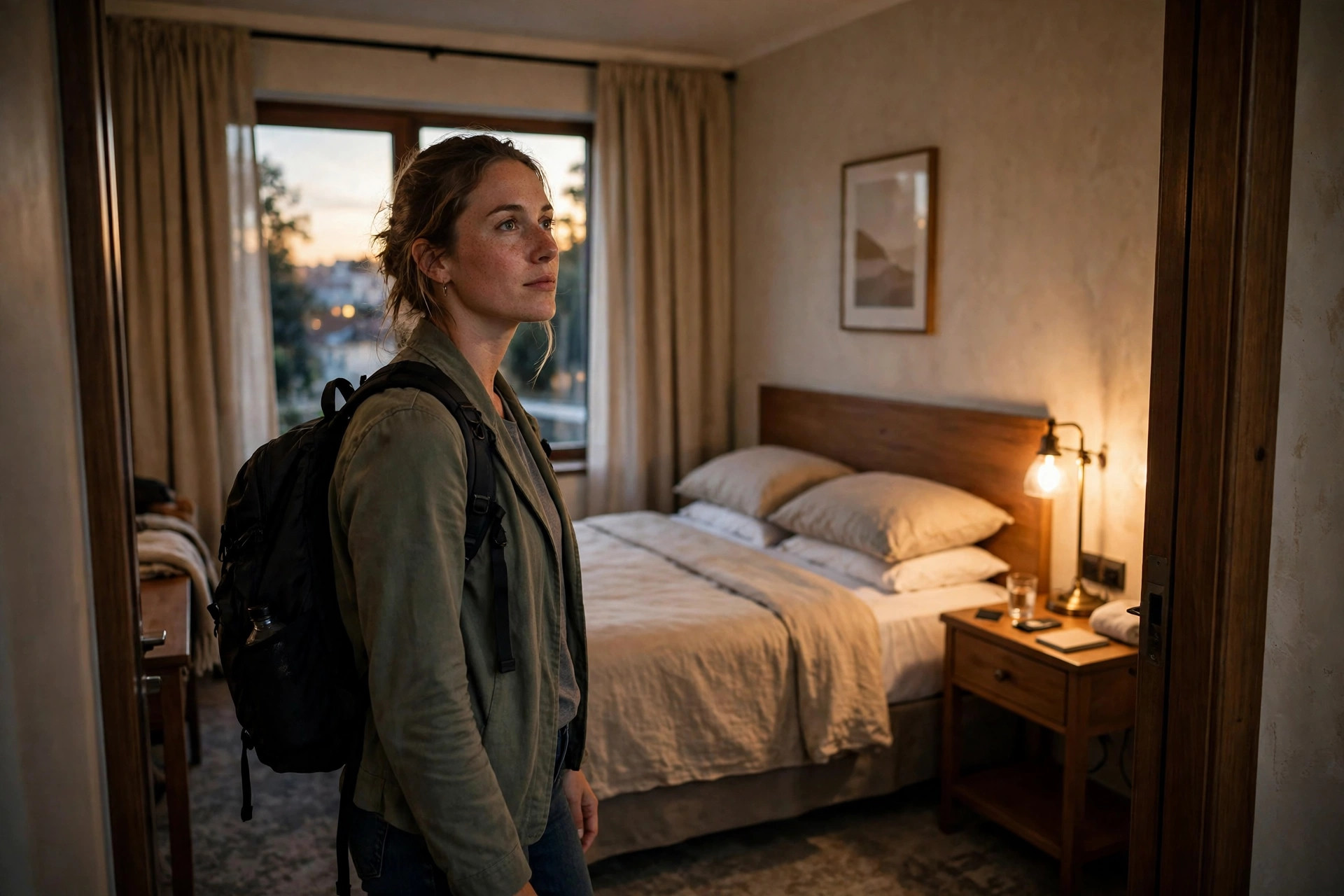
Every room, every time, before you unpack. Two minutes, in this order.
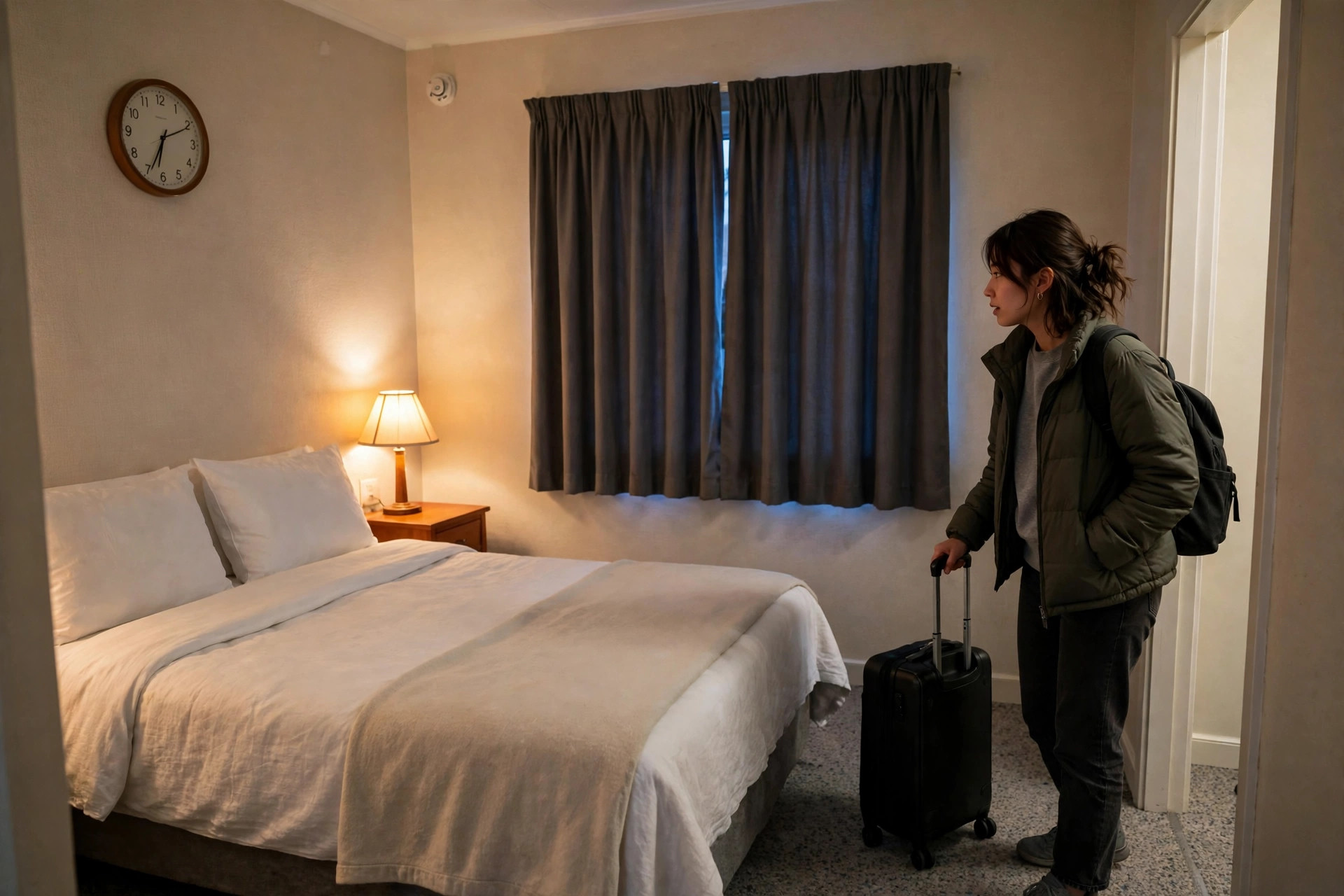
First minute: stand in the doorway and look. Anything facing the bed or the bathroom gets a second look — the smoke detector, the alarm clock, the charger, the wall socket, the picture frames, the vent. Look for a tiny hole, a dark circle that looks like a lens, a small light blinking where nothing should blink, or an object that does not belong: a second smoke detector, a charger you did not bring, a clock in the bathroom. The Indian cases that made the news are a good map of where to look — cameras fitted into light bulb holders in a Gwalior hotel, one inside a wall socket in a Mumbai hotel, one behind a bathroom light fitting in a Hyderabad flat. The hiding places repeat because a camera needs a lens pointed at a bed or a shower, and power or a battery.
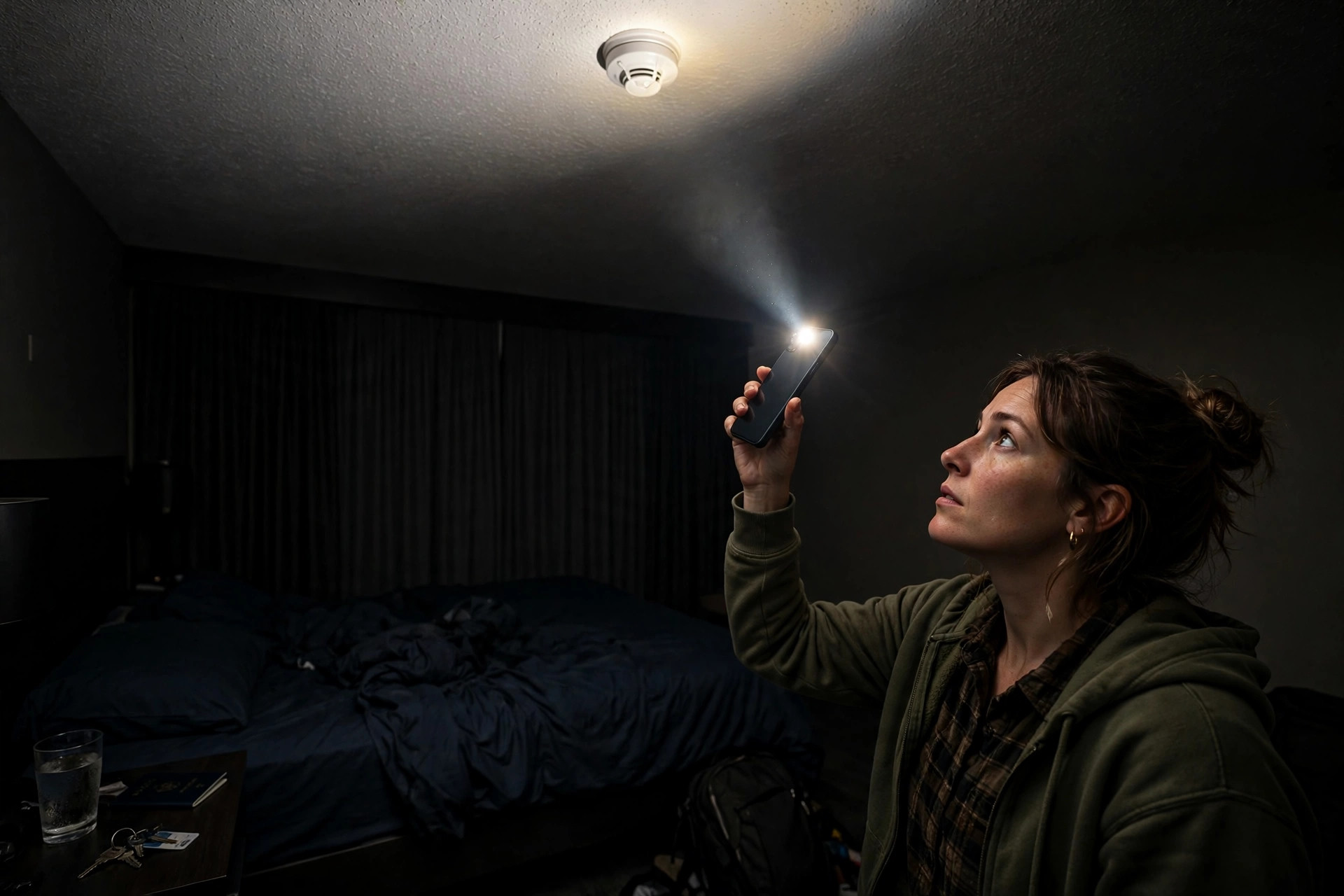
Second minute: lights off, flashlight on. Close the curtains, turn the lights off, and sweep your phone flashlight slowly across the room at eye level, watching for a small, sharp glint that flashes back. A camera lens reflects light straight back in a way that paint and plastic do not. Sweep the smoke detector, the clock, the frames, the vents, the TV and the bathroom fittings. Do the mirror test while you are there: fingertip against the bathroom mirror — a small gap between your finger and its reflection means a normal mirror; no gap at all can mean a two-way mirror, and that is a reason to check what is behind the wall.
If you use a detector app, this is the moment for it. NoPeek, a hidden camera detector app, bundles the whole arrival check into a guided Full Room Check — Wi-Fi scan, lens sweep, infrared check, tracker scan, mirror test — and ends with a coverage score and a report you can save. It runs in 12 languages, including Spanish, Portuguese and French, and you can find it on Google Play as NoPeek — Hidden Camera Detector. It is a paid app, a one-time Lifetime payment or a 7-day Trip Pass, with no ads, no account and no data collected. Use it if it fits how you travel; the two minutes above work without it. And keep the honest limit in mind, because the app states it itself: no phone app can find every hidden camera. A camera that is switched off or recording only to a memory card sends no signal at all, and no scan will see it. The physical sweep is the part that catches those.
The changing-room check: 30 seconds, in silence
Changing rooms are the one place on a trip where you are undressed in a room you did not choose, and the check there has to be fast and quiet — you cannot stand in a cubicle for ten minutes with the lights off.
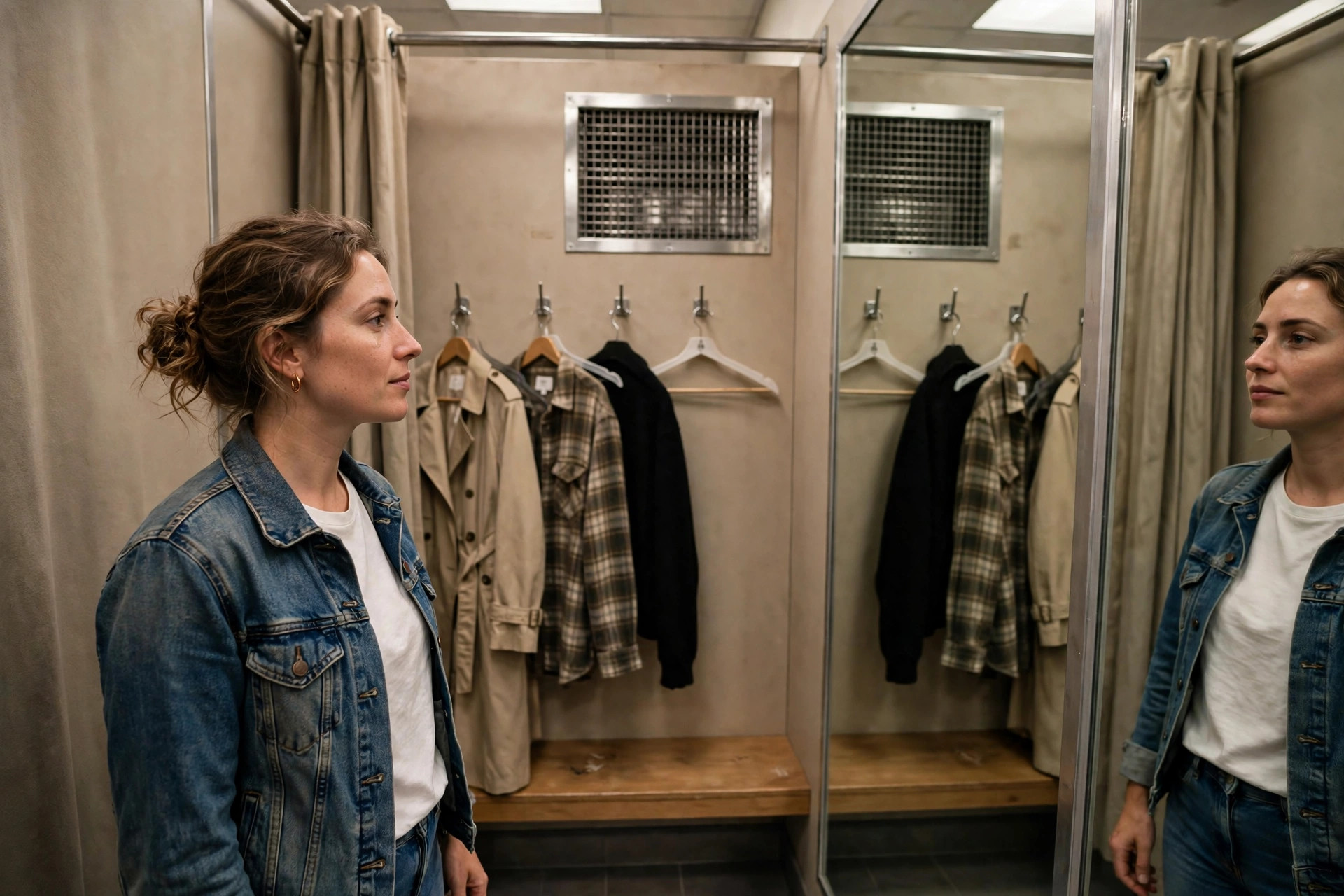
Thirty seconds. Stand still and look first: the mirror, the hooks, the vents, the top of the cubicle walls, and anything plugged in or stuck to the wall at chest height. Then, with the cubicle light off, run your phone flashlight across the mirror and the fittings. A lens flashes back; a hook does not. That is the whole check.
A detector app has a version of this built for the purpose: NoPeek's quick check is a silent 30-second sweep for fitting rooms and changing rooms — no sound, just a gentle buzz — which is the right design for a place where you do not want to draw attention to yourself. Use it in malls, in swimwear shops, in any fitting room where the mirror looks too new or the walls have gaps at the top.
If anything looks wrong, get dressed and leave. Do not argue with the shop assistant about it; tell the shop staff or the mall security on your way out, and if you found a device, call the police on 112. The same rule as a hotel room applies: photograph it in place, do not touch it.
Cabs and cars: the check nobody does
A car is a private space you did not choose either, and it deserves thirty seconds of the same attention.
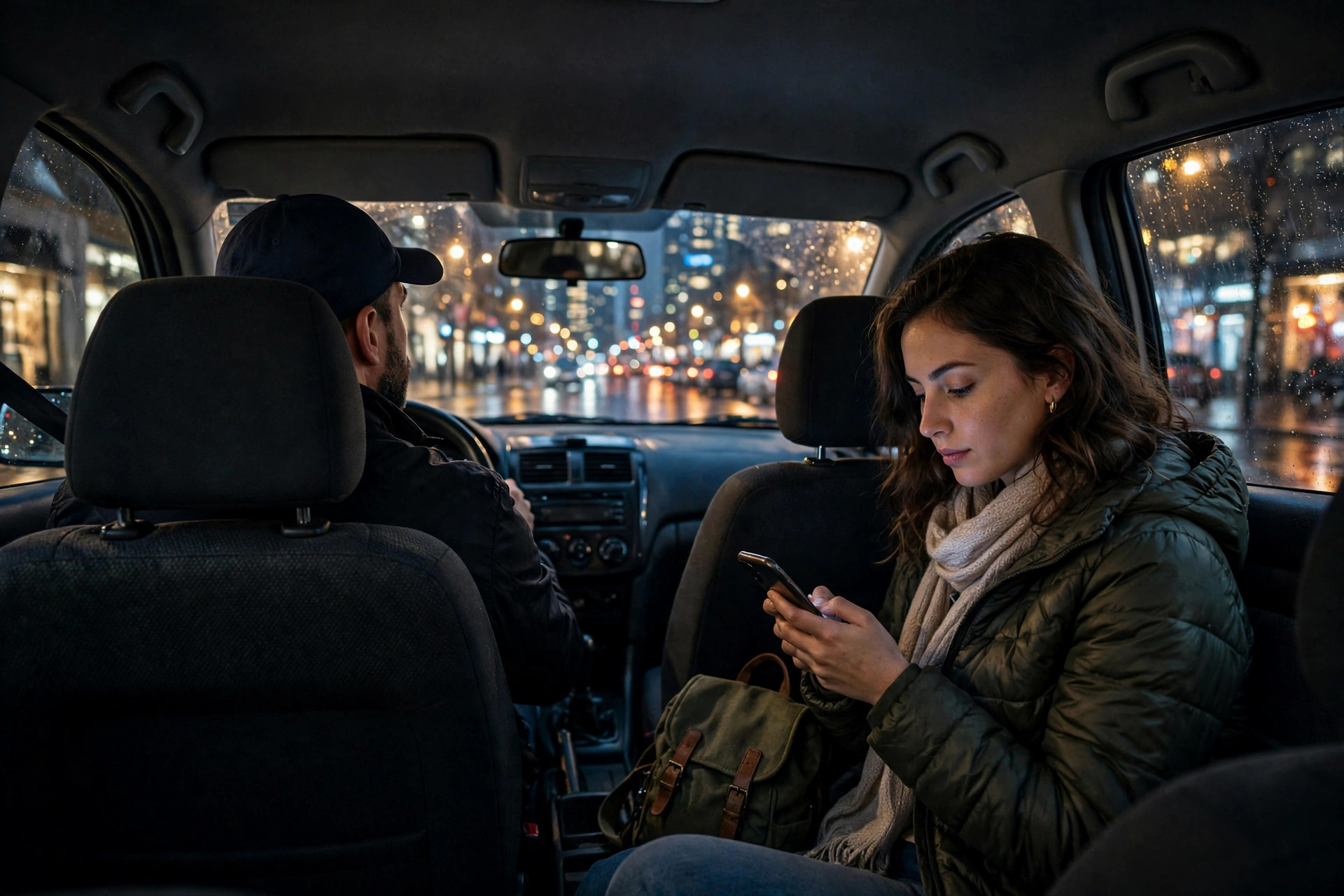
Before you settle in, glance at the dashboard, the rear-view mirror, the seat-back pockets and the roof lining — anything small and dark with a lens, anything plugged into the USB port that is not a charger you recognise. If the car has a dashcam, that is normal; a dashcam points at the road, not at the back seat. A second small camera pointed at the passenger seat is not.
Check for trackers too, because a tag in a bag is the same kind of problem as a camera in a room, and it is easier to do than most people realise. An iPhone will usually warn you with an "AirTag Found Moving With You" alert, and Android phones have a similar unknown-tracker alert. A detector app can run the same check on demand — NoPeek's tracker detector covers AirTags, Tile, Samsung SmartTag and Google Find My Device tags, and walks you toward the signal with a warmer-colder guide. Do the check when you change cabs on a long day, and whenever you pick up your bag after leaving it somewhere.
One more thing that belongs in the car and not in the guidebooks: if you are staying overnight, NoPeek has a Night Watch mode that runs while you sleep, even with the screen off, and alerts you if a new device joins the Wi-Fi or a tracker stays with you. It is the kind of feature you set once and forget about, and it is worth knowing about if you sleep in places where the Wi-Fi is shared with strangers.
What to do if something feels wrong
Trust the feeling. You do not need to prove it first.
Get out of the room. Go to the front desk, or call the host, and ask to change rooms or leave — now, not tomorrow. If you found a device, photograph it exactly where it is, from two or three angles, including one wide shot that shows the room. Do not touch it and do not unplug it; the position it was in is evidence.
Then report it, in writing, the same day. To the hotel management, by email or a message in the booking app. To the platform — on Airbnb you have 72 hours from discovery to open a claim under its Rebooking and Refund Policy. And to the police. In India, the number to save before you travel is 112: the single emergency number for police, fire and ambulance, working in every state and union territory, day and night, and the 112 India app can share your location with the responders. For a women's helpline, 1091 is listed by Delhi Police and several other forces for women in distress, and 181 is the national women helpline — if 1091 does not connect where you are, use 112 or 181.
Tell someone at home what happened the same day, even if it feels small. A message with the hotel name, the room number and the photographs is enough. If you were recorded, say so plainly in the complaint: secretly filming someone in a private place is voyeurism, a criminal offence under the Bharatiya Nyaya Sanhita and the IT Act, and the police, not the hotel, decide what happens next. You do not need to argue the point with a manager. State what you found, show the photographs, and call 112.
The routine, on one page
Save this on your phone. It is the whole guide in six lines.
- [ ] Before booking: recent reviews searched for "safe", "alone", "privacy"; staffed front desk; door with a bolt; no indoor cameras (Airbnb rule since 30 April 2024).
- [ ] On arrival, 2 minutes: look at everything facing the bed and bathroom; lights off, flashlight sweep for a glint; fingertip mirror test; Wi-Fi list for unknown devices.
- [ ] Changing room, 30 seconds: mirror, hooks, vents, top of the walls; flashlight sweep with the light off; leave and report if anything looks wrong.
- [ ] Cabs, 30 seconds: dashboard, mirror, seat pockets, roof lining; tracker check when you change cars or pick up your bag.
- [ ] If something is wrong: photograph it in place, do not touch it, change rooms or leave, report in writing, call 112 (or 1091 / 181).
- [ ] Share your live location with someone at home on arrival, every stay, every time.
Travelling alone is not about being fearless. It is about having a routine that does the worrying for you, so you can spend the trip on the trip.
Frequently asked questions
Is India safe for a woman travelling alone?
Millions of women travel alone in India every year, including on yatra routes, and most trips pass without incident. The honest version is that India is safe with habits, not safe by default: pick stays carefully, keep your arrival routine, share your live location with someone at home, and avoid unlit lanes late at night. The privacy checks in this guide are one part of that — a small, repeatable routine, not a reason to stay home.
What should I check in a hotel listing before booking?
Read the recent reviews, not the overall rating — search them for the words 'safe', 'staff', 'alone' and 'privacy'. Prefer a stay with a staffed front desk, a lockable door with a bolt or chain, and a location on a lit, busy street. On Airbnb, remember the rule since 30 April 2024: no indoor cameras in any listing, even switched off, and outdoor cameras must be disclosed with their location. If a listing hides its exact location until after booking, or the host is slow to answer a direct question about cameras or locks, book somewhere else.
How do I check a changing room for a hidden camera in 30 seconds?
Stand still and look first: mirrors, hooks, vents, the top of the cubicle walls, and anything plugged in or stuck to the wall at chest height. Then run your phone flashlight across the mirror and the fittings with the cubicle light off — a camera lens flashes back. Do it in silence; a detector app like NoPeek has a silent 30-second check for exactly this, no sound, just a gentle buzz. If anything looks wrong, get dressed and leave, and tell the shop staff or the mall security.
Can someone track me with an AirTag or a similar tag?
Yes, and it is easier to do than most people realise — a tag slipped into a bag, a jacket pocket or a car. An iPhone will usually warn you with an 'AirTag Found Moving With You' alert, and Android phones have a similar unknown-tracker alert. A detector app can run the same check on demand; NoPeek's tracker detector covers AirTags, Tile, Samsung SmartTag and Google Find My Device tags, and walks you toward the signal with a warmer-colder guide. If you get an alert, find the tag, do not take it home with you, and tell the police if you think it was placed deliberately.
What do I do if something feels wrong in a stay?
Trust the feeling and act on it the same way every time: get out of the room, go to the front desk or call the host, and ask to change rooms or leave. If you found a device, photograph it in place and do not touch it. In India, call 112 for any emergency — it works in every state — and 1091 or 181 for a women's helpline. Tell someone at home what happened the same day, and put the complaint to the hotel and the booking platform in writing.
Do detector apps actually work, or are they a gimmick?
They do part of the job well and the rest not at all, and the honest ones say so. An app can scan the room's Wi-Fi for camera-like devices, help with the flashlight lens-glare test, check for infrared night-vision cameras, and scan for Bluetooth trackers. It cannot find a camera that is switched off or recording only to a memory card. NoPeek, the app mentioned in this guide, states that plainly on its own page: no phone app can find every hidden camera, and a flag is a reason to look closer, not proof. Use the app as a shortcut for the checks, and keep doing the physical sweep yourself.
Keep exploring
 Yatra Guides
Camino de Santiago 2027 Holy Year: The Honest First-Timer's Guide — the Record Year, the Holy Door, and Which Route to Actually Walk
Camino de Santiago Holy Year 2027 for first-timers: the record year, the Holy Door opening 31 Dec 2026, real 2026 costs, routes and a 7-day Sarria plan — checked 17 Nov 2026.
 Yatra Guides
How to Check a Hotel Room for Hidden Cameras in 10 Minutes
A practical 10-minute hotel room check for hidden cameras: where they actually hide, the flashlight sweep, Wi-Fi scan and mirror test — and what to do if you find one.
 Yatra Guides
Bodh Gaya for International Visitors: The Tipitaka Ceremony, the Phone Ban, and the Buddha's Town Without the Guesswork
Bodh Gaya for first-time foreign visitors: the December 2026 Tipitaka ceremony, the temple phone ban, real costs, stays and scams — checked 14 Nov 2026.