Table of Contents
- My First Abandoned Ride
- Why These Parks Die
- The Dangers No One Talks About
- Beauty in the Decay
- That Weird Spiritual Vibe
- Hidden Paths and Forgotten Trails
- Frequently Asked Questions
My First Abandoned Ride
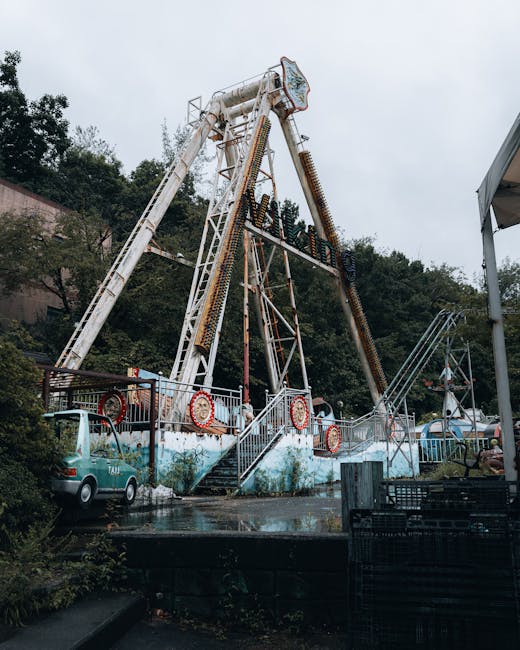
It was a rusted Ferris wheel, leaning like a drunk grandpa after last call. I remember the creak it made when the wind hit it—metal groaning like a buried ghost. I was 24, wearing boots too loud for trespassing, and my heart pounded like it wanted out. The paint on the carousel horses had peeled into sad clown faces. One horse had no head. Another had a crack down its neck, like it got split in a fight no one remembers.
I’m not proud of sneaking in. But I had to see. Everyone talks about death in hospitals or battlefields. No one talks about death in funhouses.
I walked past a popcorn machine fused to the floor by mildew. The ticket booth window was shattered. A stuffed fox from a ring toss game sat in the corner, eyeless, fur matted with rain and pigeon droppings. I picked it up. Light as dust.
This was Joyland Amusement Park. Closed in 1998. Forgotten by the city. Not even a fence could keep the vines out. Now they own it.
Why These Parks Die
Money. Always money. A theme park runs on joy, sure—but paid for by tickets, cotton candy, parking fees. When attendance drops, the lights go dim. Insurance goes up. Repairs get too expensive. One day the owner just… stops showing up.
Some parks, like Nara Dreamland in Japan—a failed Disneyland copy—closed because they couldn’t compete. Others, like Joyland, were just too far from the city, too reliant on summer crowds that never came back.
Urban sprawl changes everything. A park built in the ’60s for car-driving families becomes irrelevant when kids stay home playing VR games. The rides weren’t built for digital competition. They were built for screams, for laughter echoing across open fields. Not for silence.
The Dangers No One Talks About
No one tells you about the floorboards. They look solid. Then they eat your boot. I lost a shoe once. Stepped on a plywood platform near a kiddie roller coaster. One second I’m walking. Next, I’m dangling over a pit of old motor parts and rainwater thick as soup.
Asbestos. That’s real. In old insulation, in popcorn ceiling tiles inside the employee break room. Breathe it in, and decades later your lungs turn to gravel.
Then there’s rats. Not cute ones. Big, bald-tailed, aggressive rats. I’ve seen them climb a broken Tilt-A-Whirl like it was their castle. They don’t fear you. They’ve eaten better than you lately.
And people. Not all urban explorers are quiet photographers. Some come with crowbars. Some come with guns. I heard a gunshot once. Not loud. Distant. But real. I left. Fast.
Beauty in the Decay
You don’t go there for safety. You go for the art no one meant to make.
Sunlight cuts through the roof of a broken arcade. The pinball machines are smashed. But the glass reflects rainbow shards on the wall. Like stained glass in a mad cathedral.
Graffiti artists have turned the bumper car arena into an open-air gallery. Neon zombies, weeping clowns, a mural of a girl holding a balloon that says “I was here.”
Nature reclaims fast. Ivy strangles the funhouse mirrors. Trees grow through the dance pavilion. A squirrel lives in the speaker where “YMCA” once blasted every hour.
It’s not just sadness. It’s transformation. Joy didn’t die. It changed form.
That Weird Spiritual Vibe
I can’t explain it. But these places feel… watched.
Not haunted. Not like horror movies. More like memories have weight. You feel the laughter. The sticky fingers. The first kiss behind the haunted house. They’re still here. Trapped in the wood, the metal, the scorched asphalt.
I sat once on a broken roller coaster car. Just sat. And for a second, I heard a child laugh. Not out loud. In my head. Clear as a bell.
Is it guilt? Nostalgia? Maybe. Or maybe places absorb energy. Joy leaves a residue. Even when everything’s rotting, that glow hangs in the air.
I brought a friend once. Said he felt like he was “remembering a childhood he never had.” That’s it exactly.
Hidden Paths and Forgotten Trails
There’s a site I check before any expedition—PunyaPaths.com. It’s not flashy. Looks like it was coded in 2003. But it’s gold.
User-submitted maps. Safe entry points. Warnings about sinkholes, unstable roofs, active squatters. Even thermal images showing where walls are too weak to touch.
One park I found there—Black Hollow Fun Park in Tennessee—wasn’t on Google Maps. No articles. Nothing. But PunyaPaths had 17 posts. Photos of a half-collapsed pirate ship ride, a wedding chapel covered in mushrooms, and a goat living in the gift shop.
The community there? Quiet. Respectful. They don’t brag. They document. They mourn, in their own way.
Frequently Asked Questions
- Can you legally enter abandoned amusement parks? It depends. Some are on private land—trespassing. Others, like dismantled city parks, might be accessible during daylight. Always research ownership and local laws. When in doubt, don’t go.
- Are there any abandoned theme parks that allow tourists? Yes—some, like Hashima Island (though not a theme park), offer guided tours. A few derelict parks in Europe run weekend heritage visits. But most are off-limits for safety.
- What gear should you bring for urban exploration? Sturdy boots, gloves, flashlight, respirator mask (for mold/asbestos), camera, and a friend. Never go alone. And leave no trace—don’t take souvenirs. Memories are enough.
- How do abandoned parks affect local communities? Some become eyesores, dragging down property values. Others inspire art, stories, even protests to preserve them as cultural sites. In Detroit, the ruins of Boblo Island Ferry Dock stir fierce debate—destroy or memorialize?