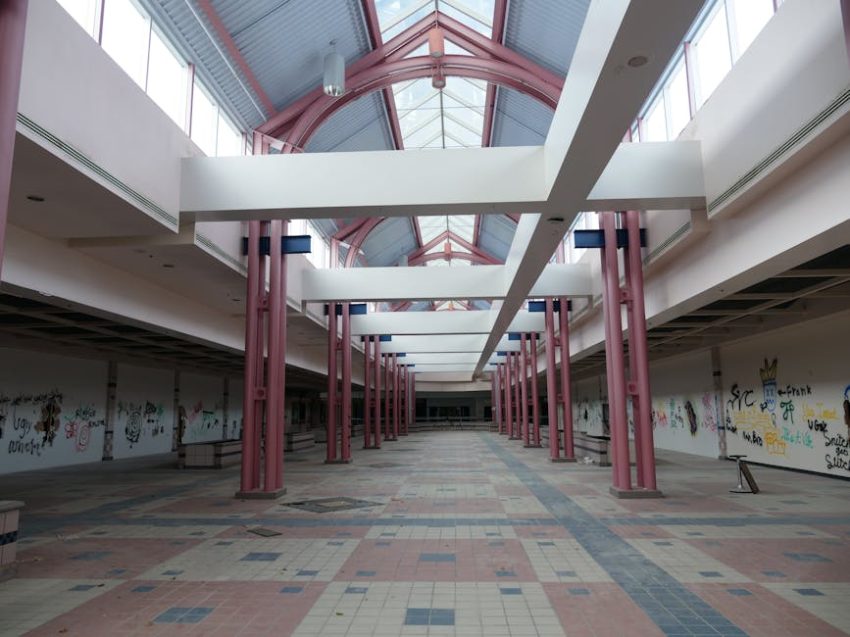
I walked into the old Riverbend Mall on a Tuesday morning—the kind of morning where the air feels heavy, like you could chew it. Fog had been sitting in the parking lot since before sunrise, and the glass doors, still somehow standing, were smeared with dirt and old rain. The neon sign above? Dead. Just blank sockets where the letters used to buzz and glow. No automatic chime. No pop songs looping through the halls. Nothing. Just silence. And that smell—wet concrete, stale butter from popcorn machines that haven’t worked in years, and something else… mildew, sure, but also like old arguments, forgotten birthdays, the ghost of a thousand bad decisions.
Ten years ago, this place was packed in the best way. Kids ditching school between JCPenney and Claire’s. Families dragging strollers and each other through the maze. Muzak humming under the noise, perfume samples slapped on wrists like free samples were the start of something. Now? Graffiti climbs the columns like it belongs there. There’s a mural—some woman with moth wings, eyes shut, face half in shadow—right where the Gap used to be. And near what’s left of the food court, someone drew a piano in chalk on the floor. Keys smudged from rain sneaking through a cracked skylight. Looked like someone had played it. Maybe still does, when no one’s watching.
This wasn’t decay. Felt more like the building finally let go.
The Ghosts That Shop No More
Dead malls are everywhere now. Not just this one. The Urban Land Institute calls them ‘grayfield’—not dead, not alive, just… stuck. Built to be temples of convenience, of ‘meet me at the Orange Julius,’ and now they’re sagging under Amazon deliveries, bad leases, and the slow drain of people moving out. But in places like Detroit, St. Louis, Homestead—real towns, not just headlines—stuff’s crawling back in. Not chains. Not developers with slick presentations. Just folks. With spray cans. With instruments. With recipes written on napkins.
Riverbend didn’t come back as a mall. It came back as something messier—”The Atrium Collective.” Thirty-seven artist studios. A gallery that swaps out every month, no fancy committee, just whoever’s ready to show. Open mic nights happen now in what used to be Foot Locker—someone reading poems to a crowd sitting on old bench displays. The food court? That’s where immigrant chefs try out dishes before they roll out in food trucks. I met Maria there, a muralist who grew up two blocks away. She used to come with her mom for school shoes. Now she paints where the fountain used to gurgle. ‘It feels like healing,’ she said. I didn’t have a smart answer for that. Just nodded. Because it really did.
Concrete Jungles, Reclaimed
Upstairs, I passed a yoga class in the old Sears. Instructor barefoot on a mat, leading sun salutations under a ceiling with tiles hanging by a thread. Sunlight cut through broken windows, hitting the wall behind her—”Tools” still faintly visible, like a scar. Down the hall, a jazz trio was playing in what used to be the Regal Cinemas lobby. Trumpet echoing down halls where people once waited for tickets and overpriced soda.
Nobody’s pretending the past didn’t happen. They just moved in with it. Like moving into your grandparents’ house—dings in the walls, pencil marks on the doorframe, all still there. You don’t sand it down. You live with it.
Jaylen, one of the people running the place, told me they never wanted the kind of ‘revival’ where outsiders roll in, slap up a mural, call it ‘edgy,’ then jack the rent so nobody from the neighborhood can afford to stick around. So they did it slow. Nonprofit. Scraps of city grants. Teamed up with schools. High schoolers made banners that now hang from the second floor—some with names, some with anger, some with hope. Middle schoolers built clay tiles for a mosaic by the east entrance. Nothing’s perfect. Pipes hang low. Ductwork sags. They ripped out the escalators, and now they’re holding up huge woven fabric pieces—like sails in a dried-up sea. But it’s not trying to impress. It’s saying: We broke. We’re still breaking sometimes. But we’re here.
Not All Malls Get a Second Life
Wish I could say this was happening everywhere. It’s not. Five miles down the road, Oakridge Plaza’s fenced off, tagged with ‘Condemned’ signs. Roof’s caving in. Floors give way when you step on certain spots. No money. No crew stubborn enough to care. It’s a reminder: this don’t happen just because it should. Takes effort. Takes cash. Takes people who show up when it’s freezing and the lights don’t work.
But Riverbend? It gives me hope. And it’s not alone. Out in California, some old mall turned into a maker space—3D printers, pottery wheels, teens building robots in the old Sears Auto Center. In Ohio, a JCPenney became a charter school with a garden on the roof—kids growing tomatoes where people once tried on blouses. Buffalo’s got an indoor farm in a dead mall now—kale, collards, spinach—feeding neighborhoods that haven’t had a grocery store in ten years.
These places aren’t about buying anymore. They’re about doing. Making. Being.
I sat for a while on a bench near the atrium—the kind people used to crash on after dragging through the jeans store. Now it’s painted up with wildflowers and bits of poetry from locals. A teen walked by, headphones on, spray can in hand, adding a red line to the wall. Didn’t feel like vandalism. Felt like adding a sentence to a story already going. Made me think of Punyapaths, something I read about—mapping old trails through sacred spots, where memory sinks into the dirt. These malls, weirdly, are becoming that. Not through forests or ruins, but through the bones of dead shopping dreams, turned into paths for art, grief, repair.
The Sound of Renewal
By late afternoon, people started showing up. Not shoppers. People. Folding chairs formed a circle near the dry fountain. Spoken word night. A woman in an orange sari stepped up, voice shaky at first, then solid. She read about her dad’s corner store, how it closed when the big chain moved in. Around me, folks nodded. Some wiped their eyes. No one clapped right away—just silence, then low murmurs of ‘yeah.’
This wasn’t just missing the past. Was heavier. Felt like we were all admitting, out loud, that things broke—and maybe, just maybe, we could fix some of it.
Later, as the sun dipped and the skylights glowed, I stood in the middle and just listened. No beeping registers. No escalators groaning. Just laughter, a guitar tuning, chalk scraping as kids drew hopscotch over old store logos. The place was alive. Just… different. Didn’t serve money anymore. Served people.
I left with chalk dust on my shoes and something quiet inside. These malls were never supposed to last. But maybe, in falling apart, they became useful in a way no one saw coming—holding space for what actually matters.
Is this happening elsewhere? Yeah. In places. Are all of ’em working? Hell no. But can you turn a failed shopping dream into something real for your community? Hell yes.
Seen an old mall come back to life? What’d it become? I’d love to hear about it.