Table of Contents
- The First Step Into the Hidden Mycelial World
- Beneath the Forest Floor: A Mycologist’s Playground
- Chasing the Season: When the Fungi Speak
- Meet the Keeper of the Spores: A Local Mycologist’s Wisdom
- Networks Unseen: The Web That Binds the Woods
- The Delicate Dance of Decay and Life
- Ethical Harvesting and the Mycophile’s Code
- The Deeper Path: Why We Keep Returning Below
- Frequently Asked Questions
The First Step Into the Hidden Mycelial World
I didn’t expect to fall in love with dirt. Or with something I couldn’t even see. But here I am, kneeling in the damp moss of an old-growth forest in western Oregon, brushing aside fern fronds with hands already stained brown, chasing whispers of mushrooms that only a handful of people know how to find.
It started innocently enough. A friend mentioned a walking tour led by a local mycologist—someone who studies fungi the way poets study silence. I signed up not knowing what to expect. I pictured a few fancy mushrooms on sticks, maybe a lecture. Instead, I got pulled into a subterranean universe so vast, so quietly intelligent, that it changed how I see forests forever.
Beneath the Forest Floor: A Mycologist’s Playground
We met at dawn. Mist clung to the trunks like wet cobwebs. Our guide, Lila, wore mud-caked boots and a backpack full of vials, notebooks, and a surprisingly delicate brass magnifying glass. She knelt, pressed a hand to the earth, and said, “Listen. They’re talking today.”
I laughed. Then I stopped. She wasn’t joking.
Lila spends thirty weeks a year underground—figuratively, mostly. She maps fungal networks, tracks fruiting cycles, and talks to trees like they’re old friends. Fungi, she explained, aren’t just mushrooms popping up after rain. They’re the nervous system of the forest.
Underfoot, threads of mycelium stretch for miles—tiny, root-like filaments that connect trees, trade nutrients, even send warnings. A Douglas fir under insect attack might signal its neighbor through the fungal web. The neighbor, in turn, starts producing defensive chemicals. All of it mediated by fungi. Underground. Silent. Constant.
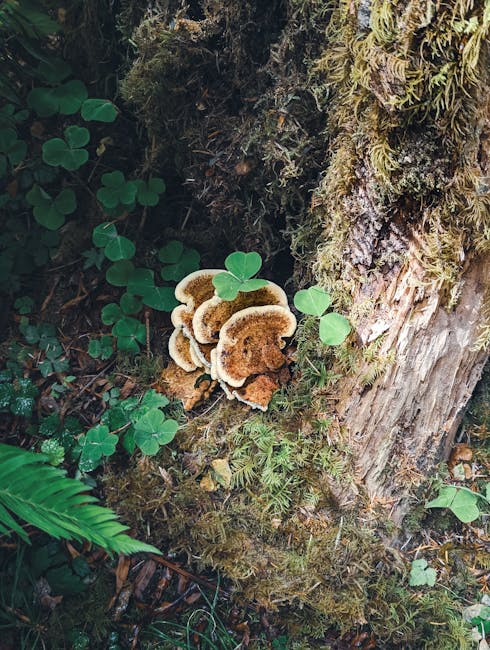
We followed one such trail along a ridge where nurse logs cradled young saplings. On the rotting wood, clusters of Hydnellum peckii—commonly known as “bleeding tooth fungus”—oozed ruby-red droplets. They looked like wounds. Lila called them “the forest’s pulse points.”
Mycelium is the real story. The mushroom itself? Just the fruit. The fleeting billboard. The underground network is the body. And it’s ancient.
Chasing the Season: When the Fungi Speak
You can’t just show up and expect to find magic. Fungi have rhythms. Temperaments. Moods.
Late September through early November is prime time in the Pacific Northwest. Rain softens the soil. Temperatures dip. That’s when the mycelium decides to fruit.
I’ve returned three times since that first walk. Each season reveals something different. One morning, we found Tricholoma magnivelare, the pine mushroom, rising like pale towers from the duff beneath ponderosa pines. Rare. Delicate. Scented like warm butter and earth. Local Indigenous tribes have harvested them for generations. We took only two. Left the rest.
Another day, after days of steady drizzle, we discovered a grove of Gymnopilus luteofolius erupting between maple roots. Bright orange. Slightly hallucinogenic. We didn’t touch them. Just admired. Watched the spores drift like cinnamon dust in a sunbeam.
Fungi aren’t just biological—they’re cultural. Spiritual, even. And walking these trails with someone who understands that depth? It’s like being shown the backstage of life.
Meet the Keeper of the Spores: A Local Mycologist’s Wisdom
Lila didn’t start in mycology. She was a botanist. Burned out. “Too many labels,” she told me. “Too much boxing of things that refuse to be boxed.”
Fungi broke her open. “They’re neither plant nor animal. They defy category. And they’ve been here longer than trees. Longer than us.”
She now mentors young foragers, leads citizen science projects, and writes field notes that read like love letters. I asked her why she keeps coming back.
“Because they remember,” she said. “Not like we do. But the network holds patterns. Responses. Trauma. Healing. Burn a patch of forest, and in five years, you’ll see fire-adapted fungi appear—species that lay dormant for decades, just waiting. That’s memory. Just not in a brain.”
I sat with that. A forest that remembers through fungus. That heals through decay. That communicates without sound.
Networks Unseen: The Web That Binds the Woods
The mycorrhizal network—often called the “Wood Wide Web”—is real. Not a metaphor. Not poetic license. It’s documented. Trees feed carbon to fungi. Fungi deliver water and minerals. It’s a mutual economy.
But it’s also political. Dominant trees might hoard resources. Seedlings get support through fungal godparents. Some fungi even parasitize others. It’s messy. Alive. Human, almost.
I once saw a dying cedar surrounded by Armillaria solidipes—honey fungus. Lila called it “the forest’s undertaker.” It moves through roots, slowly consuming. But it also clears space for new growth. Death, not as an end—but as a transfer.
There’s a trail near Mount Hood where scientists have mapped a single fungal organism spanning over 2,000 acres. Estimated age? Over 2,500 years. Older than the Roman Empire. It’s one of the largest living organisms on Earth. And nobody sees it.
The Delicate Dance of Decay and Life
We have it all backwards. We fear rot. We sanitize. We pave.
But without decay, there is no life.
Fungi are the first responders. When a tree falls, within hours, mycelium arrives. They dismantle lignin. Recycle nitrogen. Make soil. They’re not destroyers. They’re librarians—preserving and redistributing knowledge stored in wood.
I brought a piece of fruiting reishi home once. Placed it on my windowsill. Over weeks, it dried, cracked, then released a fine brown cloud one morning. Spores. Billions of them. It felt sacred.
Check out Punya Paths for deeper journeys into overlooked natural wisdom.
Ethical Harvesting and the Mycophile’s Code
Not everything is for taking.
Lila taught us a simple code: Take only what you’ll use. Never uproot. Leave the young. Photograph the rare. Honor the network.
Some mushrooms take years to fruit. Some grow only in specific symbioses. Disturb one, and you might break a connection decades in the making.
And never, ever reveal exact locations. Not online. Not to curious hikers. These trails are fragile. Sacred, in their way.
The Deeper Path: Why We Keep Returning Below
I keep going back. Not just for the mushrooms. But for the silence. The slowness. The sense that something ancient is whispering beneath my feet.
We walk above the real world most of the time. We don’t notice the threads that tie it all together. Fungi don’t care about our rush. They operate on forest time. On spore time. On deep, fungal patience.
There’s a humility in that. A reminder: we’re not the pinnacle. We’re latecomers in a story written in hyphae and decay.
And sometimes, when the light hits just right and the air smells of wet moss and something indescribably old, I swear I hear it—the quiet hum of the network, breathing beneath the soil.
Frequently Asked Questions
- How do I find a responsible mycology walking tour in the Pacific Northwest?
- Are there any endangered fungal species hikers should avoid disturbing in old-growth forests?
- What tools do amateur mycologists need to ethically observe fungi without damaging the mycelial network?
- Can you visit the 2,500-year-old Armillaria network near Mount Hood, and is it protected by conservation law?