
Photo: Wikimedia Commons
Yatra Guides
Karwa Chauth 2026 — 28 or 29 October? Date, Puja Muhurat, City-Wise Moonrise Time & the Full Vrat Guide
Karwa Chauth 2026 is on Thursday, 29 October in India (28 October is the USA date). Exact tithi, puja muhurat, sargi timing, moonrise times for 18 cities, the vrat vidhi step by step, and a Jaipur moonrise blueprint.
Quick answer: Karwa Chauth 2026 falls on Thursday, 29 October 2026 in India. The Chaturthi tithi runs from 1:06 AM to 10:09 PM on 29 October IST. In Delhi the puja muhurat is 5:38–6:56 PM and the moon rises at 8:17 PM — the fast (from sunrise, 6:31 AM) breaks after moonrise, about 13 hours 46 minutes later. If you have seen 28 October written somewhere, that is the date for the USA, not India.
Complete yatra blueprint
Karwa Chauth in Jaipur — a 3-Day Moonrise Getaway Blueprint (28–30 Oct)
Jaipur is the one city where Karwa Chauth turns into a small holiday without breaking a single rule of the vrat: bazaars built for mehndi and bangles, a fort above the city for the moonrise, and a moon that rises at 8:28 PM — late enough to do everything properly, early enough to enjoy dinner after. Arrive Wednesday 28 Oct, keep the fast in Jaipur on Thursday 29 Oct, and do Amber Fort on Friday 30 Oct before heading home.
Arrive Jaipur (Wed 28 Oct) — mehndi, Johari Bazaar & an early night
🛕 Temples & darshan
Johari Bazaar & Bapu Bazaar — the Karwa Chauth shopping run · Old City, around Hawa Mahal and Badi Chaupar
This is what the day before Karwa Chauth is for: lac bangles, mehndi cones and artists on the pavement, puja thalis, karwa pots, sieves, and leheriya dupattas in every shade of red and pink. The bazaars run late the night before the festival and the mehndi artists sit in rows — pick yours by the queue of local women, not by who calls out first.
Govind Dev Ji Temple — evening aarti (optional, keep it short) · City Palace complex, Old City
Jaipur's beloved Krishna temple, where the evening jhanki draws the whole old city. A calm, beautiful way to close the day before the fast — and the temple sits inside your bazaar round, so it costs you no extra travel.
🏨 Where to stay
Pearl Palace Heritage
₹2,500–4,500 / night
A much-loved boutique hotel with individually themed rooms and a rooftop restaurant — that rooftop matters on the 29th (see Day 2). Book the Karwa Chauth weekend early; Jaipur fills up.
Samode Haveli
₹8,000–14,000 / night
A 175-year-old haveli with a courtyard pool, five minutes from the old city gates. Heritage calm, proper service, and terraces that work beautifully for a private puja and moonrise.
Rambagh Palace (Taj)
₹25,000+ / night
The former palace of the Maharaja of Jaipur, now one of India's most famous hotels. If this Karwa Chauth is an anniversary-grade one, this is the address — lawns, peacocks, and a moonrise over the gardens.
🍽 Where to eat
Laxmi Mishthan Bhandar (LMB)
₹800–1,200 for two
Must try: Pyaaz kachori and ghewar from the sweet counter
Johari Bazaar, open 7 AM–11:30 PM. An honest word: LMB is iconic but reviews are mixed and prices are tourist-grade — go for the kachori and ghewar takeaway, not a long sit-down dinner. This is also your sargi shopping stop: sweets and dry fruits for the pre-dawn plate.
Your sargi plate — buy it today, eat it tomorrow
₹500–1,000
Must try: Fenia, fresh fruit, coconut, dry fruits, mathri
Assemble the sargi on the 28th itself — fruit, sweets, fenia, dry fruits — and tell your hotel at check-in that you need it served (or a wake-up call) around 4:30 AM. Heritage hotels in Jaipur do this every year; ask, don't assume.
- Carry the puja basics from home — your own karwa, sieve and thali. Bazaars sell everything, but the thali you have used for years is not a thing to replace on a festival-eve shopping run.
- Sleep early and set two alarms. Oversleeping past sunrise does not break anything spiritually, but it does mean fasting the whole day without sargi — a much harder day.
Karwa Chauth day (Thu 29 Oct) — sargi before sunrise, puja at muhurat, moonrise 8:28 PM
🛕 Temples & darshan
The fast day itself — rest is the programme · Your stay, and one short morning outing at most
Sargi before sunrise (Jaipur sunrise is around 6:35 AM — finish eating by then). After that, the correct Karwa Chauth itinerary is: nothing. Thirteen-plus hours without water in late-October sun is not the day for Amber Fort. Read, rest, let the mehndi darken. If you must step out, make it one short, shaded, morning visit — and be back before the heat.
Evening puja & katha — Jaipur muhurat 5:46–7:03 PM · Your stay's terrace or courtyard (heritage hotels will set this up), or with a local family/group puja
The puja and the Karwa Chauth katha are done in the evening muhurat window — in Jaipur, 5:46 to 7:03 PM on 29 October. Women gather in a circle with their thalis, the katha of Veeravati is read, thalis are exchanged in the phera, and baya is prepared for the mothers-in-law. If you are travelling as a couple, hotels and local groups welcome guests into the circle — ask at reception in the morning, not at 5:40 PM.
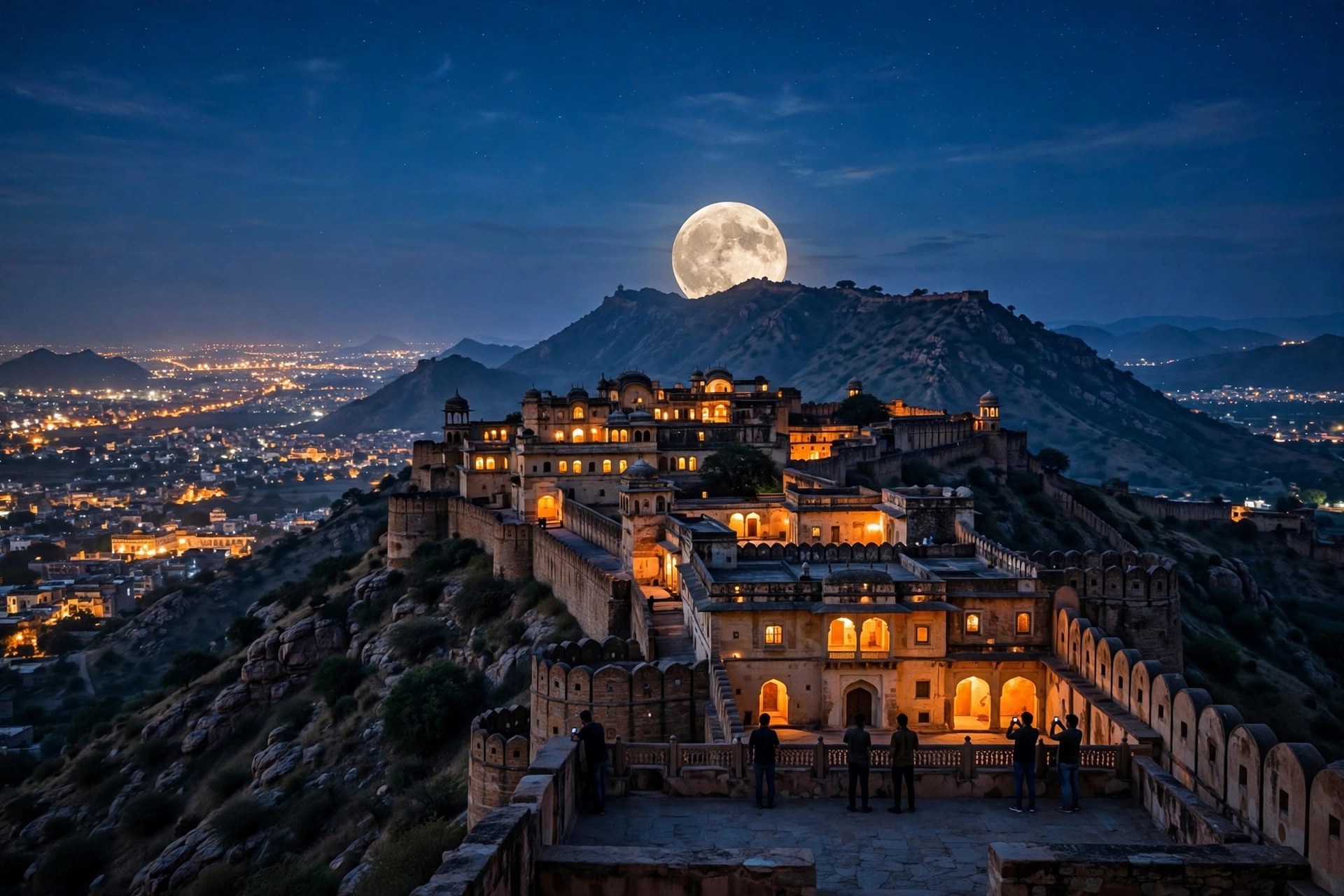
Moonrise at Nahargarh — 8:28 PM · Nahargarh Fort, Aravalli hill above the old city (Padao rooftop area)
Jaipur's best public moonrise seat: the whole lit city below, open sky above. The fort's standard closing is 5:30 PM, but in the peak season (October–March) it is reported to stay open until about 9 PM for the night view, and the rooftop cafe keeps later hours — on Karwa Chauth night, confirm this at the gate in the morning before you build your evening on it. If the fort plan fails, your hotel rooftop is the backup, and in Jaipur it is a genuinely good one.
🏨 Where to stay
Same Jaipur stay — do not shift hotels on fast day
Everything about Day 2 — sargi at 4:30 AM, the puja circle, the rooftop — works because the staff already know your plan. This is not the day to change rooms.
🍽 Where to eat
The fast-breaking dinner — after 8:28 PM
₹1,000–1,800 for two
Must try: A full Rajasthani thali, eaten slowly
Break the fast gently: water first, then a piece of fruit or something sweet, then dinner. After 14 hours, a heavy thali eaten fast will punish you. Rooftop restaurants at hotels like Pearl Palace serve late; old-city kitchens wind down by 10 PM.
- Cloud cover is the one real risk to a moonrise plan. If the sky is covered at 8:28 PM, families traditionally wait, check a moonrise app for direction, and complete the ritual when the moon shows — do not break the fast on a rumour of the moon.
- Photograph the mehndi and the thali in the afternoon light, not at the moonrise. At 8:28 PM you have a ritual to do and a queue of people waiting to do it.
The morning after (Fri 30 Oct) — Amber Fort, then home
🛕 Temples & darshan
Amber Fort — go at opening, you have earned a slow morning first · Amer, ~11 km from the old city
Do Amber the day AFTER the fast, on a full stomach and fresh legs — the fort is a climb, the palace is vast, and it deserves you at full strength. Sheesh Mahal, the Ganesh Pol gate, and the ramparts over Maota Lake in morning light.
Hawa Mahal & a last bazaar round · Badi Chaupar, Old City
Five minutes of looking up at the facade everyone photographs, then the real Jaipur: one last round of the bazaars for the things you spotted on Day 1 — leheriya dupattas, juttis, and a box of LMB ghewar for the people back home.
🏨 Where to stay
Check out after breakfast (or keep one more night)
If your train is in the afternoon, a late checkout or a baggage hold is enough. Only extend if you want a genuinely lazy second evening — Jaipur rewards it, but the blueprint does not need it.
🍽 Where to eat
Rawat Mishtan Bhandar
₹300–500 for two
Must try: Pyaaz kachori, the original famous one
Near the railway station side of town — the natural last stop before an afternoon train. Kachori for the platform, mawa kachori for home.
- Friday 30 October is a working day — afternoon trains to Delhi are busy with weekend traffic in reverse. Book the return when you book the outbound.
Karwa Chauth 2026 kab hai? Thursday, 29 October — and here is why some sites say 28
Short answer first, because that is the whole search: Karwa Chauth 2026 is on Thursday, 29 October 2026 in India.
If you have seen 28 October written anywhere, you have not found a mistake — you have found America. In the USA, the Chaturthi tithi begins a day earlier in local time, so the fast there is kept on Wednesday, 28 October. Some websites copy the US date into Indian pages, and every year lakhs of families end up asking the one question this festival should never leave open.
The Indian rule is simple and worth knowing: the fast is kept on the day on which Chaturthi is still running at moonrise. In India, the Kartik Krishna Chaturthi tithi runs from 1:06 AM on 29 October to 10:09 PM that night (IST) — and the moon rises at 8:17 PM in Delhi, squarely inside the tithi. Thursday, 29 October. Settled.
What are the exact timings for Karwa Chauth 2026?
Delhi timings first (Drik Panchang convention), then every major city below:
| Event | Timing, 29 October 2026 (Delhi) |
|---|---|
| Chaturthi tithi begins | 1:06 AM |
| Sargi | Before sunrise — roughly 4:00–6:00 AM |
| Sunrise / fast begins (Upavasa) | 6:31 AM |
| Puja muhurat | 5:38 PM – 6:56 PM (1 hr 17 min) |
| Moonrise (Chandrodaya) | 8:17 PM |
| Fast duration | 13 hours 46 minutes |
| Chaturthi tithi ends | 10:09 PM |
Three things people get wrong every year. First, the puja and the fast-breaking are two different events — puja and katha happen in the evening muhurat (5:38–6:56 PM in Delhi); the fast breaks over an hour later, at moonrise. Second, sargi ends at sunrise, not at a fixed clock time — the meal must be finished before the sun is up. Third, the tithi ending at 10:09 PM does not end your fast. The moon ends your fast.
What time does the moon rise in my city? City-wise moonrise, 29 October 2026
The moonrise moves west across India — Kolkata sees the moon nearly an hour and a quarter before Mumbai. Find your city, and then add the honest 10–20 minutes the moon takes to clear the buildings around your terrace:
| City | Puja Muhurat (PM) | Moonrise (PM) |
|---|---|---|
| Kolkata | 5:01 – 6:17 | 7:47 |
| Patna | 5:10 – 6:27 | 7:52 |
| Varanasi | 5:19 – 6:36 | 8:02 |
| Lucknow | 5:26 – 6:43 | 8:06 |
| Prayagraj | 5:24 – 6:40 | 8:06 |
| Dehradun | 5:33 – 6:51 | 8:08 |
| Kanpur | 5:29 – 6:45 | 8:10 |
| Chandigarh | 5:38 – 6:55 | 8:12 |
| Delhi | 5:38 – 6:56 | 8:17 |
| Noida / Ghaziabad | 5:38 – 6:55 | 8:16 |
| Gurugram | 5:39 – 6:57 | 8:18 |
| Agra | 5:37 – 6:54 | 8:18 |
| Amritsar | 5:44 – 7:02 | 8:18 |
| Jaipur | 5:46 – 7:03 | 8:28 |
| Bhopal | 5:44 – 7:00 | 8:31 |
| Indore | 5:51 – 7:07 | 8:39 |
| Ahmedabad | 6:04 – 7:20 | 8:52 |
| Bengaluru | — | 8:55 |
| Mumbai | 6:07 – 7:22 | 9:00 |
Timings per Drik Panchang for 29 October 2026; another panchang may differ by a minute or two — that difference does not change your evening. If your city is not listed, your moonrise sits between your nearest listed neighbours, east to west.
How does the day actually run? Sargi to moonrise, hour by hour
Before sunrise — Sargi. The day begins in the dark, with a plate sent (or given) by the mother-in-law: fresh fruit, sweets, dry fruits, coconut, mathri — and in Punjab, fenia, the fine vermicelli eaten with milk. Eat properly; this plate is your fuel for nearly fourteen hours. Finish before sunrise (6:31 AM in Delhi). Many women also take their bath and dress simply at this hour; the full shringar is saved for the evening.
Sunrise to afternoon — the fast. Nirjala means without water, and this is the hard, plain fact of the day. The traditional way to survive it is also the sensible one: rest. Afternoons are for the mehndi to darken, a nap, and staying out of the late-October sun. Save your energy — the evening has a puja, a full shringar, and a moonrise standing-up on a terrace.
Late afternoon — Solah Shringar. The sixteen adornments: the red (or bridal) outfit, sindoor, bindi, mehndi, bangles, kajal, jewellery, alta, and the rest of the list your family keeps. Begin by about 4:30 PM if your muhurat is near 5:40 — dressing up on an empty stomach is slower work than anyone admits.
Evening muhurat — Puja and Katha. In the muhurat window, women sit in a circle with decorated thalis — karwa (the earthen, spouted pot filled with water), diya, sweets, the baya plate. The Karwa Chauth katha is read aloud — the story of Veeravati, the queen whose fast was broken early by her brothers' deception and who won her husband back through devotion; and in many homes, the older tale of Karwa the potter's wife, whose devotion moved Yama himself. Thalis are rotated in the circle (the phera), blessings taken, baya given to the mother-in-law.
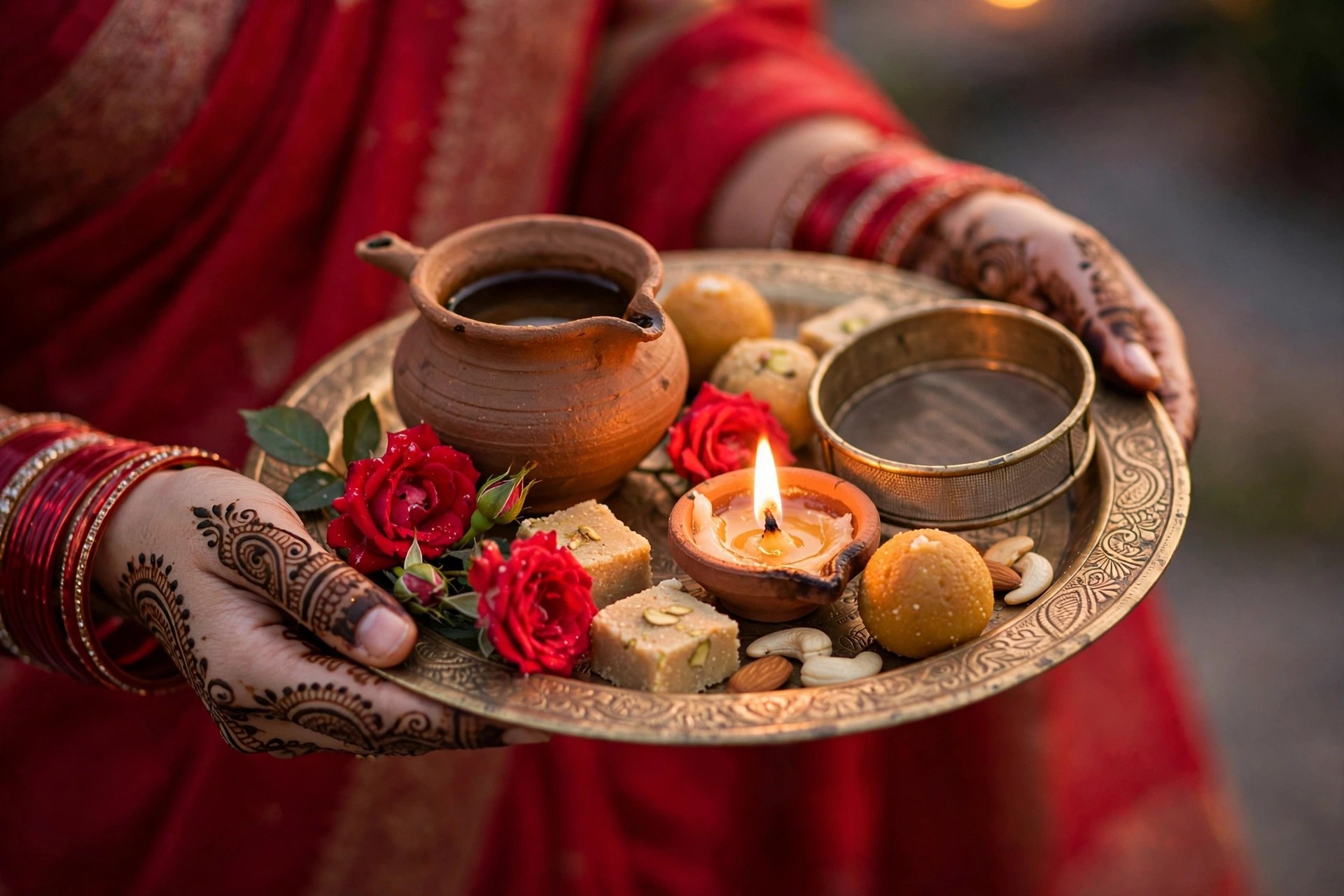
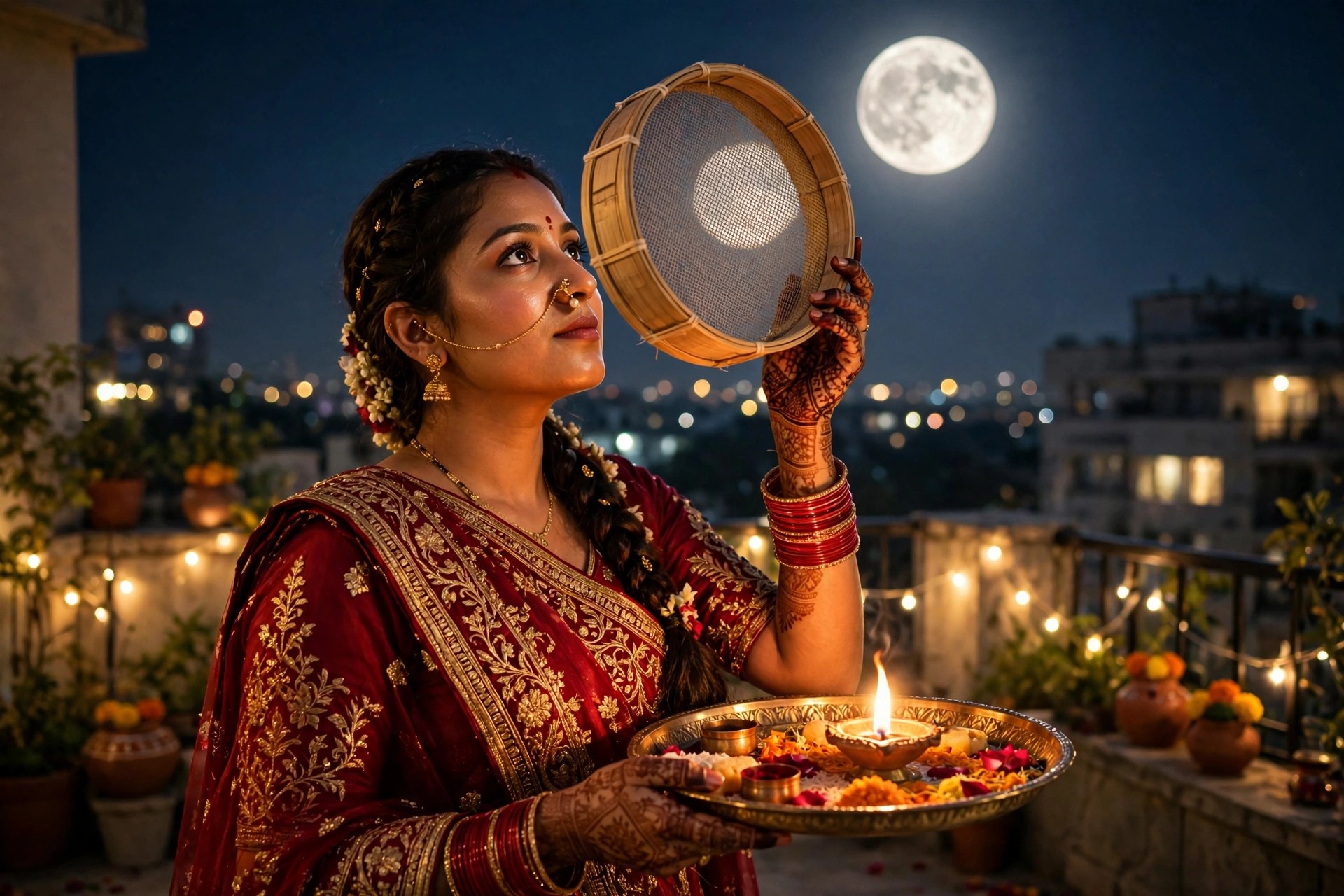
Moonrise — the moment the day was for. When the moon is sighted, the wife looks at it through a sieve (chhanni), then looks at her husband's face through the same sieve. Arghya — water from the karwa — is offered to the moon. The husband then gives her the first sip of water and the first bite of something sweet. The fast is over. Fourteen hours, one moon, one sip: there is no more compressed piece of theatre in the Indian festival calendar.
Why a sieve and a clay pot? What Karwa Chauth actually means
Karwa is the earthen pot with a spout; Chauth is the fourth day — Kartik's Krishna Paksha Chaturthi, four days after Sharad Purnima's full moon (which is why the Karwa Chauth moon is a waning, late-rising moon, and why you wait until 8 or 9 PM for it).
The sieve is the part everyone photographs and few explain. One reading is practical-poetic: you look at the moon filtered, the way you look at a whole marriage — the bright and the shadowed together, nothing hidden, nothing stared at raw. The clay karwa carries the water of the arghya, an offering made with the humblest vessel in the house, not the richest. And the fast itself, kept by wives for their husbands' long lives, has quietly become something wider in modern homes: husbands who fast alongside, unmarried women who keep it for their own reasons, couples who treat it as one deliberate day of devotion in a distracted year. The tradition is older than all of us; it is also still being written.
Who should NOT keep the full nirjala fast?
This section exists because most Karwa Chauth articles are too sentimental to write it.
- If you are pregnant, nursing, diabetic, on regular medication, or have any condition that fasting affects — do not keep a waterless fast on the strength of a festival article. Keep the phalahari version: water, fruit, milk, at intervals. This is not a modern loophole; families have always made this room, and your elders know it.
- If you feel dizzy, faint, or unwell during the day, eat and drink. A vrat broken for health carries no fault in any honest reading of the tradition.
- First-time fasters: the mistake is the afternoon. Eat a real sargi, rest through the middle of the day, and the evening takes care of itself.
Devotion that hospitalises you has served nobody — least of all the person you are fasting for.
Where can you actually see this moonrise properly?
Karwa Chauth is a home festival, and a family terrace remains its true venue. But if you are travelling, or the two of you simply want this year's moonrise to be an occasion, three honest options:
Jaipur — the fullest version. Bazaars made for the festival eve, heritage rooftops for the puja, and Nahargarh Fort above the city for an 8:28 PM moonrise over a lit pink city. The 3-day blueprint at the top of this page is built exactly for this — arrive 28th, fast on the 29th, Amber on the 30th. Jaipur is five hours from Delhi and the train options are many; it is the easiest 'occasion' version of Karwa Chauth in North India.
Your own city's highest honest rooftop. Not a mall food court — a real terrace, a fort wall, a riverbank. In Varanasi the ghats give you an 8:02 PM moonrise over the Ganga; in Lucknow, the Gomti banks at 8:06 PM. The test is simple: can you see the eastern sky unobstructed? The Karwa Chauth moon rises in the east, later and redder than you expect.
And the option nobody sells you: home, done properly. A thali prepared without hurry, the katha read aloud and not skimmed, the sieve lifted at the right minute, dinner together after. Travel adds the backdrop. It does not add the vrat.
What will the Jaipur Karwa Chauth trip cost? (October 2026)
Per couple, 3 days ex-Delhi, festival-week rates assumed:
| Item | Budget | Comfort |
|---|---|---|
| Delhi–Jaipur return (train / cab share) | ₹1,600–2,400 | ₹9,000–13,000 (cab both ways) |
| Stay, 2 nights (Pearl Palace class / Samode Haveli class) | ₹5,000–9,000 | ₹16,000–28,000 |
| Food, 3 days (incl. fast-breaking dinner; fast day costs nothing) | ₹2,500–4,000 | ₹4,000–6,500 |
| Mehndi, bangles, thali & bazaar shopping | ₹1,500–3,000 | ₹3,000–8,000 |
| Local cabs incl. Nahargarh evening | ₹1,500–2,500 | ₹2,500–4,000 |
| Total per couple | ₹12,100–20,900 | ₹34,500–59,500 |
The honest footnote: the most expensive line in most couples' Karwa Chauth is not on this table — it is the gift. That one is between you and your conscience.
Sargi — what exactly goes on the plate?
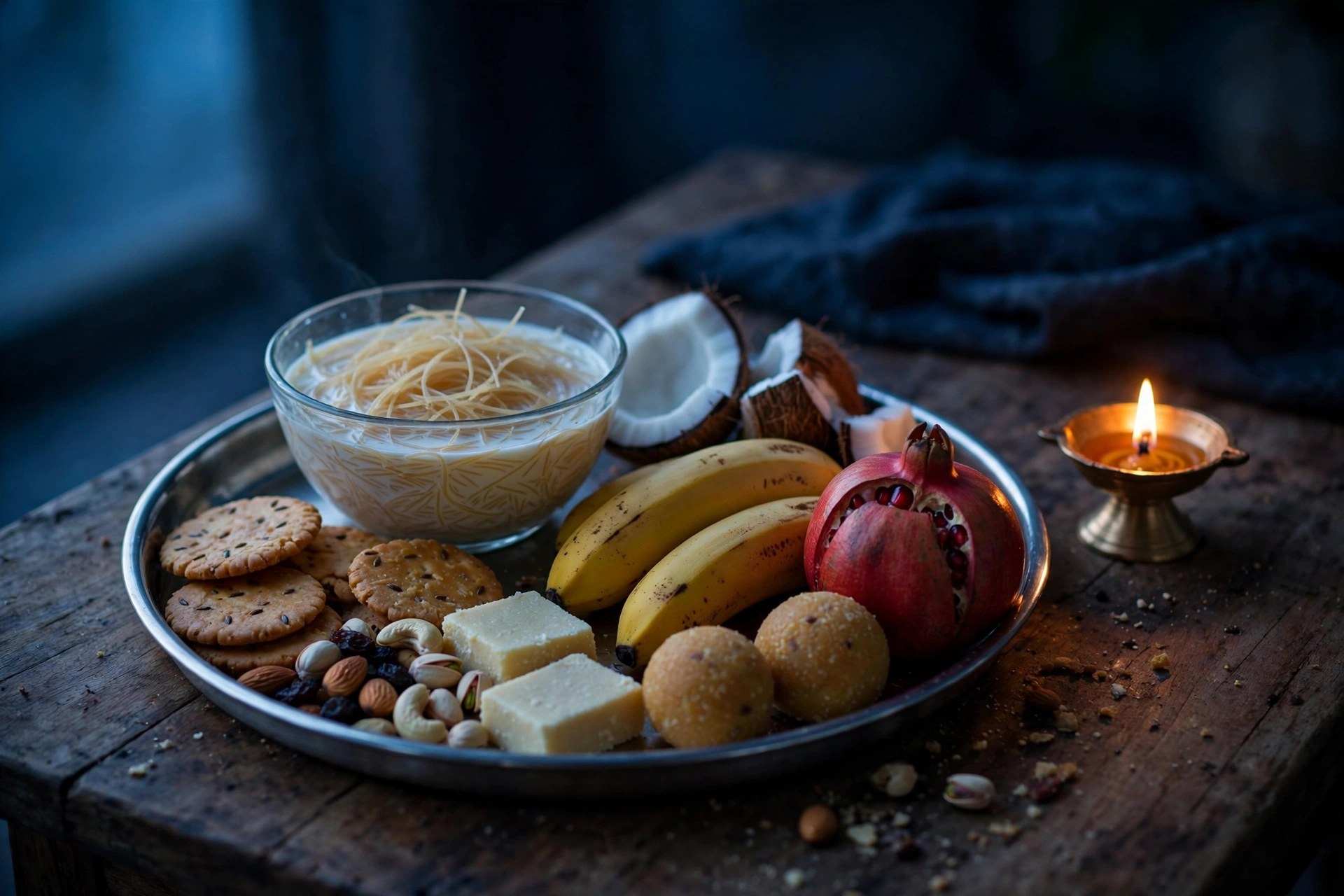
The sargi is traditionally given by the mother-in-law, and it is both a meal and a blessing, which is why its contents are half nutrition, half symbolism:
- Fenia — fine roasted vermicelli, eaten with sweetened milk (the Punjabi essential)
- Fresh fruit — pomegranate and banana above all; slow energy, real hydration
- Dry fruits and nuts — the calorie base of the plate
- Coconut — fresh or dry, an auspicious constant
- Sweets and mathri — mithaas for the day, and something savoury to balance it
- A full glass of water or milk, last — because after sunrise, there is no more
Eat the sargi like you mean it. A symbolic nibble makes for a miserable 2 PM.
Facts verified October 2026. Karwa Chauth date, tithi, puja muhurat and city-wise moonrise timings: Drik Panchang for 29 October 2026, cross-checked against Economic Times, Vedantu and The Daily Jagran reports of October 2026 (the 28 October date circulating in some reports is the USA observance). Nahargarh Fort: standard hours 10 AM–5:30 PM, entry about ₹100 for Indian visitors (2026 revised monument fees; some listings still show ₹50 — confirm at the gate), with reported peak-season extension for night viewing October–March. Laxmi Mishthan Bhandar rating and review count: Google reviews as aggregated October 2026. Hotel and travel prices are typical late-October 2026 rates; festival-week Jaipur sells out early. Health guidance is general information, not medical advice.
Frequently asked questions
Karwa Chauth 2026 kab hai — 28 ya 29 October?
India me Karwa Chauth Thursday, 29 October 2026 ko hai. 28 October wali date USA ke liye hai — wahan Chaturthi tithi local time me ek din pehle shuru ho jati hai. Drik Panchang ke hisaab se India me Chaturthi tithi 29 October ko subah 1:06 AM se raat 10:09 PM tak hai, aur chaand bhi 29 ki raat hi Chaturthi me ugega — vrat ka din wahi hota hai jis raat chaand Chaturthi me dikhe.
What is the Karwa Chauth 2026 puja muhurat?
In New Delhi, 5:38 PM to 6:56 PM on 29 October 2026 (1 hour 17 minutes). It shifts with your city: Kolkata 5:01–6:17 PM, Lucknow 5:26–6:43 PM, Jaipur 5:46–7:03 PM, Ahmedabad 6:04–7:20 PM, Mumbai 6:07–7:22 PM. Do the katha and puja inside this window; the fast itself breaks later, at moonrise.
What time is moonrise on Karwa Chauth 2026 in my city?
Delhi 8:17 PM, Kolkata 7:47 PM, Patna 7:52 PM, Varanasi 8:02 PM, Lucknow 8:06 PM, Chandigarh 8:12 PM, Jaipur 8:28 PM, Bhopal 8:31 PM, Bengaluru 8:55 PM, Mumbai 9:00 PM — all on 29 October 2026, per Drik Panchang. Add 10–20 minutes in real life: the moon has to clear the buildings and trees around your terrace first.
What time should sargi be eaten on Karwa Chauth 2026?
Before sunrise. In Delhi, sunrise on 29 October is at 6:31 AM, so most families finish sargi between about 4:00 and 6:00 AM. Sargi is the pre-dawn meal traditionally sent by the mother-in-law — fruits, sweets, dry fruits, and in Punjab, fenia. After sunrise the nirjala fast begins: no food, no water, until moonrise.
Can pregnant women or women on medication keep the Karwa Chauth fast?
Tradition itself makes room here. Many pregnant women, new mothers, and women who are unwell or on regular medication keep a lighter phalahari fast — water, fruit, milk — instead of the full nirjala fast, and families accept it as fully sincere. If you have any health condition, ask your doctor before deciding; no vrat is worth a medical emergency, and no honest pandit will tell you otherwise.
How long is the Karwa Chauth fast in 2026?
In Delhi, from sunrise 6:31 AM to moonrise 8:17 PM — 13 hours 46 minutes. Western cities fast longer in clock terms because their moonrise is later: Mumbai's fast runs to about 9:00 PM. The fast ends only after the moon is sighted, arghya is offered, and the customary first sip of water is taken.
Keep exploring
 Yatra Guides
Ayodhya Deepotsav 2026 — Dates, Where to Watch, Pass Zones & Honest Costs
Deepotsav 2026: 33 lakh diyas light Ayodhya's Saryu ghats on 7 November. Verified schedule, free e-pass zones, best free viewing spots and honest costs.
 Yatra Guides
Sharad Purnima 2026 — Purnima Kab Hai, Moonrise Time, Kheer Ritual & Where to Celebrate
Sharad Purnima 2026 is on Sunday, 25 October. Exact tithi and moonrise timings, the kheer-under-moonlight ritual done right, Raas Purnima in Vrindavan, and a full Purnima calendar.
 Yatra Guides
Shri Mata Vaishno Devi Yatra 2026 — Registration, Helicopter Fare, Both Routes, Real Hotels & the Complete 3-Day Blueprint
Shardiya Navratras 2026 drew 4+ lakh pilgrims to Vaishno Devi. Free RFID registration, helicopter fares, old vs Tarakote route, real Katra hotels and restaurants, and a full 3-day blueprint.