
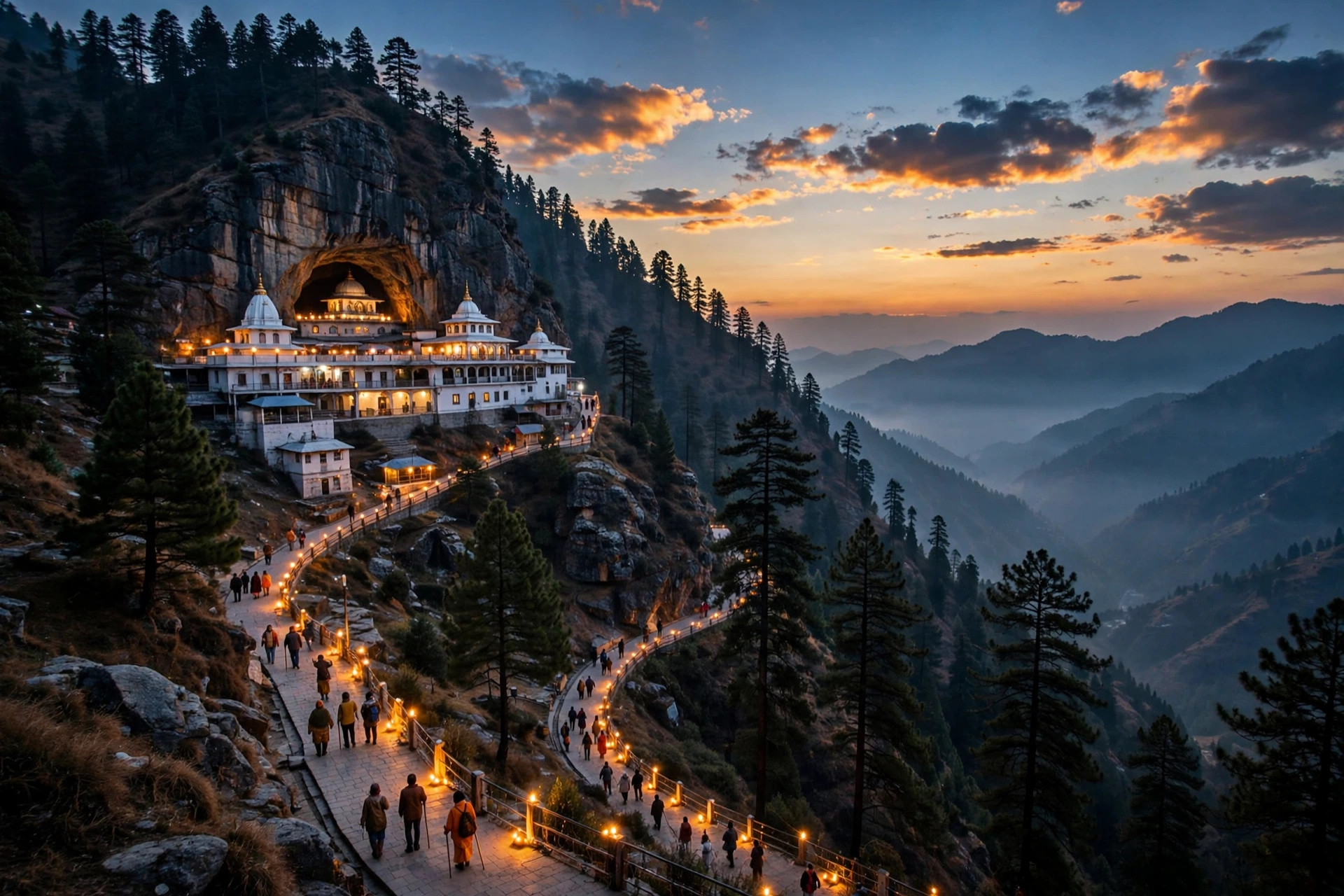
Photo: Wikimedia Commons
Yatra Guides
Shri Mata Vaishno Devi Yatra 2026 — Registration, Helicopter Fare, Both Routes, Real Hotels & the Complete 3-Day Blueprint
Shardiya Navratras 2026 drew 4+ lakh pilgrims to Vaishno Devi. Free RFID registration, helicopter fares, old vs Tarakote route, real Katra hotels and restaurants, and a full 3-day blueprint.
Quick answer: Over 4 lakh pilgrims visited the Shri Mata Vaishno Devi shrine during the nine-day Shardiya Navratras 2026 — more than double last year's 1.78 lakh — capping a record pilgrimage year across India. This guide covers everything you need for the yatra: the free RFID registration system, current helicopter fares (₹2,320 one-way), the old 13-km track vs the gentler Tarakote Marg, and a complete 3-day blueprint with verified Katra hotels and restaurants.
Complete yatra blueprint
3-Day Vaishno Devi Yatra — Complete Blueprint
Day 1: arrive in Katra, register, and settle. Day 2: the full trek — Bhawan darshan plus Bhairon Nath. Day 3: optional buffer day or the return journey. Everything below is sequenced around the Atka Aarti pauses so you never wait in a frozen queue.
Arrive in Katra — register, collect RFID, Banganga dip, market evening
🛕 Temples & darshan
Yatra Registration Counter (YRC), Katra Bus Stand · Near Katra Bus Stand (also counters at SVDK station, Niharika Complex, Tarakote — 24/7)
Collect your physical RFID Yatra Access Card with on-the-spot photo verification. Free. Carry the online slip and your photo ID.
Banganga — holy dip at the track's start · ~1.5 km from Katra YRC, at the base of the old track
The holy stream where Mata Vaishno Devi is believed to have struck the earth with her arrow to quench Hanuman's thirst. Pilgrims take the ritual dip before the climb begins.
🏨 Where to stay
Hotel Shree Palace
₹1,500–2,500 / night
Inexpensive, walkable to station and helipad. The honest budget pick for yatra families.
Hotel Madhuban Katra
₹2,500–4,500 / night
Walking distance from the yatra parchi counter; modern amenities, 24-hour service. The best-rated mid-range stay in Katra.
Hotel Kanta International
₹2,500–4,500 / night
42 rooms with clear views of the hills and the holy track to Bhawan; walkable to the bus stand and yatra counter.
🍽 Where to eat
Prem Vaishno Dhaba
₹300–500 for two
Must try: Rajma chawal thali (100% vegetarian, no onion/garlic)
Main Bazar. The satvik staple — eat here on arrival night, light enough for an early morning start.
Madhuban Sattvic Restaurant
₹400 for two
Must try: Sattvic thali
Jammu–Katra Road. The crowd-verified option — thousands of diners can't all be wrong.
- Register for yatra BEFORE you book train tickets if possible — online registration opens ~60 days ahead and peak dates fill first.
- Only postpaid SIMs work in J&K (Airtel/BSNL strongest up the track). Tell family you'll be offline on the climb.
- Buy a walking stick in Katra market (₹50–100) — your knees will thank you on the descent.
The full yatra — Katra → Bhawan → Bhairon Nath → Katra
🛕 Temples & darshan
Ardhkuwari (Adhkuwari) — the midpoint cave · ~6 km from Katra on the old track (reached via Tarakote Marg too)
The cave where Mata Vaishno Devi stayed in deep meditation for nine months, guarded by Hanuman. The Garbh Joon cave darshan needs a separate token (long queues in peak season); Attka Aarti here is 6:00 AM (₹500/person).
Shri Mata Vaishno Devi Bhawan — main darshan · Trikuta Hills, 5,200 ft altitude
The holy cave shrine housing the three Pindis — Mahakali, Mahalakshmi and Mahasaraswati. Open 24 hours; the queue pauses only for Atka Aarti (~6:20–8:00 AM and ~6:20–8:00 PM in winter).
Bhairon Nath Temple — the completion · ~1.5 km above Bhawan (6,619 ft)
Tradition holds the yatra is incomplete without darshan of Bhairon Nath — the shrine where the goddess forgave Bhairav. Walk up (45–60 min, steep) or take the ropeway: ₹100 per person return, ~3 minutes, roughly 8 AM–6 PM.
🏨 Where to stay
Same Katra hotel, both nights
Descend the same day — the track is fully lit and safe at night, and your own bed beats any Bhawan dorm queue. The Shrine Board also has Bhawan-area accommodation if you must break the climb, but book ahead.
🍽 Where to eat
Shrine Board Bhojanalaya / Langar on the track
₹50–150 / meal (subsidized)
Must try: Rajma chawal at Tarakote Marg's bhojanalaya
Tarakote Marg has 2 bhojanalayas with free filtered water ATMs; the track has medical units and resting shelters throughout.
Manoranjan Vaishno Dhabha
₹200–400 for two
Must try: Rajma chawal — 'best rajma chawal in Katra' per multiple diner reviews
Kashmere Road, near Main Bazar. Your well-earned dinner after the descent.
- Start the climb at 4–5 AM: you beat the sun, the crowd, and the morning aarti pause in one move.
- Never lose your RFID card — it is scanned at multiple security points. Lose it and you go back to Katra for a fresh one.
- Ponies/palkis/pitthus: use only the Shrine Board's prepaid counters at fixed government rates — never pay a tout on the track.
Buffer day — rest, Jammu side-trip, or train home
🛕 Temples & darshan
Raghunath Temple, Jammu (optional) · Raghunath Bazaar, Jammu city
One of the largest temple complexes in North India, built in 1835–1860 — if you have a half-day in Jammu before your train, this and the Ranbireshwar Temple make it worthwhile.
Katra market — prasad and Kalakand run · Main Bazar, Katra
Dry fruits, red chunri, and the famous Kalakand of the Jammu region. Buy from the established sweet shops, not track touts.
🏨 Where to stay
Checkout / departure
🍽 Where to eat
Sagar Ratna, Katra
₹300–500 for two
Must try: Masala dosa — a change of pace after two days of rajma
South Indian comfort food in Katra, for the palate that needs variety.
Nathus Sweets, Katra
₹150–400
Must try: Kalakand — the Jammu-region signature sweet
Buy your take-home prasad here, in the Main Market.
- Do not book a same-day morning departure — night climbs end at 2–3 AM. Give your body the buffer day.
- Carry cash on the mountain; UPI connectivity drops at altitude along the track.
2026: the year the pilgrimage numbers broke records
On 20 October 2026, the day after Mahanavami, UNI India reported that more than 4 lakh pilgrims had paid obeisance at the Shri Mata Vaishno Devi cave shrine during the nine-day Shardiya Navratras. The nine-day Shat Chandi Maha Yagya, organised by the Shri Mata Vaishno Devi Shrine Board (SMVDSB) for universal peace and prosperity, concluded with Purnahuti on Mahanavami — performed by pandits led by Padma Shri Prof Vishwamurti Shastri, with Shrine Board CEO Sachin Kumar Vaishya participating in the closing rituals (uniindia.com, tribuneindia.com).
The numbers behind it are striking: an average of over 40,000 pilgrims a day through Navratri — 47,346 on Day 1 alone (news.abplive.com) — against roughly 1.78 lakh in the same nine days last year. That is more than a doubling (hindustantimes.com).
And Vaishno Devi is not alone. On 7 October 2026, the New Indian Express reported that Uttarakhand's Char Dham Yatra had crossed 56.88 lakh pilgrims for the season — beating the 2023 record of 56.31 lakh with a month of the season still to run (newindianexpress.com). 2026 is, by every measure, the year of the Indian pilgrimage.
That is exactly why this guide exists: the crowds are bigger than ever, the infrastructure has kept pace, and the honest way to do this yatra is with facts, not folklore.
Is the yatra open right now?
Yes — the Bhawan is open year-round, every single day. There is no season, no closing date. But the yatra you get in November is very different from the one you get in February, and that matters more than any calendar date.
What does registration actually involve? (It's free — always)
This is the single most misunderstood part of the yatra, so here it is straight:
- Register online first at online.maavaishnodevi.org — the ONLY official portal (max 5 pilgrims per transaction). Pick your date; registration typically opens ~60 days ahead, and Navratri dates fill the day the window opens. It costs nothing.
- Collect your RFID Yatra Access Card in Katra — the online slip alone is not permission. Show it at a YRC counter (Katra Bus Stand, SVDK railway station, Niharika Complex, or Tarakote — which runs 24/7) with your photo ID. You are photographed on the spot and issued the physical RFID lanyard card.
- Cross the first check post (Banganga or Tarakote) within 6 hours of the card's issue — the card is confiscated at the check post otherwise, and you'll need a fresh one.
The Shrine Board's own page states it plainly: no other organization, private or public, is authorized to issue yatra registration (maavaishnodevi.org). If anyone asks for money for registration, VIP access, or a guaranteed helicopter ticket through a website that isn't the official portal, walk away — SMVDSB has repeatedly warned against fake websites and unauthorized agents (discoverwithdheeraj.com).
Which route should you take to the Bhawan?
There are two ways up from the Katra side, and choosing right is the single biggest comfort decision of your yatra.
| Old (traditional) track | Tarakote Marg | |
|---|---|---|
| Distance | ~13 km Katra → Bhawan | ~14 km Katra → Bhawan (7-km pedestrian-only stretch between Banganga and Adhkuwari) |
| Gradient | Steeper, uneven in stretches | Ramp-style, gentle 1-in-12 gradient, no steps |
| Crowd | Ponies, palkis, mules share it | Pedestrians only — no animals |
| Facilities | Decades of shops and dhabas | 2 bhojanalayas, 4 viewpoints, 7 toilet blocks, medical unit, 16 water ATMs, 500 LED lights |
| Best for | The authentic yatra; anyone wanting pony/palki | Elderly, knee patients, anyone who wants a calm climb |
Tarakote Marg was inaugurated by PM Narendra Modi on 19 May 2018 (thekashmirimages.com) specifically to decongest the old 6-km Banganga–Adhkuwari track, and the National Green Tribunal had directed it be opened for pedestrians exclusively (greaterkashmir.com).
Our honest take: if this is your first yatra and you can walk, take the old track up — the Banganga dip, the Adhkuwari midway stop, the Sanjichhat sunset are the pilgrimage. If anyone in your group has bad knees, breathing trouble, or is over 60, take Tarakote Marg up and the old track down (the descent is gentler on everyone). A fit walker does either climb in 5–7 hours.
How do the helicopter, ropeway, battery car and ponies work?
The hierarchy of mountain transport, in one honest table:
| Service | Route | Price (Oct 2026) | Honest notes |
|---|---|---|---|
| Helicopter | Katra Serli Helipad ↔ Sanjichhat | ₹2,320 one-way / ₹4,640 return (GST incl.) | 8-min flight; ~8 AM–4:30 PM; weather decides everything — fog, wind and rain cancel flights and refunds take weeks. Book only on maavaishnodevi.org; non-transferable; report 1 hour early; under-2s free. Fare revised 16 Oct 2025 (devotionalpoint.com, theunstumbled.com) |
| Ropeway | Bhawan ↔ Bhairon Nath | ₹100 per person (one-way or return — per ride) | ~3 minutes; roughly 8 AM–6 PM; tickets at the counter near Bhawan, online booking opens ~2 months ahead in peak season (gokshetra.com, maavaishnodevi.live) |
| Battery car | Adhkuwari ↔ Bhawan | ~₹350–450 one-way | Priority for elderly/differently-abled; advance booking strongly advised; fills fast in peak weeks (hindutempleguide.com) |
| Pony | Banganga → Bhawan | ₹1,000–1,800 one-way | Prepaid counters only; fixed government rates — the tout on the track is not your friend (kashmirtravels.in) |
| Palki | Katra → Bhawan | ₹3,500–4,500 | For senior citizens and patients; same prepaid-counter rule |
| Pitthu (porter) | Katra → Bhawan | ₹550–750 | Up to 20 kg luggage or small children; regulated (hindutempleguide.com) |
The helicopter trap nobody warns you about: the fare is fixed and fair — but cancellations are common from November through February when Trikuta Hills sit in fog and freezing cloud. If your yatra is built around a single-day helicopter plan in December, you are gambling with the mountain's weather. Always have a walking backup plan.
When does the Bhawan actually close? (It almost doesn't)
The shrine is open 24 hours, all night, every night. The queue pauses only twice a day — for the Atka Aarti, roughly 6:20–8:00 AM and 6:20–8:00 PM in winter (summer evening aarti shifts to ~7:20 PM). Attka Aarti participation itself can be booked: ₹2,000 per person, or ₹5,100 for a group of 3–4 at Bhawan; ₹500 per person for the 6:00 AM aarti at Garbh Joon, Adhkuwari (maavaishnodevi.live).
The pilgrim's secret that no board advertises: 3:00–5:30 AM is the shortest-queue window of the day. The night darshan runs straight through; the crowds that arrived by evening have finished, and the morning rush hasn't started. Start your climb at 4 AM and you'll walk into Bhawan as the queue empties.
How to reach Katra
- Rail (best option): Shri Mata Vaishno Devi Katra station (SVDK), ~1.5 km from Katra town. Direct from New Delhi — the Vande Bharat day train (~8 hours) and the overnight Shri Shakti AC Superfast are the two trains pilgrims actually take. Book the moment IRCTC opens the window for your dates.
- Air: Jammu Airport (IXJ), ~50 km, 1.5–2 hours by taxi to Katra (₹1,500–2,000).
- Road: Jammu–Katra is ~50 km on good highway; buses and taxis run constantly.
The winter warning (November–February)
Bhawan sits at 5,200 ft and Bhairon Nath at 6,619 ft. From late November, nighttime temperatures at Bhawan drop toward freezing, and the early-morning track is genuinely bitter — heavy woolens, gloves, a cap and a windcheater are not optional. December–January brings fog that cancels helicopter flights and makes the ropeway intermittent. The flip side: this is also when the ancient Prachin Gufa (original cave) opens to a lucky few during low-crowd weeks — the authentic route, open only when daily footfall is low (hindutempleguide.com).
Costs, honestly: the full trip budget (Oct 2026)
| Item | Cost |
|---|---|
| Yatra registration + RFID card | Free (₹0) |
| Train, New Delhi → Katra (sleeper/3AC) | ₹350–1,300 / person |
| Vande Bharat, New Delhi → Katra | ~₹1,500–2,200 / person |
| Taxi, Jammu airport → Katra | ₹1,500–2,000 |
| Hotel, 2 nights (budget, e.g. Hotel Shree Palace) | ₹3,000–5,000 total |
| Hotel, 2 nights (comfort, e.g. Hotel Madhuban Katra) | ₹5,000–9,000 total |
| Trek (on foot) | Free |
| Helicopter, Katra ↔ Sanjichhat (one-way) | ₹2,320 / person |
| Helicopter return | ₹4,640 / person |
| Ropeway, Bhawan ↔ Bhairon Nath | ₹100 / person |
| Battery car, Adhkuwari ↔ Bhawan | ~₹350–450 one-way |
| Pony, Banganga → Bhawan | ₹1,000–1,800 one-way |
| Track food (2 days, bhojanalayas + dhabas) | ₹500–1,000 / person |
| Katra food (arrival + return evenings) | ₹500–1,000 / person |
| Comfortable 3-day total, ex-Delhi (train + walk + budget stay) | ₹8,000–14,000 / person |
| Same, with helicopter both ways | ₹16,000–22,000 / person |
For international visitors
Vaishno Devi is open to everyone, no pass or Indian ID needed for darshan (a passport works for registration). Fly into Jammu or take the Vande Bharat from Delhi to Katra. Notes that matter: get a postpaid Indian SIM (prepaid doesn't roam in J&K); carry cash for the mountain (UPI drops at altitude); Katra is vegetarian and alcohol-free — eat the rajma-chawal without complaint, it's genuinely good; and if you're there November–February, bring a real winter jacket, not a travel fleece. Pair it with Amritsar's Golden Temple (6 hours by road from Jammu) for a full North-India spiritual circuit.
Facts verified October 2026. Navratri footfall: uniindia.com, tribuneindia.com, hindustantimes.com, news.abplive.com (20 Oct 2026 reports); Char Dham record: newindianexpress.com (7 Oct 2026); registration rules: maavaishnodevi.org (SMVDSB official); fares and timings: devotionalpoint.com, theunstumbled.com, hindutempleguide.com, gokshetra.com, maavaishnodevi.live; hotels and restaurants: verified via places data + Justdial ratings, October 2026. Helicopter fares are Board-fixed but re-check maavaishnodevi.org before booking; helicopter and ropeway are weather-dependent.
Frequently asked questions
Is registration for the Vaishno Devi yatra really free?
Yes. The Yatra Parchi (registration slip) and the physical RFID Yatra Access Card are 100% free — registration is mandatory for every pilgrim above 5 years of age, even helicopter passengers. Register online at online.maavaishnodevi.org (up to 5 pilgrims per transaction) and collect your physical RFID card from a Shrine Board counter in Katra after photo verification. Anyone demanding money for "registration" is a scammer.
What is the helicopter fare to Vaishno Devi in 2026?
The Shrine Board fare is ₹2,320 per person one-way (Katra ↔ Sanjichhat) and ₹4,640 for a same-day or next-day return, inclusive of 5% GST — revised from 16 October 2025. The 8-minute flight operates roughly 8:00 AM–4:30 PM, weather permitting. Book only on maavaishnodevi.org; no agent is authorized, and tickets are non-transferable. The old ₹1,036 fare you may see quoted is outdated.
Which route should I take — the old track or Tarakote Marg?
For first-timers, the old 13-km Banganga–Adhkuwari–Sanjichhat track is the authentic yatra with the pony/palki option. For the elderly or anyone worried about knees, Tarakote Marg — the 7-km pedestrian-only ramp-style track between Banganga and Adhkuwari (opened 2018) — is gentler and far less crowded, though the total Katra→Bhawan walk is ~14 km. Both routes rejoin at Adhkuwari.
How long does Bhawan darshan actually take?
The shrine is open 24 hours, but the darshan queue pauses twice daily for the Atka Aarti — roughly 6:20–8:00 AM and 6:20–8:00 PM (winter). Time your Bhawan arrival to just miss the aarti window, or arrive between 3:00–5:30 AM for the shortest queues of the day. Never attempt to reach Bhawan during the aarti pause unless you want to wait in the queue hall.
Can the Vaishno Devi yatra be done in one day?
Physically yes (the trek up and down is doable in 12–14 hours by a fit walker), but honestly: no. The one-day rush means no Adhkuwari, a tired darshan, and no Bhairon Nath temple — and tradition says the yatra is incomplete without Bhairav Nath darshan (₹100 ropeway from Bhawan, ~3 minutes). Take 2–3 days.
Is Katra a vegetarian town? What should I eat?
Yes — Katra town is fully vegetarian, and most dhabas serve satvik food without onion or garlic. Eat rajma-chawal at Prem Vaishno Dhaba (Main Bazar) or Manoranjan Dhaba (Kashmere Road), a Shrine Board bhojanalaya langar on the track, and carry home Kalakand from the market sweet shops. Non-veg is essentially unavailable and inappropriate — plan accordingly.
Keep exploring
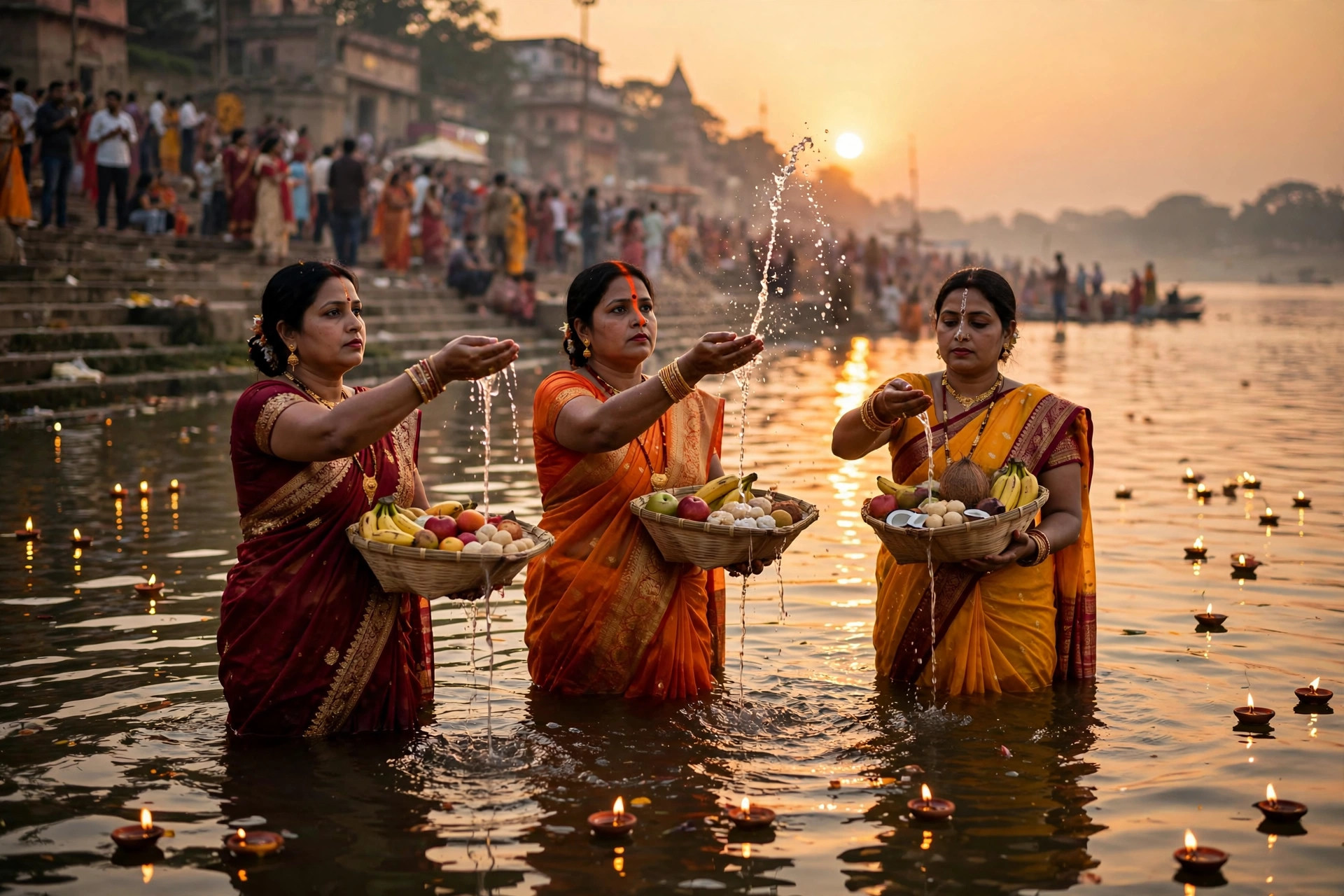 Yatra Guides
Chhath Puja 2026 in Patna — Dates, Arghya Timings, Best Ghats & the Complete Travel Blueprint
Chhath Puja 2026 runs 13–16 November. Verified dates, Patna ghat-by-ghat plan, real hotels and restaurants, festival train schedules, and a complete 4-day blueprint — the honest Chhath travel guide.
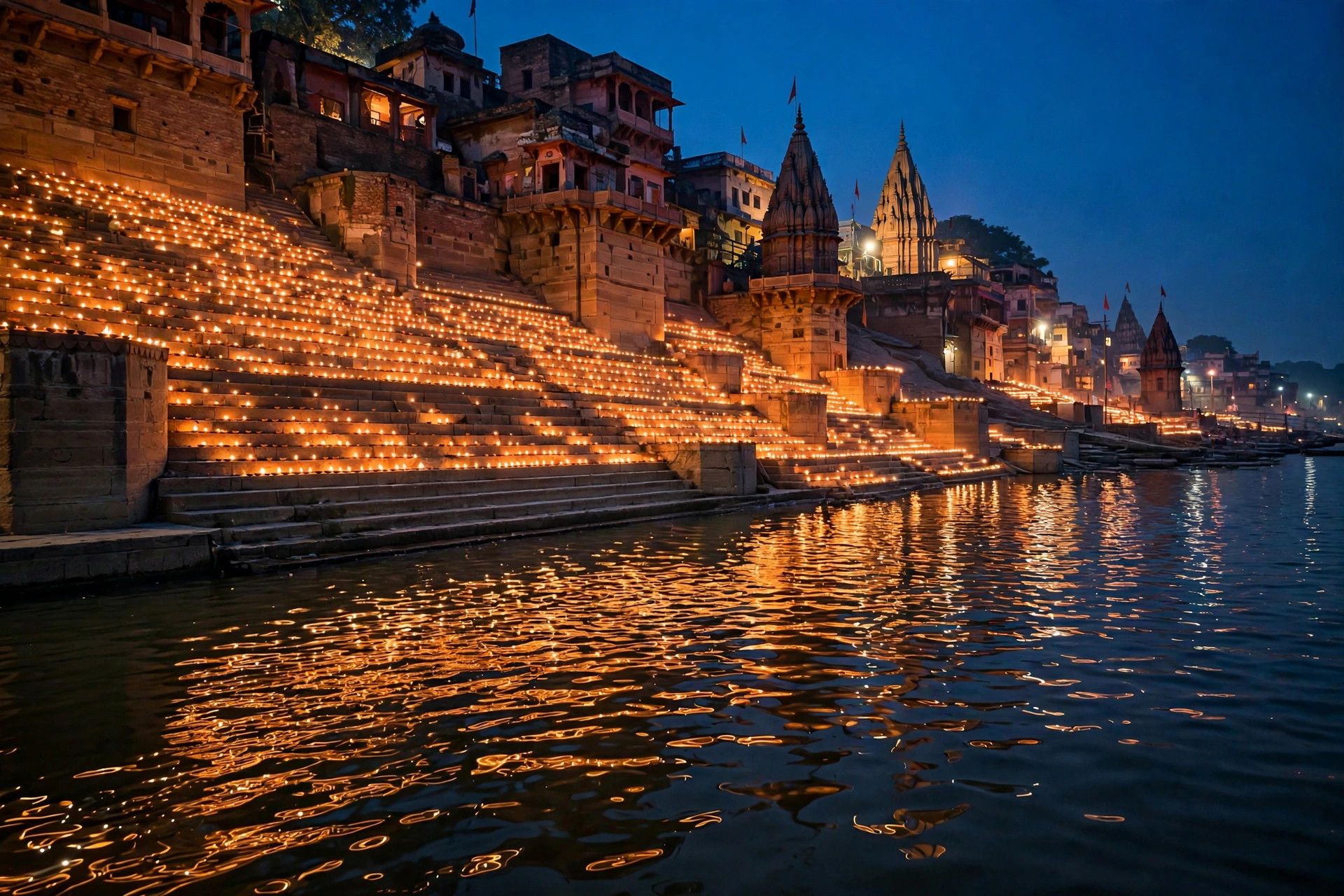 Yatra Guides
Dev Deepawali Varanasi 2026 — Dates, Boats, Best Ghats & Honest Costs
Dev Deepawali 2026 is on 24 November. Verified boat prices, best ghats to watch from, real hotels and a complete 2-day plan — the honest Varanasi festival guide.
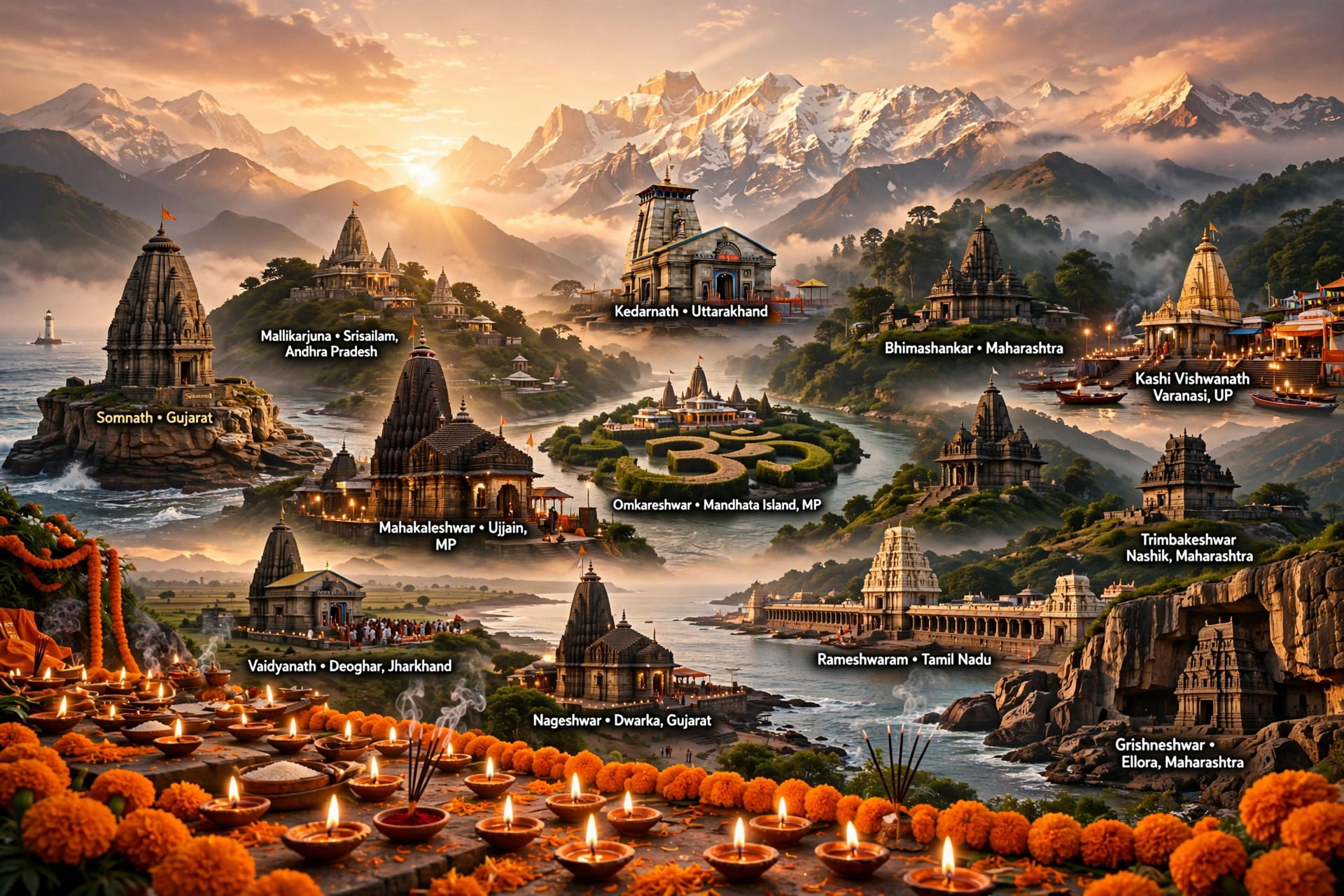 Yatra Guides
12 Jyotirlingas — Complete List, Locations & How to Plan Your Journey (2026)
All 12 Jyotirlingas with exact locations, nearest airports, best months to visit and smart circuit planning. The master guide — updated Oct 2026.