
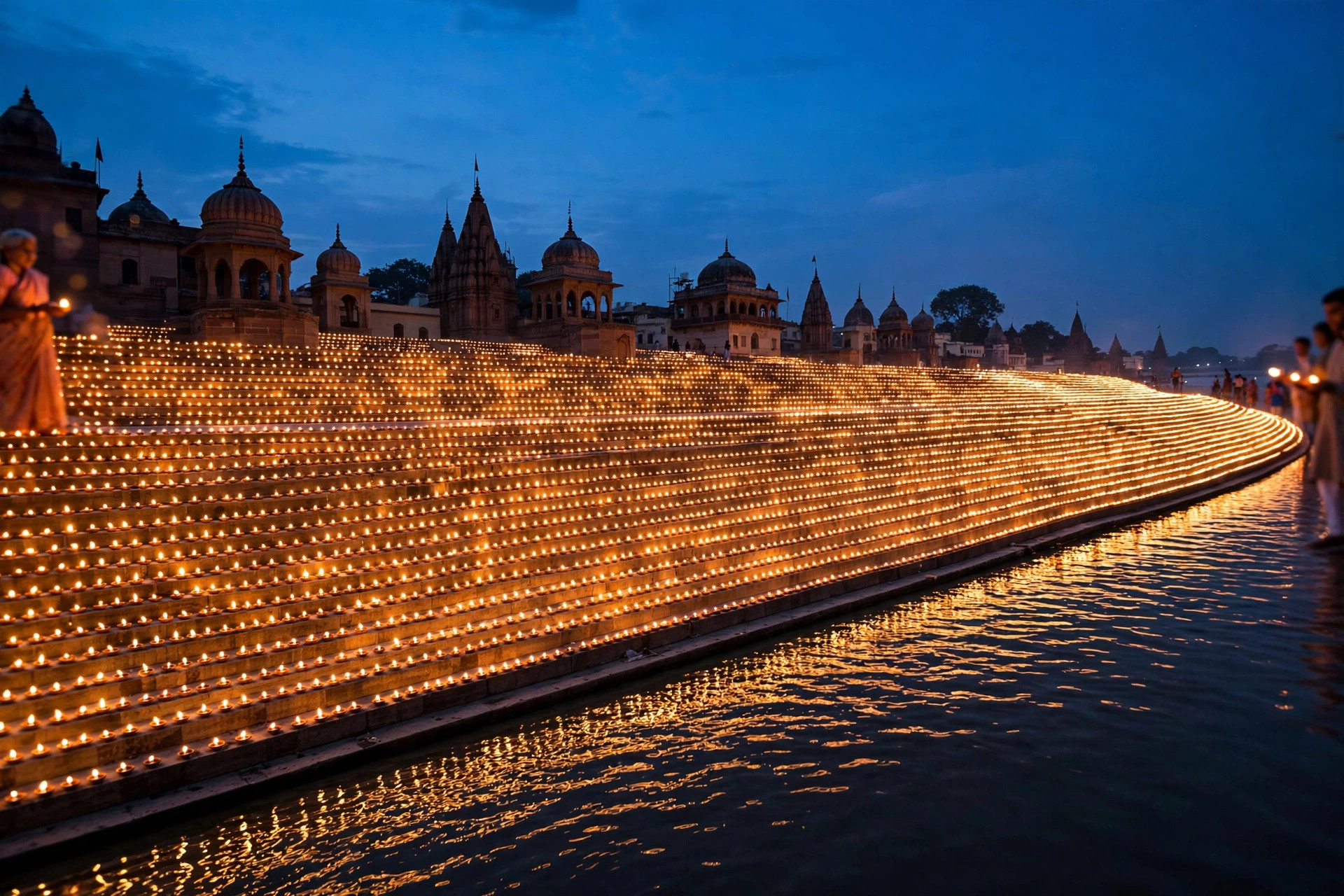
Photo: Wikimedia Commons
Yatra Guides
Ayodhya Deepotsav 2026 — Dates, Where to Watch, Pass Zones & Honest Costs
Deepotsav 2026: 33 lakh diyas light Ayodhya's Saryu ghats on 7 November. Verified schedule, free e-pass zones, best free viewing spots and honest costs.
Quick answer: Ayodhya Deepotsav 2026 runs 6–7 November, with the world-record diya lighting on the evening of Saturday, 7 November at Ram Ki Paidi and the Saryu ghats — a 33-lakh-diya official target, the Saryu Maha Aarti and a drone show. The lit ghats are pass-controlled; the public watches free from Naya Ghat, the Saryu bridge and downstream ghats, so arrive by mid-afternoon on 7 November and book hotels now.
Complete yatra blueprint
3-Day Ayodhya Deepotsav — Complete Blueprint
The full Deepotsav week plan: darshan before the crowds, the free viewing spots that actually work, where to sleep at three budgets, and what to eat — mapped so you never need another guide.
Arrive + Ram Mandir Darshan + Shobha Yatra
🛕 Temples & darshan
Shri Ram Janmabhoomi Mandir · Ram Janmabhoomi complex, Ayodhya
Do the darshan on the morning of 6 November, before Deepotsav crowds peak. The Trust has stepped up Kartika-month arrangements with special festivals across the month.
Hanuman Garhi + Kanak Bhawan · Old Ayodhya, walking distance from the temple
Hanuman Garhi (the city's protector deity, 76 steps up) and Kanak Bhawan (the palace gifted to Sita) are the classic half-day Ayodhya circuit — do both in the afternoon of 6 November.
Deepotsav Shobha Yatra · Saket College → Ram Katha Park
The festival's opening event: a grand Ramayana tableau procession with folk artists and themed floats through the old city.
🏨 Where to stay
Clubhouse Hotel Ayodhya
₹3,377 / night (Oct 2026 listings)
Practical budget base; Ayodhya fills completely in Deepotsav week, so even budget rooms must be booked weeks ahead.
Amritara Ramila Kutir
₹4,741 / night (Oct 2026 listings)
Near Ramghat Halt Crossing — walking distance to Ram Katha Park, Naya Ghat and Lata Chowk. In-house vegetarian restaurant BHOJ; the best-located mid-range pick for the 7th.
IRA by Orchid Ayodhya
₹4,545 / night (Oct 2026 listings)
Darshan Nagar, 4.2 km from Ram Janmabhoomi — 4.5/5 from 710 Google reviews, 4.8 on TripAdvisor. The reliable comfort pick if the ghat-side hotels are sold out.
🍽 Where to eat
Chandra Marwadi Bhojanalay
Marwadi thali ₹250–280; Dal Fry Thali ₹120 (Oct 2026)
Must try: Marwadi thali + khurchan pedas from the adjoining Chandra Sweets
Ram Path, serving since 1948 — the old city's classic vegetarian kitchen. Ask for 'bina pyaz-lasun' (no onion-garlic) if you want it satvik.
Kake Di Hatti Ayodhya
₹200–400 for two (indicative)
Must try: Chole bhature + Delhi-style classics, 100 m from the temple
The highest-rated eatery near Shri Ram Janmabhoomi (4.8/5) — useful when you want a sit-down meal after darshan.
- Do your temple darshan on the 6th — on the 7th, the old-city roads close from the afternoon and the temple area becomes very hard to reach.
- Keep your 7 November day plan light: lunch, rest, then head to the ghats by mid-afternoon.
Deepotsav Main Night — Diyas, Aarti & Drone Show
🛕 Temples & darshan
Deepotsav main event — 33 lakh diyas · Ram Ki Paidi + Saryu ghats (view from Naya Ghat / Saryu bridge / downstream ghats)
The 10th Deepotsav attempts its own Guinness record again: an official target of 33 lakh earthen diyas across ~2 km of riverfront, lit by ~34,000 volunteers. The lighting window is 5:45–7 PM, followed by the Saryu Maha Aarti, a 3D hologram projection of the Ramayana and a drone show (7:15–8:30 PM).
Pushpak Arrival + Rajyabhishek (daytime) · Ram Katha Park stage
The afternoon ceremony: the symbolic arrival of the Pushpak Viman and the coronation (Rajyabhishek) of Lord Rama — part of the official 3-day programme.
🏨 Where to stay
Same hotel as Day 1 — do not check out
N/A
On 7 November night, Ayodhya is fully booked and roads are closed — your room is your fallback. Return on foot or e-rickshaw after the drone show.
🍽 Where to eat
Eat before you leave for the ghats
₹150–400 for two
Eat your main meal by 3 PM. Carry water and light snacks; the ghat food stalls are packed and overpriced on the night.
- This is not a night for a big camera bag and heels. Travel light, wear walking shoes, carry cash and a power bank — networks crawl in the crowds.
- The drones fly 7:15–8:30 PM — don't leave right after the diyas are lit; the best part of the night comes after.
- Ignore touts selling 'VIP passes' near the ghats on the night — legitimate access is through official channels only.
Diwali Day — Ram Mandir Illumination + Departure
🛕 Temples & darshan
Diwali at Ram Janmabhoomi · Shri Ram Janmabhoomi Mandir
On Diwali day (8 November), diyas are lit at the sanctum of the Ram Mandir itself, followed by city-wide fireworks in the evening. A calmer, more devotional counterpoint to the previous night's spectacle.
Nageshwarnath Temple (optional morning stop) · Theri Bazaar, 500 m from Ram Ki Paidi — founded, tradition says, by Kush, son of Rama
One of Ayodhya's oldest Shiva temples and a quiet morning counterpoint to the Ram-centric circuit. Pairs well with the Saryu ghats before you leave.
🏨 Where to stay
Depart, or one buffer night
N/A
If your train is on the 8th, book it now — festival-week trains out of Ayodhya fill weeks ahead.
🍽 Where to eat
Diwali-day thali in old Ayodhya
₹200–400 for two
Must try: Poori-sabzi breakfast near the temple lanes
Most temple-lane eateries open early on Diwali; the old city wakes up hungry.
- The 8th is for the temple, not the ghats — the riverfront is being cleaned and the crowds are gone.
- Carry prasad home early; the shops near the temple sell out of the good stuff by afternoon.
What Deepotsav actually is
Every Diwali has an origin story, and Ayodhya owns this one. Deepotsav — the "Festival of Lamps" — recreates the night Lord Rama returned to Ayodhya after 14 years of exile, the event that Diwali itself commemorates. While Diwali is celebrated across India, Ayodhya's Deepotsav is the only celebration staged at the original site, on the banks of the Saryu where the story began. (ayodhyavaranasitourism.com)
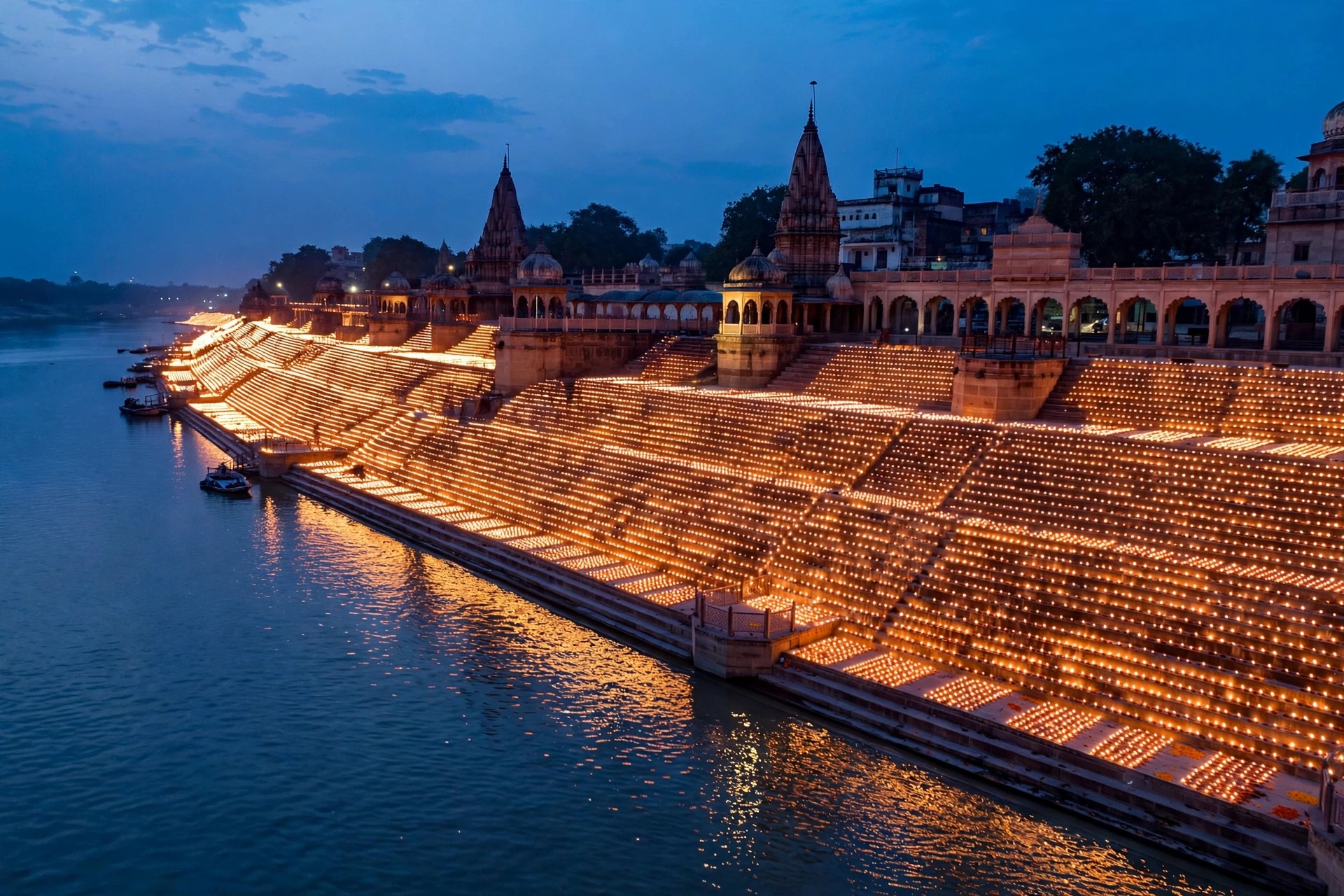
The festival is young and already enormous. Launched in 2017 with 1.71 lakh diyas, it has broken its own Guinness World Record nearly every year since — the official year-wise series runs 3.01 lakh (2018), 4.04 lakh (2019), 6.06 lakh (2020), 9.41 lakh (2021), 15.76 lakh (2022), 22.23 lakh (2023), 25.12 lakh (2024), and 26,17,215 diyas lit simultaneously in 2025, plus a second 2025 record: 2,128 people performing aarti together. The 2026 edition — the 10th — has an official target of 33 lakh earthen diyas across about two kilometres of the Saryu riverfront, from Ram Ki Paidi to the ghats, lit by around 34,000 volunteers with some 65 lakh wicks, 55,000 litres of oil and 150 kg of camphor arranged. (organiser.org)
A note on the numbers, because they move: some outlets currently quote the 2026 target as 28 or 30 lakh — the 33-lakh figure comes from the October 2026 official preparation reports, so that is the one to plan around. And if you see "22.23 lakh" attached to 2025, that is wrong: 22.23 lakh was the 2023 record; 2025's official figure is 26,17,215. (timesofindia.indiatimes.com)
When exactly is Deepotsav 2026? The 3-day schedule
The main event is certain — the evening of Saturday, 7 November. Sources disagree on the official festival range (some say 5–7 November, others 6–8), but the days around the 7th all carry cultural programming, and the schedule below is what every source agrees on.
| Date | Day | What happens | Where |
|---|---|---|---|
| 6 Nov | Friday | Shobha Yatra — grand Ramayana tableau procession with folk artists and floats (one source reports a ~9 PM start, unusual; verify locally) | Saket College → Ram Katha Park |
| 7 Nov | Saturday | MAIN EVENT — 33-lakh diya lighting (5:45–7 PM; some sources say 5:30), Saryu Maha Aarti, 3D Ramayana hologram projection + drone show (7:15–8:30 PM) | Ram Ki Paidi + Saryu ghats; Pushpak Arrival & Rajyabhishek at Ram Katha Park (~3:30 PM) |
| 8 Nov | Sunday | Diwali — diyas at the Ram Mandir sanctum, city-wide fireworks | Shri Ram Janmabhoomi Mandir + across the city |
(theunstumbled.com, etvbharat.com)
The weekday matters: some guides list 7 November as a Friday — it is a Saturday. Plan your travel days accordingly. And the drone count is genuinely disputed: travel guides say 500 drones, while the Times of India (September 2026) reports the government planning a 2,100-drone show, with a repeat two days later at Jamghat. 2025 flew 1,100 indigenous drones — so expect something bigger than last year, whatever the final number is.
New for this 10th edition, and worth arriving in daylight for: the whole city is getting dressed up, not just the ghats — Ramayana-themed decorative gateways along the major routes, a Pushpak Viman installation, Ram Rath and a Bharat Milap stage, decorative floaters on the Saryu, and ten themed selfie points each at Ram Katha Park and Ram Ki Paidi. (freepressjournal.in)
Can you just walk to the ghats? Pass zones and the honest answer
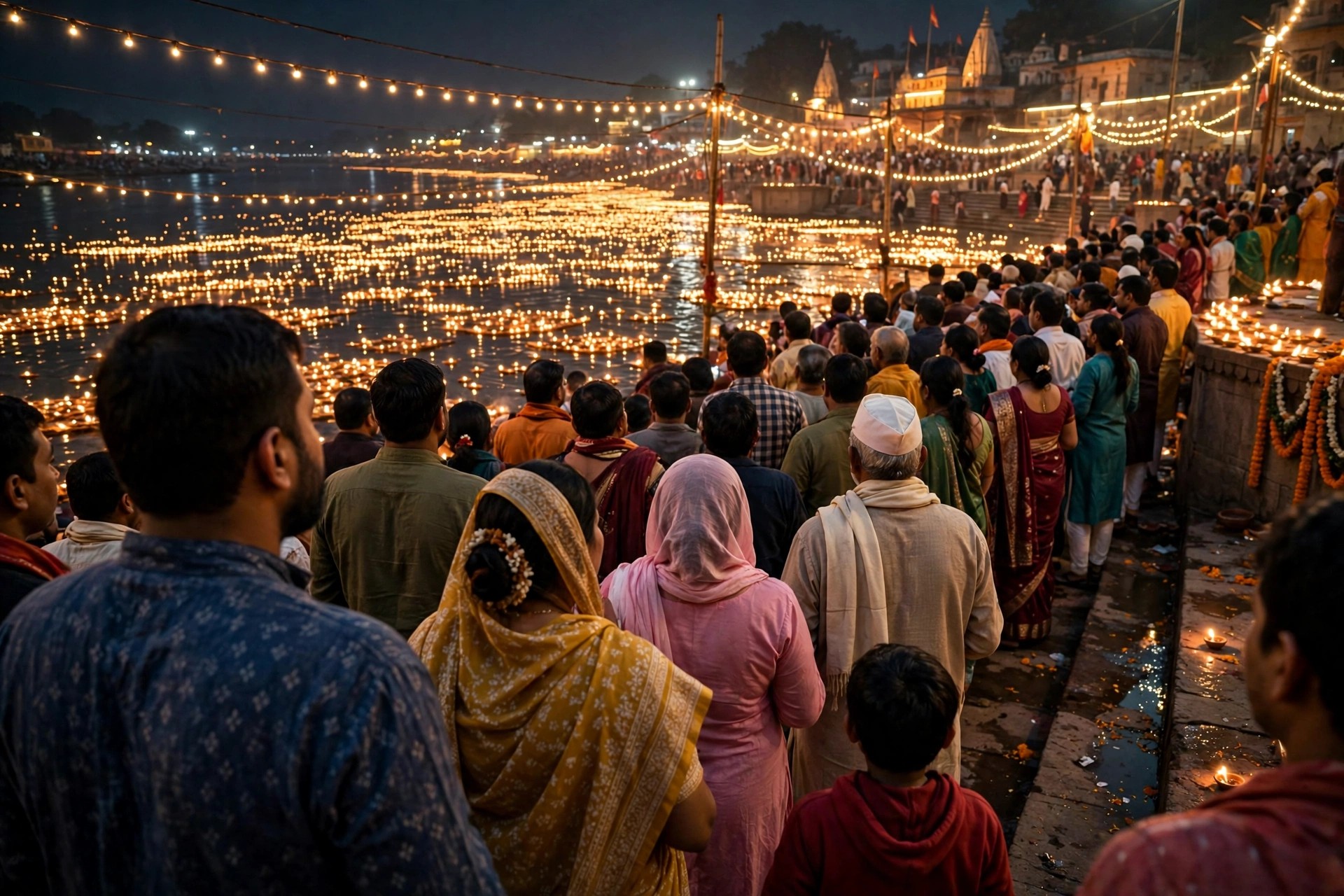
This is the question that decides your whole trip. The Ram Ki Paidi riverfront — the lit stretch where the diyas actually burn — is a pass-controlled zone on 7 November. You cannot simply walk in. The general public watches from three free areas: the Naya Ghat side, the Saryu bridge, and the ghats downstream of the controlled zone. These are not consolation prizes — from the bridge and Naya Ghat you see the entire lit riverfront as one panorama, which is arguably the better view. (zingbus.com, zingbus.com)
There is also a legitimate free route in: the district administration issues a free e-pass for the central amphitheatre at Ram Ki Paidi — register on uptourism.gov.in during September–October with your name, mobile number, ID details and group size, and you get a digital QR code to present at the checkpoint on 7 November. It is limited and first-come-first-served, so if you want it, do it now. Note the scope: the pass covers only the central amphitheatre — Naya Ghat, Dharm Path and the general Ram Ki Paidi viewing positions need no registration at all. (ayodhyavaranasitourism.com)
What that means in practice:
- Roads into the ghat zone close from the afternoon on 7 November, and designated entry gates open around 3:30 PM. Last-mile access is on foot or by e-rickshaw.
- Viewing positions fill before the lamps are lit. Arrive at Naya Ghat or the bridge by mid-afternoon — 3 to 4 PM at the latest.
- Don't buy "VIP passes" from touts near the ghats on the night. Legitimate controlled-zone access comes only through official channels; everything else is a scam or a fantasy.
- Travel light. Big bags slow you through security cordons; wear shoes you can walk kilometres in.
Ram Mandir during Deepotsav week: the darshan window
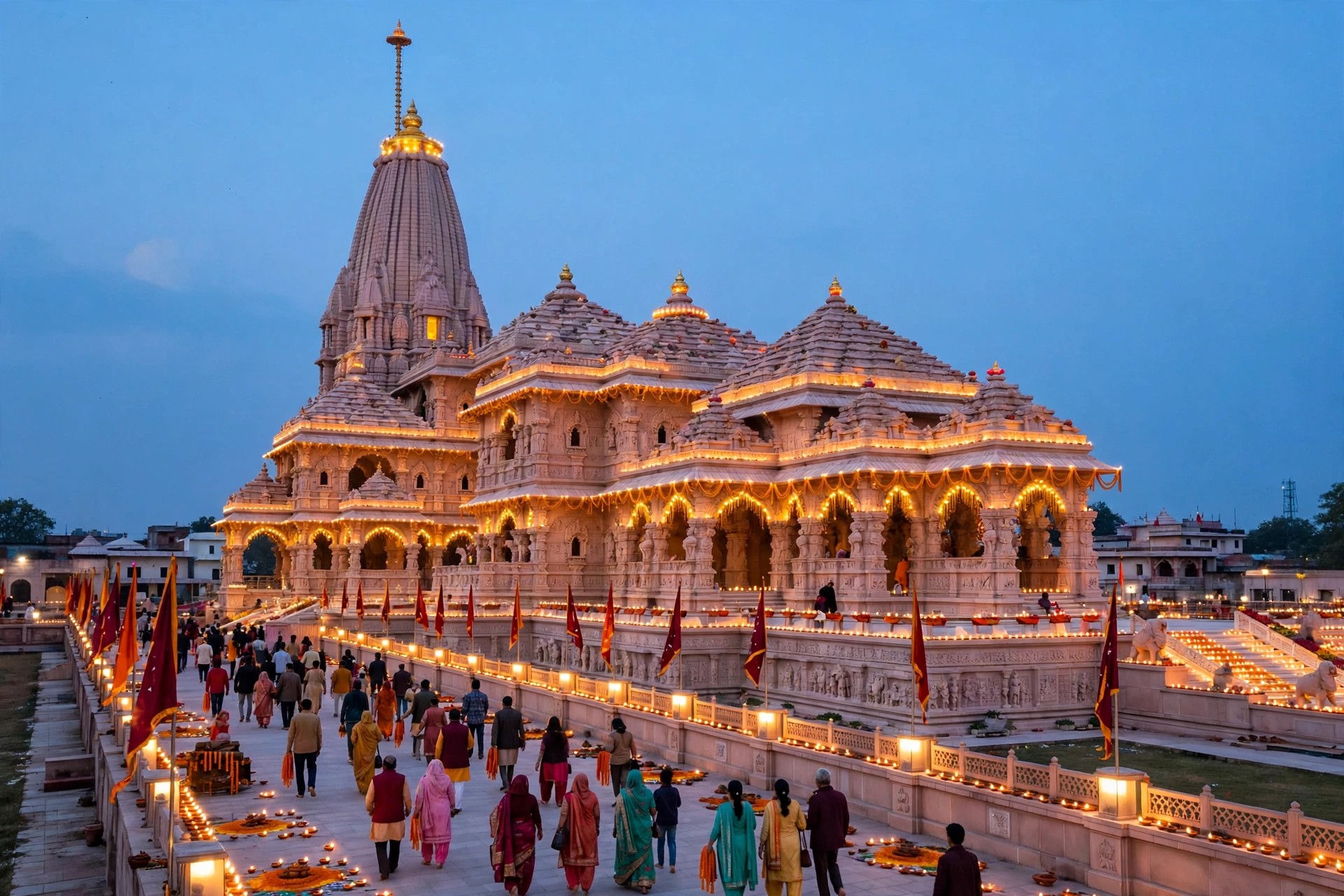
The Shri Ram Janmabhoomi Teerth Kshetra Trust has stepped up preparations for the whole Kartika month — the religious committee reviewed arrangements in mid-October for everything from Valmiki Jayanti (26 October) through Annakoot and Deepotsav. The temple is open through Deepotsav week, and on Diwali day (8 November) diyas are lit at the sanctum itself. (etvbharat.com)
The honest strategy: do your darshan on the morning of 6 November, before the festival crowds peak. On 7 November the old-city roads close from the afternoon and reaching the temple becomes very difficult. General darshan runs 6:30 AM–12 PM and 2–9:30 PM; Shringar Aarti is around 6:30 AM and Sandhya Aarti around 7–7:30 PM. Aarti slots need free passes booked in advance through the Trust portal (srjbtkshetra.org) or its camp office — anyone charging for them is unofficial. (tripcosmos.co)
Two things to know before you go: Sugam Darshan (the priority lane) is listed as free on some guides and ₹250–300 on others — both cite the same official portal, so treat the cost as unverified and book through srjbtkshetra.org only. And the complex rules are strict: no mobiles, cameras, leather items or bags inside (free cloakroom lockers provided), modest dress with shoulders and knees covered, and a government ID for security checks. (visitindia.co)
How to get there
By air: Maharshi Valmiki International Airport (AYJ) is about 10 km from the city centre, and October 2026 brought new direct connections: Akasa Air and Air India Express from Delhi (afternoon), IndiGo from Bengaluru (Tue/Thu/Sat), plus SpiceJet's daily Delhi, Bengaluru, Ahmedabad and Hyderabad services. Benchmark fares in October 2026 run roughly ₹3,500–9,000 one way — book now, festival-week fares are already climbing.
By rail: the standout option is the Vande Bharat 22425/22426 between Ayodhya Cantt and Delhi's Anand Vihar Terminal (6 days a week, ~8h15; departs Ayodhya Cantt 15:25, arrives Delhi 23:40; Chair Car ~₹790–905, Executive ~₹2,225). There is also a Vande Bharat from Gomtinagar (Lucknow) to Ayodhya Dham, and a morning Vande Bharat from Varanasi (09:10) reaching Ayodhya Dham by 11:34 — that one is the perfect festival-day feeder. Older Delhi–Ayodhya expresses take 10–12 hours; Lucknow has multiple trains at ~3 hours.
By road: the Delhi–Lucknow corridor feeds into Ayodhya; Lucknow is 135 km away, roughly 3 hours by road, and a Lucknow–Ayodhya cab runs ₹1,500–3,500 one way depending on the vehicle.
The Lucknow backup plan is real and widely used: Ayodhya's hotels sell out completely during Deepotsav week, so many visitors base themselves in Lucknow and drive in for the evening of the 7th. It works — but you must leave Lucknow by early afternoon to beat the road closures, and you'll return late at night.
If you want zero planning, UP Tourism sells a 3-day Deepotsav package at ₹16,999/person (twin-sharing) with AC transport, meals, hotel and guided shrine visits including the Saryu Aarti vantage points — bookable via the UPSTDC portal. (timesofindia.indiatimes.com)
On 7 November itself: get to the ghat areas by mid-afternoon. After the roads close, your options are your feet and an e-rickshaw. (zingbus.com)
Where to stay: book now or sleep in Lucknow
Ayodhya fills completely during Deepotsav week. Book 3–4 weeks ahead — which, as of this writing (24 October, two weeks out), means now. Four honest, verified picks:
- Budget — Clubhouse Hotel Ayodhya: 3.6/5, ~₹3,377/night on October 2026 listings. The practical budget base; nothing fancy, but it puts a roof over your head for the festival.
- Mid-range, near the ghats — Amritara Ramila Kutir: near Ramghat Halt Crossing, walking distance to Ram Katha Park, Naya Ghat and Lata Chowk. 9.4/10 on Trip.com and 4.5–4.6 on TripAdvisor, ~₹4,741/night, with an in-house vegetarian restaurant (BHOJ). The best-located mid-range pick for the 7th.
- Mid-range alternative — The Ramayana Hotel, Darshan Nagar: 4.0/5 across 2,689 ratings, ~₹3,968/night. Good value, though one recent review flags inconsistent room quality — ask for a renovated room.
- Comfort — IRA by Orchid Ayodhya: Darshan Nagar, 4.2 km from Ram Janmabhoomi. 4.5/5 from 710 Google reviews and 4.8 on TripAdvisor, ~₹4,545/night. The reliable comfort pick when the ghat-side hotels are gone.
One honest caveat: Deepotsav-week surge multipliers are not published anywhere we could verify — the rates above are October 2026 base listings, and festival-week prices will be higher. That is exactly why you book now, not next week.
If Ayodhya is sold out, Lucknow (135 km, ~3 hours by road) is the practical backup: stay there, drive in by early afternoon on the 7th, and return after the drone show.
What to eat in Ayodhya
Ayodhya is a fully vegetarian temple city, and the old lanes around the temple do poori-sabzi breakfasts and chaat the way only temple towns can. The must-try list: kachori-sabzi (the breakfast), rabri and pedas — especially the dry-fruit pedas sold as prasad near Hanuman Garhi — rabri lassi in a kulhad, dahi vada and baati-chokha. Verified picks:
- Chandra Marwadi Bhojanalay, Ram Path — serving since 1948. Deluxe/Special/Marwadi thalis at ₹250–280, Dal Fry Thali at ₹120. The old city's classic vegetarian kitchen; from the adjoining Chandra Sweets, take home khurchan pedas.
- Kake Di Hatti Ayodhya — 4.8/5, roughly 100 m from Shri Ram Janmabhoomi. The highest-rated eatery near the temple; the sit-down option after darshan.
- Shri Kanak Sarkar Rasoi, near Kanak Bhawan — 4.1/5, unlimited vegetarian thali. The pilgrim-canteen style meal that locals swear by.
- Radha Ratna Restaurant and Rooms, Ram Path Rd (near Lata Mangeshkar Chowk) — 7 AM–11:30 PM, pure veg, known for chokha-bati and mushroom gravy.
- Shri Kanak Bhawan Prasad Grih — inside Kanak Bhawan itself; the prasad meal, eaten sitting down, is part of the visit.
One local tip: ask for "bina pyaz-lasun" (no onion-garlic) — most bhojnalayas near Hanuman Garhi serve satvik food by default, but it never hurts to say it.
Costs, honestly: the full trip budget (Oct 2026)
| Item | Cost |
|---|---|
| Delhi–Ayodhya flight | ₹3,500–9,000 one way (Oct 2026 benchmarks) |
| Vande Bharat, Delhi (Anand Vihar)–Ayodhya Cantt | CC ₹790–905, EC ₹2,225; ~8h15 |
| Train, Delhi–Ayodhya (sleeper/3AC) | ₹300–1,500 |
| Lucknow–Ayodhya cab (one way) | ₹1,500–3,500 |
| Hotel, 2 nights (budget) | ~₹6,700+ (base rates; surge unverified) |
| Hotel, 2 nights (mid-range) | ~₹9,500+ (base rates; surge unverified) |
| Saryu boat: private / shared / Water Metro | ₹1,500–2,000 per boat (6–8 pax) / ₹60–300 per person / ₹300 per ride |
| Deepotsav e-pass | Free (uptourism.gov.in) |
| UPSTDC 3-day Deepotsav package | ₹16,999 / person (twin-sharing) |
| E-rickshaw / local transport, 3 days | ₹300–600 |
| Food, 3 days | ₹1,500–2,500 / person (indicative) |
| Comfortable 3-day total, ex-Delhi | ₹18,000–30,000 / person |
Deepotsav itself — the ghat viewing, the aarti, the drone show — is free to watch from the public areas. Your money goes to the bed and the journey, which is exactly why you book the bed first. Hotel rates above are October 2026 base listings; Deepotsav-week surge multipliers are not published anywhere verifiable, so budget upward. Prices reviewed October 2026; festival-week fares and rates move fast.
For international visitors
Deepotsav is open to everyone — no pass needed for the public viewing areas, and the UP government is actively inviting foreign culture ministers and the Indian diaspora from 30+ countries for 2026, so international visitors are expected and welcome. (No Ayodhya-specific foreign-national restrictions surfaced in any source we read.) A few things worth knowing: Ayodhya is a dry, fully vegetarian temple city — respect that. Dress modestly (covered shoulders and knees) at the temple and ghats; leather items, phones, cameras and bags are banned inside Ram Mandir, and photography is strictly prohibited at Nageshwarnath Temple. Carry your passport for hotel check-in and a government ID for temple security; book through established operators, not random WhatsApp numbers. The Saryu bridge viewpoint is the best low-effort option if you don't want to fight the ghat crowds. And on the 7th, carry cash — UPI and cards fail when the networks crawl.
Prices and schedule reviewed 24 October 2026. Deepotsav 2026 main event: Saturday, 7 November (Diwali: Sunday, 8 November). Sources: Organiser (10 Oct 2026), Times of India (Sep–Oct 2026: prep numbers, 2025 record, UPSTDC package), ETV Bharat (17 Oct 2026), WebNewswire (6 Oct 2026), HinduTone festival roundup (9 Oct 2026), ZingBus Ayodhya guides, TheUnstumbled schedule breakdown, Ayodhya-Varanasi Tourism entry guide, TripCosmos (darshan/aarti/boat data), Bhaskar English (water metro fares, Jun 2026). Hotel/restaurant ratings verified via Google/places data and travel listings, Oct 2026.
Frequently asked questions
When is Ayodhya Deepotsav 2026?
The main lamp-lighting is on the evening of Saturday, 7 November 2026 — the day before Diwali (8 November). Festivities begin on Friday, 6 November with the Ramayana Shobha Yatra, and the main event (diya lighting 5:45–7 PM, drone show after) happens at Ram Ki Paidi and the Saryu ghats on 7 November.
Can I just walk to the ghats and watch Deepotsav?
Not the lit ghats — the Ram Ki Paidi riverfront zone is pass-controlled, and there is a free e-pass (uptourism.gov.in, Sept–Oct registration, limited) for the central amphitheatre. The general public watches free without any pass from the Naya Ghat side, the Saryu bridge and the ghats downstream of the controlled zone. Roads into the ghat area close from the afternoon on 7 November — entry gates open around 3:30 PM — and viewing positions fill up well before the lamps are lit, so arrive by mid-afternoon.
How many diyas will be lit for Deepotsav 2026?
The official target for the 10th edition is 33 lakh earthen diyas across roughly two kilometres of the Saryu riverfront, lit by about 34,000 volunteers with 65 lakh wicks and 55,000 litres of oil arranged. (Some outlets quote 28–30 lakh; the 33-lakh figure is from the October 2026 official prep reports.) The 2025 edition set the standing Guinness World Record with 26,17,215 diyas lit simultaneously — plus a second record, 2,128 people in one aarti.
Can I visit Ram Mandir during Deepotsav week?
Yes — the temple is open, and the Shri Ram Janmabhoomi Teerth Kshetra Trust has stepped up Kartika-month preparations. But expect the heaviest crowds of the year. Do your darshan on the morning of 6 November or after 8 November; on 7 November the old-city roads close from the afternoon and reaching the temple becomes very difficult.
Where should I stay for Deepotsav 2026?
Book an Ayodhya hotel 3–4 weeks ahead — the city fills completely during Deepotsav week and festival-night rates surge. If Ayodhya is sold out, Lucknow (135 km, ~3 hours by road) is the practical backup base for a same-evening trip.
How do I reach Ayodhya?
Fly to Maharshi Valmiki International Airport (Ayodhya Dham, ~10 km from the centre) with direct flights from Delhi, Mumbai and Bangalore, or take the train to Ayodhya Dham Junction. On 7 November, leave for the ghats by mid-afternoon — old-city roads close and only shuttle/e-rickshaw access works near the riverfront.
Keep exploring
 Yatra Guides
Karwa Chauth 2026 — 28 or 29 October? Date, Puja Muhurat, City-Wise Moonrise Time & the Full Vrat Guide
Karwa Chauth 2026 is on Thursday, 29 October in India (28 October is the USA date). Exact tithi, puja muhurat, sargi timing, moonrise times for 18 cities, the vrat vidhi step by step, and a Jaipur moonrise blueprint.
 Yatra Guides
Sharad Purnima 2026 — Purnima Kab Hai, Moonrise Time, Kheer Ritual & Where to Celebrate
Sharad Purnima 2026 is on Sunday, 25 October. Exact tithi and moonrise timings, the kheer-under-moonlight ritual done right, Raas Purnima in Vrindavan, and a full Purnima calendar.
 Yatra Guides
Shri Mata Vaishno Devi Yatra 2026 — Registration, Helicopter Fare, Both Routes, Real Hotels & the Complete 3-Day Blueprint
Shardiya Navratras 2026 drew 4+ lakh pilgrims to Vaishno Devi. Free RFID registration, helicopter fares, old vs Tarakote route, real Katra hotels and restaurants, and a full 3-day blueprint.