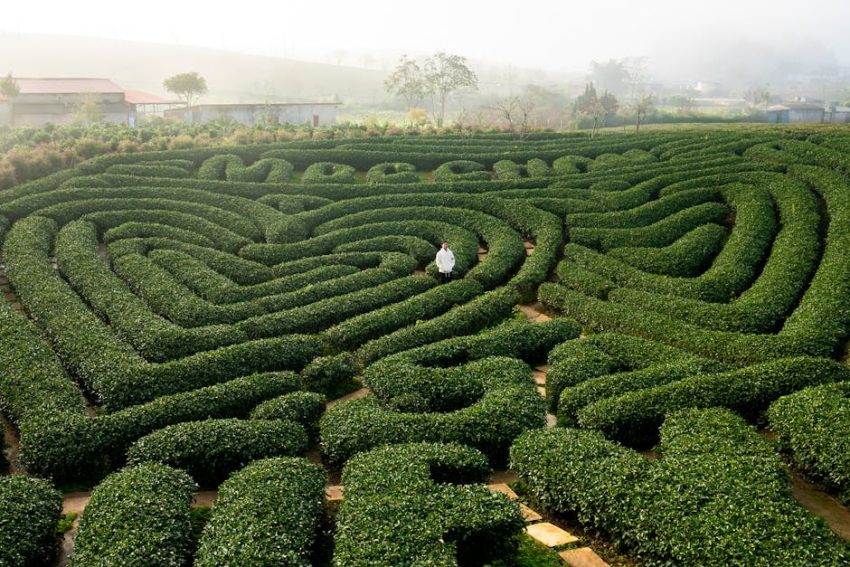
I stood there, hands on my hips, staring into the damn hedge. Heart already pounding like it knew something I didn’t. I wasn’t scared—okay, maybe a little—but this thing? The Yancheng Dafeng Maze in China? Not a joke. Not even close. Felt more like a prank pulled by someone who’d given up on logic. World’s biggest permanent maze, they say. Over 35 acres of green walls twisting like they were laughing at me. Sign at the front said, “Find Your Way—Or Don’t.” Cute. I smirked. Twenty minutes in, the smirk was gone.
Being bad at mazes feels different. Nobody cares if you mess up a Google Maps route. But inside a hedge maze? It’s just you, a thousand identical green branches, and the creeping suspicion that yeah, you might be kind of an idiot. I walked the same path three times before I admitted it—even to myself. Shirt soaked. Phone dead since the first hour. My usually decent sense of direction had bailed like a friend dodging a group chat. I turned right because the light seemed softer, kinder. Big mistake. Smack into a yew wall like, ‘Nope. Try again.’
But I kept going. And then, somehow, it got… quiet. Even calm.
The Quiet Panic of Being Actually, Truly Lost
We don’t get lost anymore. Not really. Our phones buzz us back on track before we even notice we’re off. That little blue dot? Always there, always saying, ‘Wrong way, dummy.’ But in here? Nothing. No signal. No digital gods. Just me, my ragged breath, and the slow creep of a thought: what if I don’t make it out before dark? What if they find me in April, curled up under the ivy like a sad snack, nibbled by squirrels?
After about ten minutes, I noticed my chest—tight, like someone was squeezing it. Breathing like I’d sprinted a mile. Thoughts looping: Why am I doing this? What if I just… stay? Do botanical gardens have a procedure for that? Dumb, yeah. But the fear wasn’t. It felt real. Heavy. The maze didn’t care that I’d written books. Didn’t care that I once found my way through Marrakech blindfolded on a bet. All it cared about was whether I could do this. Nothing else mattered.
I dropped onto a bench shaped like a question mark—yeah, hilarious—and tried to slow my breath. That’s when it came back: something I’d read years ago. We don’t just see our way through space. We feel it. Smell it. Sense the wind, the light, the way corners echo. But stress? Stress wipes that out. Cortisol, that greasy bastard, floods your brain and suddenly you can’t tell left from right—or if you’re still breathing.
So I stopped trying to win. Just… started paying attention.
The Map in Your Head (And How This Thing Broke It)
There’s this idea—cognitive mapping. Edward Tolman, some guy from the 1940s, studied rats in mazes. He found they weren’t just memorizing turns. They were building little invisible models in their heads. Brain blueprints. We do the same. But mazes? They’re built to wreck that. Fake paths that look real. Corners that mirror each other. Dead ends that feel like progress. The good ones—Leeds Castle, Dole Plantation in Hawaii—they’re not puzzles. They’re mind games.
Got stuck in the Dole maze once. Forty-seven minutes. Sticky as hell. Smelled like wet corn and bad decisions. Watched families zip past, kids screaming like it was fun, while I kept hitting the same junction over and over—like a glitch. Started talking to the stalks. “Alright, fine. You win. I’m not leaving, am I?”
But I wasn’t mad at the maze. I was mad at me. Why couldn’t I see it? Why did my brain keep picking the same wrong turn? Then it hit me: that frustration? That’s the real trap. It’s not testing if you’re smart. It’s testing if you’ll keep walking when you know you’re wrong.
What It Feels Like to Be Wrong on Purpose
Once talked to a neuroscientist—Dr. Rajiv Mehta, in Edinburgh. Studies how people navigate under pressure. He told me the best maze-solvers aren’t the ones with perfect spatial memory. They’re the ones who bounce back fastest from screwing up.
“They don’t freeze,” he said. “They treat a dead end like data.”
I loved that. Started testing it. Went to every dumb maze I could find—fall festivals, garden estates, roadside attractions. Instead of swearing when I backtracked, I’d say out loud, “Cool. That’s a nope.” Started marking mental X’s. Lean into the loop.
And slowly, something shifted. The panic didn’t vanish, but it got quieter. I stopped fighting the maze. Started listening. Noticing stuff: how the leaves rustled differently in some corridors, how the shade moved, how one turn just felt right even when it went nowhere. Wasn’t about escaping anymore. Was about being there.
One afternoon at Longleat—the first commercial maze in Britain, apparently—I caught myself laughing. Circling a snail statue for the third time. Didn’t care. Just stood there, hands on my knees, breathing hard. “How did I miss that?” I muttered. “Why do I keep thinking ‘forward’ means anything?”
The Weird Calm of Having No Idea
I don’t remember exactly when I got out of Yancheng. No fanfare. No kid cheering. Just a gap in the hedge, a patch of gravel, and a bored attendant scanning tickets like he’d rather be anywhere else. I stepped out, legs shaky, and turned back. From the outside, the maze looked… small. Simple. Like a kid’s doodle in green crayon.
But I knew.
Mazes aren’t about finding the exit. They’re about what happens while you’re stuck. They show you how you handle not knowing. How you deal with being wrong. How you keep moving when every part of you wants to sit down and cry.
Now I go looking for them. Not because I’m better. I’m not. But because they teach me how to suck at something and keep walking anyway. How to stay calm when you’re turned around. How to trust that even if you spin in circles for an hour, you’ll eventually hit a turn that opens up.
If you want to understand how people deal with uncertainty—skip the textbooks. Walk a maze. Better yet, get properly lost in one. Let your heart race. Let your thoughts go to shit. And then—breathe, reset, and take another damn turn.
For more on how brains map space, dig into the idea of cognitive maps in psychology. And if you like walks that mess with your head as much as your feet, check out Punyapaths, where we write about walking like it means something.