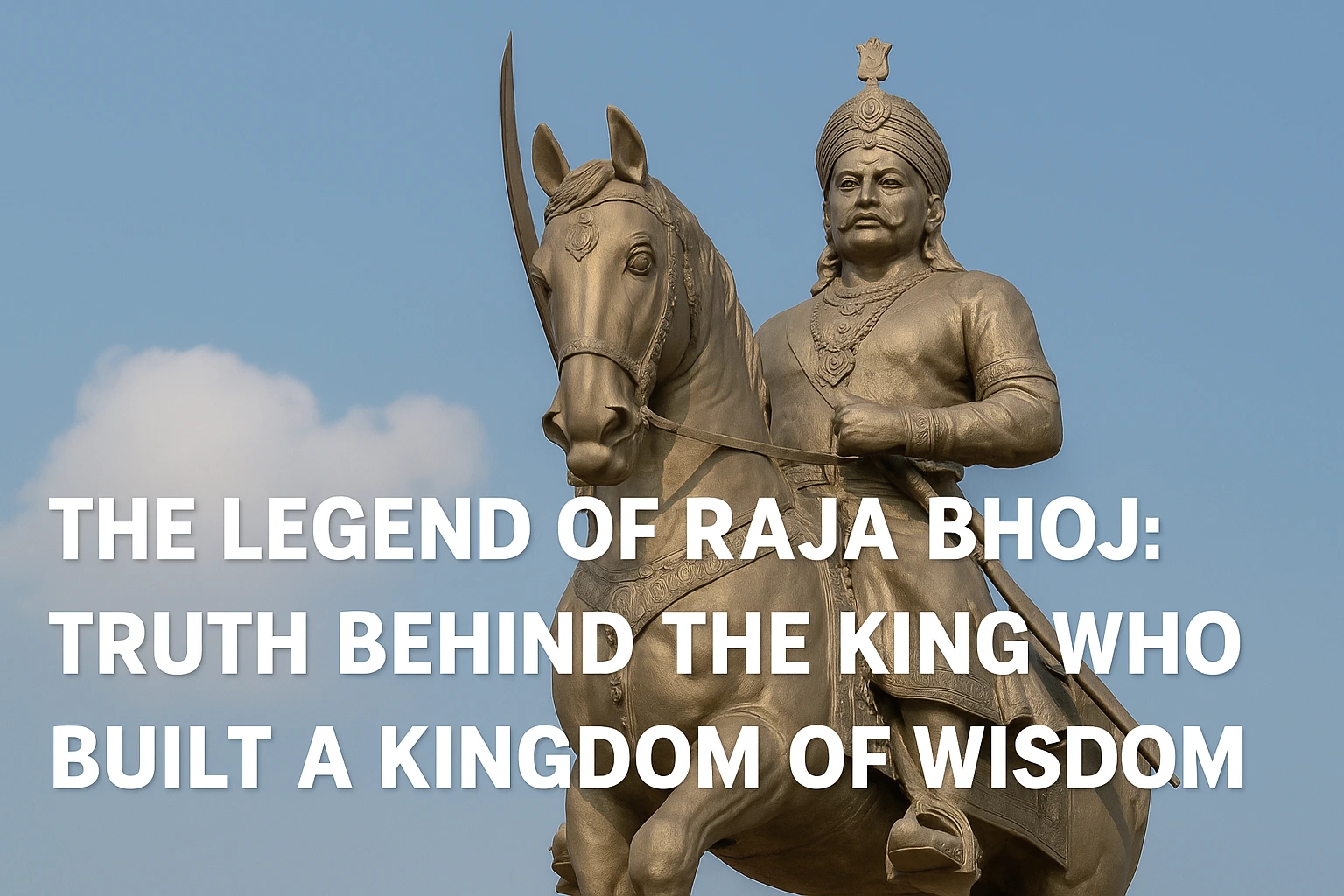
The Legend of Raja Bhoj: Truth Behind the King Who Built a Kingdom of Wisdom
When we hear the phrase “Kaha Raja Bhoj, kaha Gangu Teli,” we’re instantly reminded of the stark comparison between grandeur and mediocrity. But how much do we truly know about Raja Bhoj, the legendary king behind the name? Was he just a symbolic figure, or was he a real monarch whose deeds shaped history? Let us dive deep into the historical and legendary aspects of this fascinating ruler.
Who Was Raja Bhoj?
Raja Bhoj was a powerful and renowned king of medieval India, who ruled the Malwa region in present-day Madhya Pradesh during the early 11th century. He belonged to the Paramara dynasty, with his capital in Dhar, near modern Indore. Unlike many kings known only for conquests, Raja Bhoj’s fame primarily arises from his patronage of learning, art, architecture, and his role as a philosopher-king.
He ruled approximately from 1010 CE to 1055 CE, a time when India was facing invasions from various sides. Despite the turbulence of his era, Raja Bhoj is remembered not for battle glories, but for building a legacy of culture and knowledge that echoes even today.
Raja Bhoj: The Scholar King
One of the most remarkable aspects of Raja Bhoj’s personality was his commitment to scholarship. He is believed to have authored or commissioned over 80 works on topics ranging from astronomy, medicine, and architecture to poetry, grammar, and even yoga. Some of his most famous works include:
- Samarangana Sutradhara – A treatise on architecture and mechanical engineering
- Rajmartanda – Commentary on Patanjali’s Yoga Sutras
- Yuktikalpataru – A comprehensive work on medicine
His court was a center of learning, often compared to the ancient Nalanda or Takshashila universities. Scholars, poets, and artisans from all over India traveled to Bhoj’s court seeking patronage and knowledge.
The Bhojeshwar Temple – A Monument to Grandeur
One of the most iconic symbols of Raja Bhoj’s reign is the Bhojeshwar Temple, located in Bhojpur, near Bhopal. Though incomplete, this Shiva temple houses a massive 18-foot-high Shiva Lingam carved out of a single stone — one of the largest in India. The temple showcases Raja Bhoj’s ambition to create monumental architecture, unmatched in scale and spiritual grandeur.
Experts believe that had the temple been completed, it would have rivaled the Kailasa temple in Ellora. The precision of stone cutting and architectural planning reflect the advanced knowledge of civil engineering during his reign.
The Bhojtal (Upper Lake) of Bhopal
Another testimony to Raja Bhoj’s visionary thinking is the Bhojtal, or the Upper Lake in Bhopal. Legend says that Raja Bhoj was suffering from a skin disease that couldn’t be cured. His royal physicians advised him to bathe in a lake formed by combining the waters of 365 rivers.
Acting upon this advice, Bhoj constructed a massive reservoir by building a dam across the Kolans river. The lake still exists today and serves as a crucial water supply for the city of Bhopal. This not only reflects Raja Bhoj’s engineering acumen but also his focus on public welfare and infrastructure.
Debunking the Gangu Teli Myth
The phrase “Kaha Raja Bhoj, kaha Gangu Teli” has been widely used across North India to highlight class disparity or sharp contrast between two individuals. But who was Gangu Teli?
Many believe Gangu Teli was a commoner or a rival who tried to take the throne. However, historians argue that this character might be a fictional or exaggerated representation. Some sources suggest that Gangu Teli was a noble of lower caste origin who later tried to overthrow Bhoj or create his own power base.
Regardless of its factual basis, the comparison highlights the immense stature Raja Bhoj held in public memory. It’s worth noting that such idioms reflect societal attitudes of the time and should be critically examined rather than taken at face value.
Military and Political Achievements
Though Raja Bhoj is not primarily remembered for his military campaigns, he did face and resist invasions from the Chalukyas and other South Indian dynasties. He was also part of several regional alliances to maintain political stability in Central India.
He engaged in diplomatic and sometimes hostile relations with rulers like Chalukya Jayasimha II and Kalachuri King Gangeyadeva. His rule was also marked by strategic matrimonial alliances and diplomatic engagements that ensured the Paramara dynasty remained influential for decades.
Raja Bhoj and the Golden Age of Malwa
Under Raja Bhoj, the Malwa region flourished like never before. The king established multiple cities, including Bhojpur and Bhojshala, which became famous centers of learning and art. Temples, public works, and educational institutions built during his rule laid the foundation for a cultural renaissance in Central India.
Bhojshala, a Sanskrit school and temple dedicated to goddess Saraswati, stands as another testimony to his love for education and the arts. Though its current status is mired in controversy, historical records point to its glorious past during Bhoj’s reign.
The Mystery of His Death
There is no clear record of how Raja Bhoj died. Some texts suggest he died in battle; others claim he succumbed to illness. What is certain is that his death marked the end of an era in Central Indian history. The dynasty continued after him, but none could match his wisdom and legacy.
Legacy in Modern India
Raja Bhoj’s influence lives on even today. The Bhopal Airport is officially named Raja Bhoj International Airport. His name is revered in folklore, regional literature, and even popular TV serials and documentaries.
In a world where historical figures are often judged by conquest and brutality, Raja Bhoj stands apart as a king of wisdom, vision, and culture. He epitomizes the idea that true greatness lies not in power, but in purpose and knowledge.
Conclusion: Why Remember Raja Bhoj?
Raja Bhoj’s story teaches us that leadership is about building, not just ruling. His reign combined spirituality, infrastructure, art, science, and inclusive governance — the hallmarks of a golden era.
As modern India looks towards becoming a knowledge superpower, revisiting Raja Bhoj’s model of education-driven governance and sustainable architecture can offer timeless lessons.
So next time you hear “Kaha Raja Bhoj, kaha Gangu Teli,” remember — the story of Bhoj is not just about greatness; it’s about using wisdom to create a legacy that lasts beyond lifetimes.
📌 Tags:
#RajaBhoj #IndianHistory #LegendsOfIndia #MalwaDynasty #BhojeshwarTemple #AncientIndia #Punyapaths