
Photo: Wikimedia Commons
Yatra Guides
Pushkar Fair 2026 for International Visitors: Dates, Costs in USD, and the Honest First-Timer's Playbook
Pushkar Fair 17–24 Nov 2026 for first-time foreign visitors: the sacred lake, Brahma Temple and camel fair — dates, costs in ₹, $ and €, real stays, safety and the scams to walk away from.
Quick answer: The Pushkar Fair runs 17–24 November 2026 and ends on Kartik Purnima, Tuesday 24 November. Come for the holy town first — Pushkar Lake and the Brahma Temple — and treat the camel fair as the spectacle around it. Three nights cost roughly $150–$350 per person on the ground, and the best days to be there are 19–22 November, before the pilgrimage crowds peak.
Complete yatra blueprint
3-Night Pushkar Fair Plan for International Visitors — Complete Blueprint
Built for a first-time foreign visitor arriving for the fair's best window, 19–22 November 2026, with the exact halts, real hotels with ratings, real food stops, and costs in rupees, dollars and euros. Add a night to 24 November if you want Kartik Purnima.
Arrive via Ajmer — Lake, Brahma Temple, Old Town
🛕 Temples & darshan
Pushkar Lake — the ghats at sunset · Pushkar Lake
Start here, not at the fairground. The lake is ringed by 52 ghats, and the evening aarti is when the town shows you what it actually is. Walk the full circuit slowly; the quieter ghats on the far side are where locals bathe.
Brahma Temple — evening darshan · Near the lake, old town
One of the very few temples in the world dedicated to Lord Brahma, with a four-faced marble idol and a red spire you can see from across town. The present structure dates to the 14th century. Go in the evening when the fair crowds are at the ground, not here.
🏨 Where to stay
Zostel Pushkar
Dorms from about ₹250–450 (about $3–5 / €2–4); private rooms from about ₹2,200 (about $23 / €21)
Panch Kund Road, 1.3 km from Varaha Temple; 4.6/5 on Tripadvisor (584 reviews). Pool, terrace, and the easiest place in town to meet other travellers. Book now — fair week sells out.
Inn Seventh Heaven
Rooms from about ₹2,500–4,500 / night in normal weeks (about $27–48 / €24–43); expect surge pricing in fair week — check live rates and cancellation terms
Restored haveli in Choti Basti, 4.6/5 on Tripadvisor (1,188 reviews), 8.9/10 on KAYAK. Quiet courtyard, rooftop restaurant, 14 individually designed rooms. The calmest sleep in the old town.
🍽 Where to eat
Original Ganga Laffa and Falafel
₹200–400 for two (about $2–4 / €2–4)
Must try: Falafel laffa roll with hummus
Main Market Road near Narsingh Ghat; 4.8/5 on Tripadvisor (395 reviews). Pushkar's famous Israeli falafel — the dish the town is quietly known for after the lake.
The Sixth Sense, Inn Seventh Heaven
₹500–900 for two (about $5–10 / €5–9)
Must try: Vegetarian thali, cooked to order
Rooftop restaurant at Inn Seventh Heaven, open lunch and dinner. Quiet, homemade-style Indian and Western food with a lake view. Tell the kitchen how spicy you want it — the default is tuned mild for Western palates.
- Buy a local SIM at Jaipur airport with your passport, a photo and your hotel address — you will need it for OTPs, maps and cab bookings.
- Carry cash. Cards work in hotels and bigger restaurants, but the fairground stalls, camel handlers and small eateries are cash-only.
- November nights in the desert are cool. Pack a layer for the evenings even though the days are warm.
Fairground Morning — Trading, Camels, Cultural Programme
🛕 Temples & darshan
Livestock trading at dawn · Mela Ground dunes
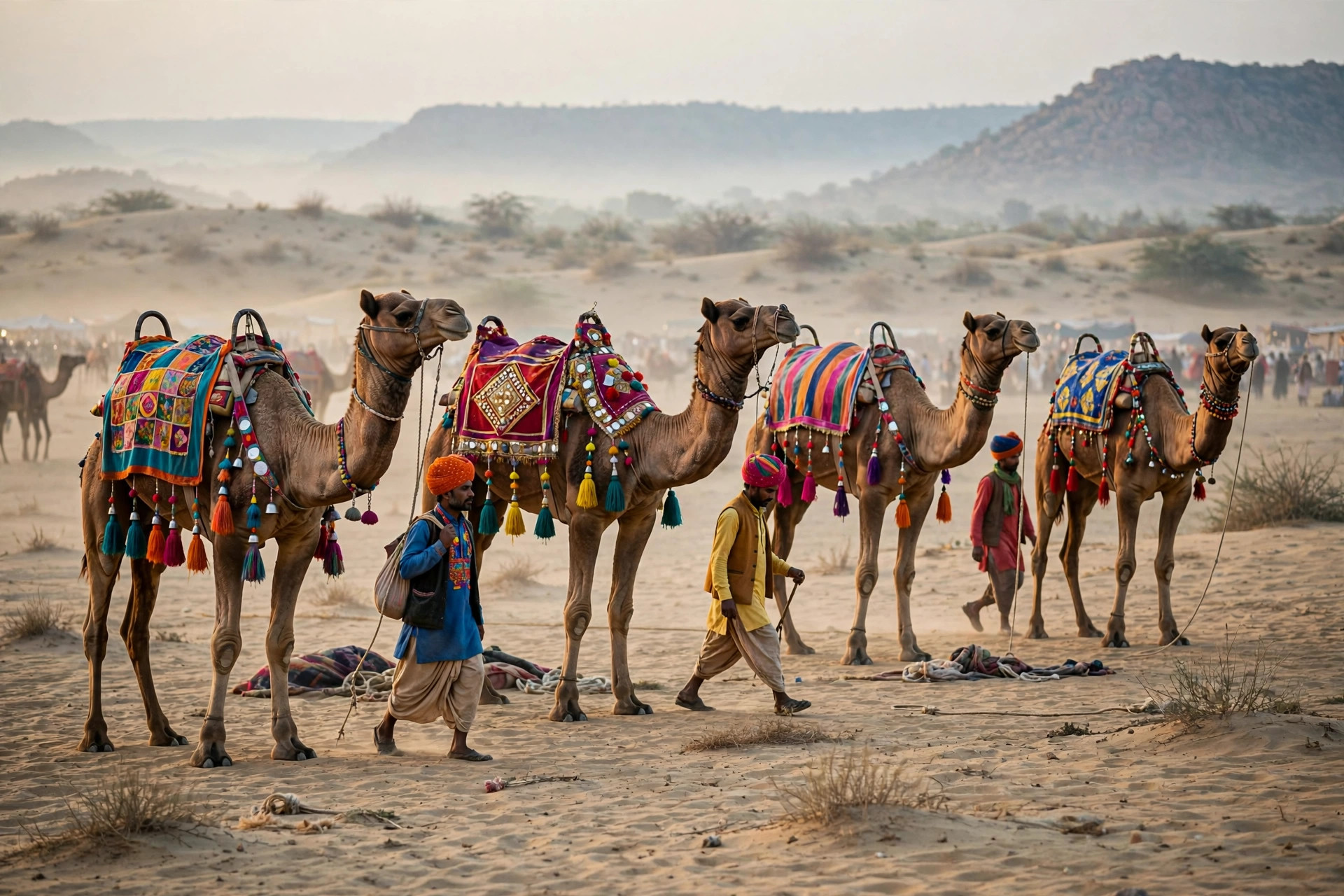
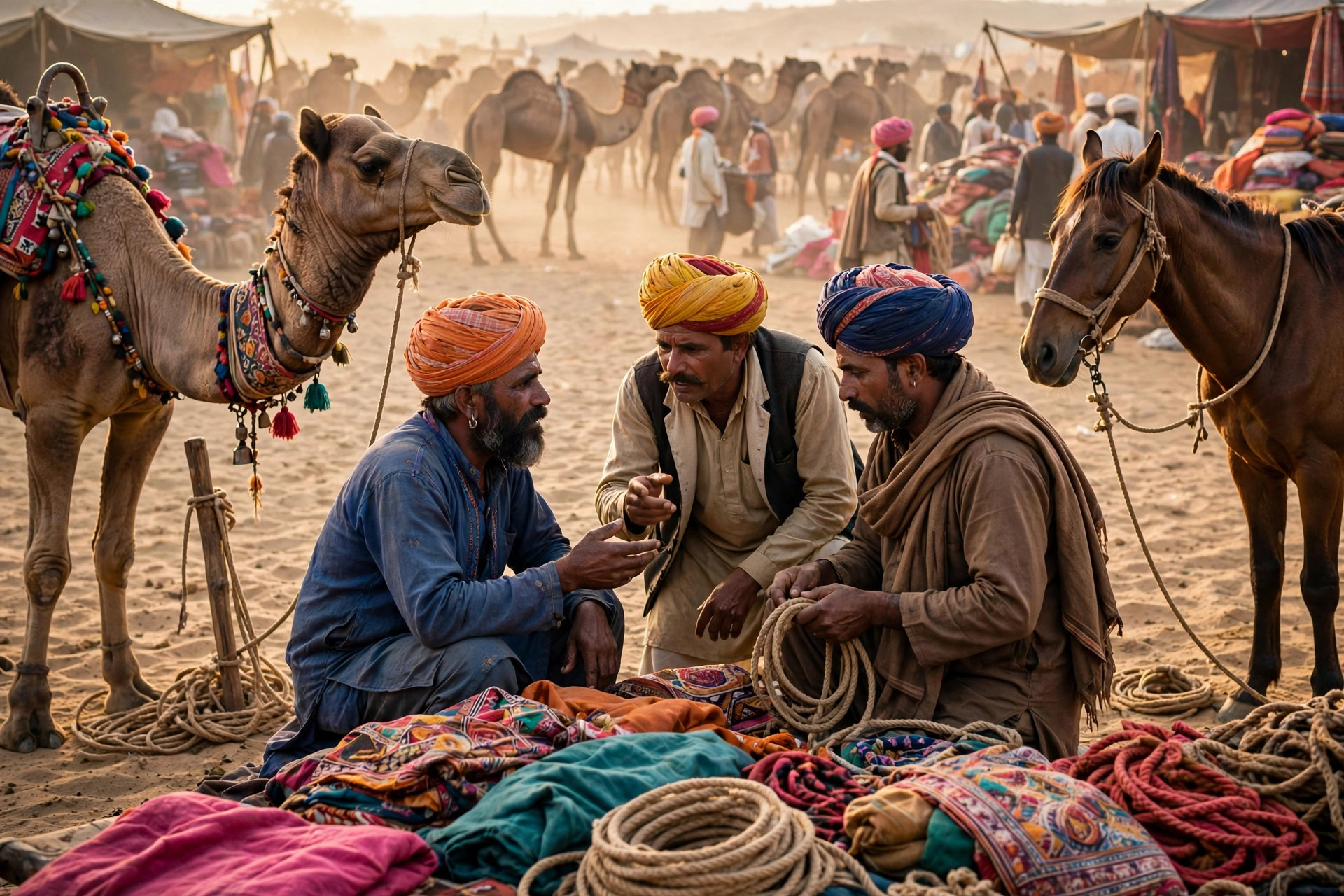
Be there by 8 AM. This is the working fair — traders in turbans bargaining over camels, horses and cattle in the cool hours, before the heat and the crowds. The animals are at their best-dressed in the morning, and the light is the best you will get all week.
Cultural programme — competitions and folk performance · Mela Ground stadium
The Rajasthan Tourism programme takes over in the second half of the fair: camel races and dances, longest-moustache and turban-tying contests, folk music and dance. In 2026 the programme includes a 'Chak De Rajasthan' football match between local players and foreign tourists on 17 November, and a Lagaan-costume exhibition cricket match on the morning of 23 November.
🏨 Where to stay
Hotel Pushkar Palace
Rooms from about $48 (about ₹4,500) in normal weeks (KAYAK); expect surge pricing in fair week
Right on the lake in Choti Basti, 3.3/5 on Tripadvisor (657 reviews) but 4.5/5 for location and 8.1/10 on KAYAK (427 reviews). Book it for the lake-view balcony and the ghats at your doorstep — and know the rooms are old-fashioned rather than polished. Location is what you are paying for.
Pratap Mahal, IHCL SeleQtions
5-star; check live fair-week rates — expect a steep premium over normal weeks
Rated 4.8/5 on Tripadvisor (2,685 reviews), the highest-rated 5-star stay in Pushkar. If you want one comfortable night with a pool and proper service after a dusty fairground day, this is the pick.
🍽 Where to eat
The Laughing Buddha Vegan Café
₹300–600 for two (about $3–6 / €3–6)
Must try: Veggie burger and homemade bread; salads
4.6/5 on Tripadvisor (499 reviews), Travellers' Choice. Hippie café with a balcony over the town — the place to decompress after the fairground dust.
Sunset Cafe
₹400–700 for two (about $4–7 / €4–7)
Must try: Curries and the apple pie
On Pushkar Lake, 3.9/5 on Tripadvisor (566 reviews). The view at sunset is the draw and regulars swear by it — but check your bill carefully before paying; a few recent reviews report double-charging and one fake note handed back as change.
- Agree every camel ride price — full amount, route and duration — before you mount or pose for a photo. There is no fixed tariff, and the price quoted after the photo is never the price quoted before it.
- Drink water all day. The fairground is open sand with almost no shade, and November sun at midday is stronger than it feels.
Savitri Hill, Bazaars, Food Trail — and Kartik Purnima if You Stay
🛕 Temples & darshan
Savitri Mata Temple — hilltop at sunrise · Ratnagiri Hill, above Pushkar
The quiet third stop after the lake and the Brahma Temple. Climb the steps or take the ropeway for the view over the whole town, the lake and the fairground dunes in one frame. Go early, before the heat, and you will mostly have it to yourself.
Kartik Purnima bathing (if staying to 24 November) · Pushkar Lake ghats
The religious climax of the fair: tens of thousands of pilgrims bathe at dawn in the lake on the full-moon day, and the Brahma Temple sees its heaviest footfall of the year. The fair closes on the morning of 24 November with the Kala Jatha Yatra, a mega cultural procession, and final prize distributions.
🏨 Where to stay
The Westin Pushkar Resort & Spa
5-star resort; check live fair-week rates — expect a steep premium
Rated 4.8/5 on Tripadvisor and 8.4/10 guest rating on Expedia. A full resort with a pool and spa a short drive from the old town — the right base if you want to escape the fair crowds entirely in the evenings.
Ananta Spa & Resorts, Pushkar
Rooms from about $42 (about ₹3,900) in normal weeks (BudgetYourTrip); expect surge pricing in fair week
5-star resort about 4 km before Pushkar at Leela Sevri, guest rating 7.8/10 on BudgetYourTrip. Lawns, pool and space — good for families who want the fair by day and quiet by night.
🍽 Where to eat
Laxmi Misthan Bhandar
₹100–200 for two (about $1–2 / €1–2)
Must try: Puri sabzi for breakfast
Near Gau Ghat — the breakfast stop locals point you to. Simple, crowded, and the best puri sabzi in town. Go before 9 AM.
Dream Tibetan Kitchen
₹300–500 for two (about $3–5 / €3–5)
Must try: Veg momos and thali
A traveller favourite for momos, including cheese and Nutella dessert dumplings, plus Buddha bowls and thali. A good change of pace after two days of Rajasthani food.
- The bazaars are best in the late afternoon, when the light is soft and the shopkeepers have time to talk. Bargain politely and walk away once — the price usually drops.
- Total honest ground budget for 3 nights: about $150–$350 per person, excluding your international flight to Delhi and excluding the fair-week hotel surge at the comfort end.
Should you go to Pushkar for the fair — or for the town?
Start with the honest answer, because most guides get this backwards. Pushkar is a holy town first and a fair second. The lake and the Brahma Temple are the reason the place exists; the camels are the spectacle that grew up around them. If you arrive expecting a camel theme park, you will spend three days slightly annoyed. If you arrive expecting a small, dusty, deeply religious town that happens to host one of the largest livestock gatherings on earth for one week a year, you will have one of the best weeks of your India trip.
The Pushkar Fair — the Pushkar Mela, or Kartik Mela — runs from Tuesday 17 November to Tuesday 24 November 2026, and it ends on Kartik Purnima, the full-moon day when tens of thousands of pilgrims bathe at dawn in Pushkar Lake. That is the whole trip in one sentence. Everything else in this guide is about getting the timing, the money and the town right.
The fair is free to enter. There is no ticket, no pass and no package you need to buy to walk onto the fairground. Remember that, because it is the single most useful fact in this guide: anyone selling you entry to the Pushkar Fair is selling you something that does not exist.
When exactly is the Pushkar Fair 2026?
The official fair runs 17–24 November 2026, eight days, organised by Rajasthan Tourism and the district administration. The religious climax is Kartik Purnima, Tuesday 24 November, with the ritual dawn bath — the Kartik snan — in Pushkar Lake and the heaviest footfall of the year at the Brahma Temple. The fair closes on the morning of the 24th with the Kala Jatha Yatra, a mega cultural procession, and final prize distributions.
But the dates on the poster are only half the story. The fair has two distinct halves, and which half you see depends entirely on when you arrive:
- 17–20 November: trading. Livestock dealing in the cool mornings, camels and horses changing hands on the dunes, breeders pitching camp. This is the working fair, and it is at its best early.
- 21–24 November: competitions and pilgrimage. Camel races and dances, the longest-moustache and turban-tying contests, folk music and dance, hot air balloons, Deepdaan lamps on the ghats, and the pilgrimage build-up to Kartik Purnima.
Herders start arriving even earlier — the camps begin going up on the dunes from about 10 November, a full week before the formal opening. So if you land in Pushkar on, say, 15 November, the fairground is already alive even though the official programme has not started.
The programme for 2026, as reported by CNBC-TV18 on 8 November, opens at 10 AM on 17 November with an inaugural puja, flag hoisting and nagada drums, followed by a Mandana folk art competition and a 'Chak De Rajasthan' exhibition football match between local players and foreign tourists. The cultural peak comes on the morning of 23 November with the fair's novelty event: an exhibition cricket match played in period costumes inspired by the film Lagaan. The district administration finalises the day-by-day schedule close to the dates, so treat any detailed programme you find online as provisional and check the day's timings at your hotel each morning.
Which days should you actually come? If you want the camels and the trading, come early — 17–20 November. If you want the competitions, the colour and the pilgrimage atmosphere, come late — 21–24 November. If you want the best mix of everything without the maximum crowd, the sweet spot is 19–22 November: the trading is still going, the competitions have started, and the Kartik Purnima crush has not yet arrived. Three nights inside that window is the plan in the blueprint above. One warning: the fair follows the Hindu lunar calendar, so the dates move every year — the 2027 fair will fall in the first half of November. Do not reuse this year's dates for next year's trip.
Do you need a visa?
Yes, and there is nothing special about Pushkar here — the standard India rules apply. Citizens of the US, UK, EU, Canada, Australia and New Zealand all need a visa before travel; there is no visa on arrival for these passports. Apply for the e-Tourist visa online at indianvisaonline.gov.in, between 4 and 120 days before you land. Your passport needs six months' validity from arrival. A 30-day visa costs $25 for July–March arrivals ($10 for April–June), a 1-year visa $40, and a 5-year visa $200 for most nationalities ($160 for US passports, $484 for UK passports), plus a 3% bank charge. The full fee table and the timing traps — the 1-year and 5-year visas run from the date the visa is granted, not from your arrival — are in our Kedarnath guide for international visitors, and the same rules apply here.
Carry your passport and a printout of your visa at all times in Pushkar. Hotels ask for it at check-in, and you will want it on you at the ghats and the fairground. Keep a photocopy in your bag and the original in a money belt.
How do you get there and get around?
Most foreign visitors fly into Jaipur International Airport, about 145–150 km from Pushkar, and drive 2.5–3.5 hours via Kishangarh and Ajmer. A pre-booked one-way sedan from Jaipur costs roughly ₹2,000–2,800 (about $21–30 / €19–27); GoIbibo lists Jaipur airport to Pushkar from ₹2,061 plus ₹530 in taxes. Premium chauffeur services quote far more — $90–120 one way — and buy you a nicer car and a driver who waits at arrivals, not a faster road. Book the car before you land; the airport taxi queue during fair week is the worst place to start negotiating.
If you are already travelling in India, the smarter arrival is by train to Ajmer Junction. Pushkar sits about 15 km from Ajmer across the Nag Pahar hill pass — 16 km by road according to GoIbibo, about 30 minutes. A cab from Ajmer station starts at around ₹408 plus taxes; shared autos and buses run the same route for less. Ajmer is on the main Delhi–Jaipur–Ahmedabad line, so it is easy to reach from almost anywhere in the north. Kishangarh Airport, about 40 km away, takes a few domestic flights but has far fewer connections than Jaipur.
| Leg | How | Time | Approx. cost (Nov 2026) |
|---|---|---|---|
| Jaipur airport → Pushkar | Pre-booked sedan | 2.5–3.5 hrs | ₹2,000–2,800 (about $21–30 / €19–27) |
| Jaipur → Pushkar (premium) | Chauffeur car | 2.5–3.5 hrs | $90–120 |
| Ajmer Junction → Pushkar | Cab | 30 min | From ₹408 + taxes (about $4–5 / €4) |
| Ajmer → Pushkar | Shared auto / bus | 30–45 min | ₹30–60 (about $0.30–0.65) |
| Old town → fairground | Walk / auto | 20–30 min on foot | Free on foot; auto ₹50–100 |
Once you are in Pushkar, walk. The old town is compact, most lanes are pedestrian, and the lake, the temple and the bazaars are all within a few minutes of each other on foot. The fairground is a 20–30 minute walk from the lake. Festival traffic congests the approach roads badly — allow an extra hour for any arrival or departure during fair week, and do not plan a tight train connection out of Ajmer on 24 November.
The sacred core: the lake and the Brahma Temple
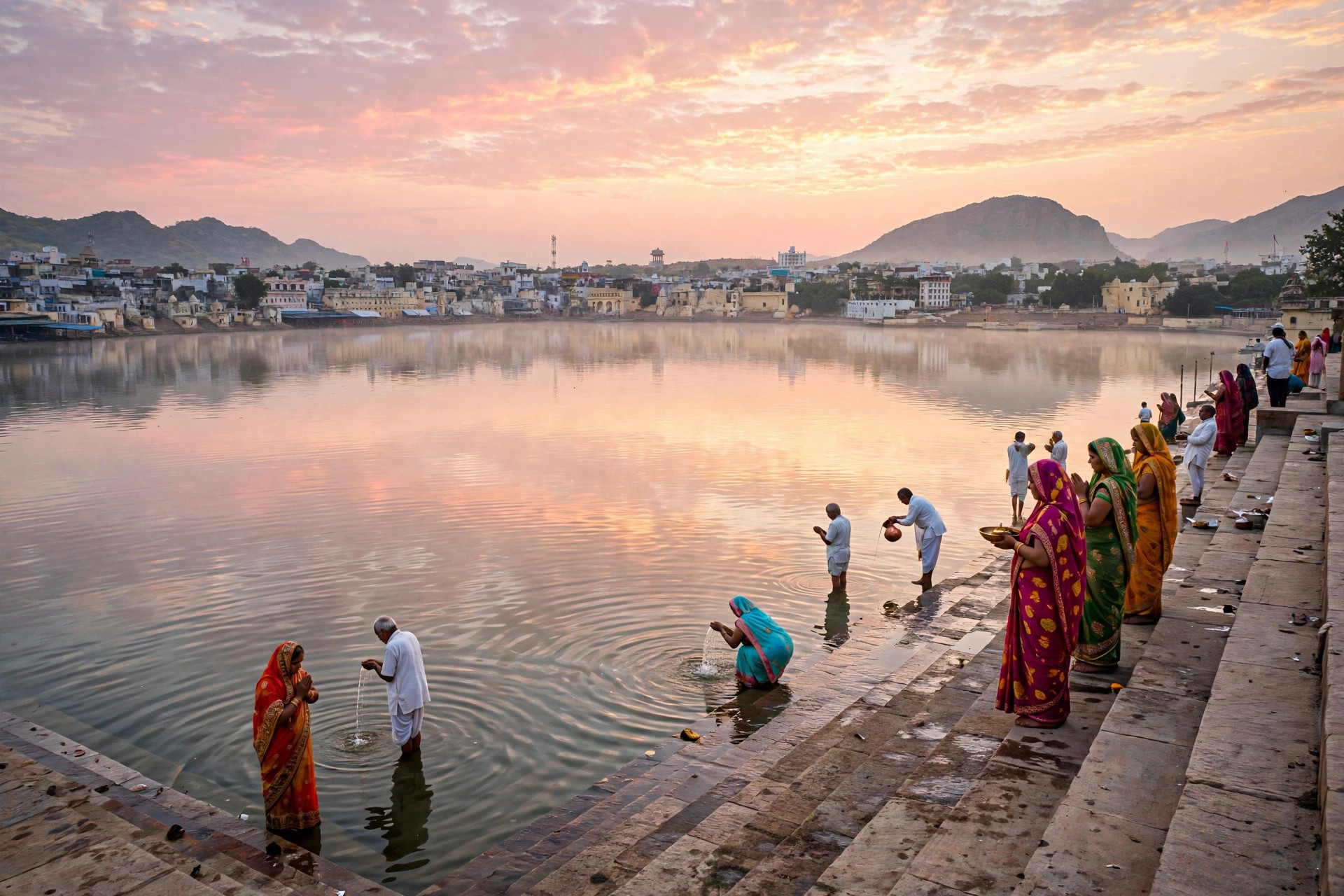
Pushkar Lake is ringed by 52 ghats, and it is the reason the town exists. Legend says Brahma dropped a lotus here and the lake formed where it fell — "Pushkar" means born from a flower — and the town is called Tirth Raj, the king of pilgrimage sites. Pilgrims bathe in the lake to wash away sins, and during Kartik the ghats are busy from before dawn.
Go to the lake twice. Once at sunrise, when the bathing is at its most serious and the town is quiet. Once at sunset, for the evening aarti, when the lamps come out and the whole lakeside fills up. The two visits feel like different places. The quieter ghats on the far side of the lake are where locals bathe; the main ghats near the bazaar are where the crowds gather. Both are worth your time.
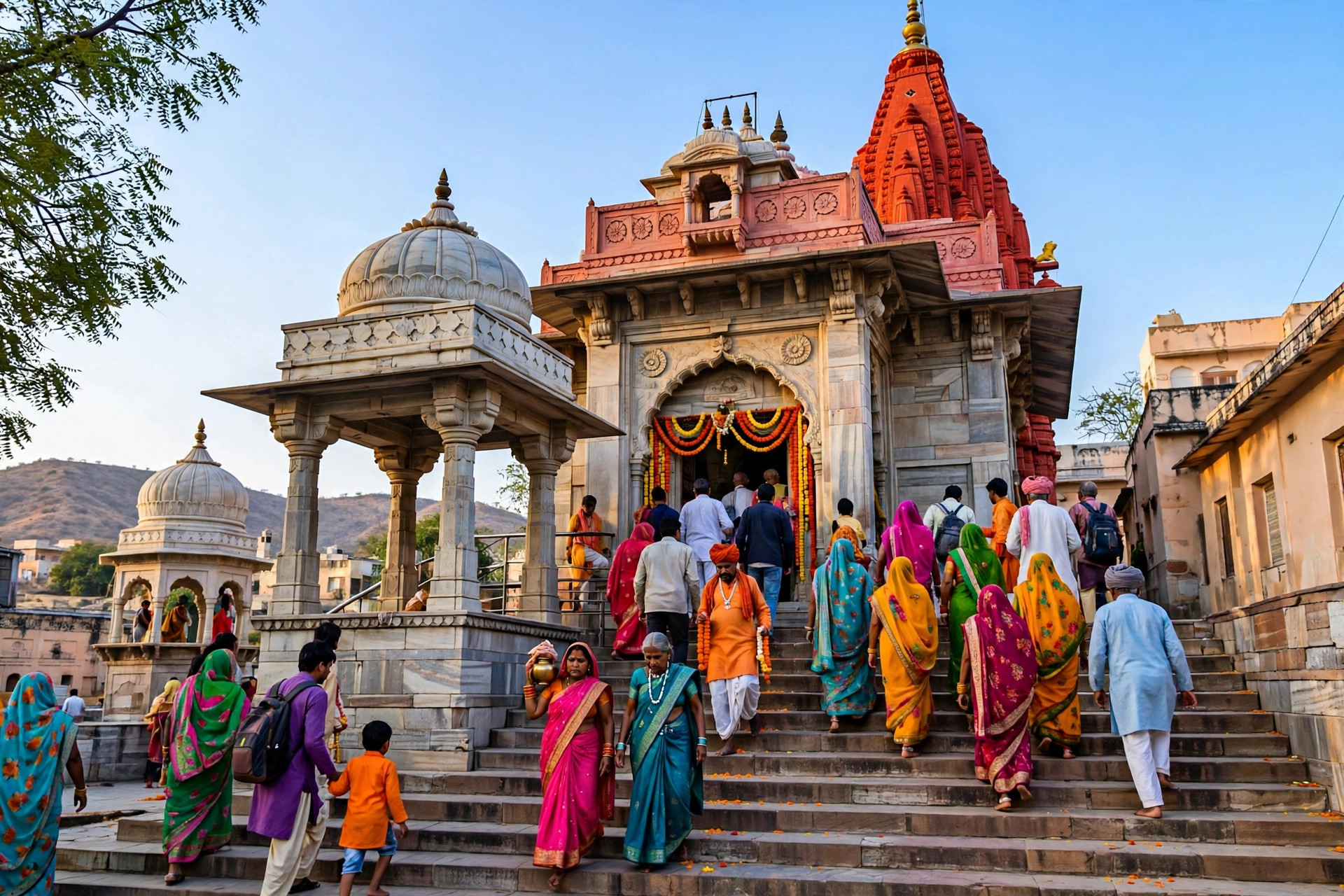
The Brahma Temple stands a short walk from the lake, its red spire visible from across town. It is one of the very few temples in the world dedicated to Lord Brahma, the creator, with a four-faced marble idol inside. The present structure dates to the 14th century. Usual hours are roughly 5 AM–1:30 PM and 3–9 PM, with a midday break — confirm the day's hours at your hotel during fair week, when timings shift. Go in the evening, when the fair crowds are at the ground and the temple queue is short. Shoes off, shoulders and knees covered, and no photography inside the sanctum.
The third stop is the Savitri Mata Temple on the hill above town. It is the quiet one: climb the steps or take the ropeway at sunrise for the view over the lake, the old town and the fairground dunes in a single frame. Most visitors never go. That is exactly why you should.
What does the whole trip actually cost?
Ground costs only — your international flight to India is extra. Conversions use ₹94 to the dollar and ₹105 to the euro, the rates on 10 November 2026, and are rounded; the rupee figure is the one that matters on the ground.
| Expense (3 nights, per person) | Budget | Comfort |
|---|---|---|
| Transport (Jaipur–Pushkar return, local autos) | ₹4,500–6,000 (about $48–64 / €43–57) | ₹8,000–12,000 (about $85–128 / €76–114) |
| Stay (3 nights) | ₹1,500–4,500 (about $16–48 / €14–43) | ₹12,000–25,000 (about $128–266 / €114–238) |
| Food (3 days) | ₹1,500–2,500 (about $16–27 / €14–24) | ₹3,000–5,000 (about $32–53 / €29–48) |
| Camel ride / fairground activities | ₹300–1,000 (about $3–11 / €3–10) | ₹1,000–3,000 (about $11–32 / €10–29) |
| Local transport, tips, misc | ₹1,000–2,000 (about $11–21 / €10–19) | ₹2,000–4,000 (about $21–43 / €19–38) |
| Total | about $95–170 / €85–155 | about $275–480 / €245–430 |
Two honest caveats. First, the comfort column assumes you book early; fair-week rates at the good hotels can run well above normal-season prices, and by 10 November the honest advice is to book now and check cancellation terms, not to hunt for bargains. Second, the budget column assumes a hostel dorm or a basic guesthouse. If the hostels are full — and in fair week they often are — the cheapest available room may cost double the budget figure. That is the real price of arriving late.
Is Pushkar safe? Including solo women, honestly
Pushkar is generally safe, and it is one of the more comfortable small towns in India for a first-time foreign visitor. The town is small, the streets are busy until late, foreign travellers are a normal sight, and the risks worth planning for are specific rather than general.
What is safe: walking the old town and the lake in the daytime and early evening, eating anywhere busy, staying in any well-reviewed hotel or hostel, travelling by pre-booked cab. Solo women travel here regularly — hostels like Moustache Pushkar (8.9/10 from 686 guest reviews, with female-only dorms) and Zostel Pushkar are full of women travelling alone, and the town's backpacker infrastructure is built around them.
What needs care: poorly lit lanes alone late at night, especially the lanes behind the lake away from the main bazaar; valuables in a back pocket in the Kartik Purnima crowd; any fare that was not agreed before you got in; and the fairground after dark, which is large, sandy and badly lit in places. The rules that matter are boring and they work: daylight travel, a registered stay, modest dress in temple areas, your passport in a money belt, and your live location shared with someone back home.
The real risks in Pushkar are touts and inflated prices, not violent crime. Which brings us to the next section — the one this guide would be dishonest without.
Scams and pressures to avoid
"My brother's shop." In the bazaars, a friendly man will walk with you, ask where you are from, and steer you to his brother's / cousin's / friend's silk, carpet or handicraft shop. Inside, the pressure starts: tea, then fabric unrolling, then a price that drops by half, then by two-thirds, then a story about export. The goods are often fine. The prices are not. The walk-away line is simple: "Thank you, I am just looking today" — said once, with a smile, while you keep walking. Do not stop, do not sit down for tea, do not let the conversation start. Once you are inside the shop, leaving politely takes ten times longer than not entering.
The camel-photo price switch. At the fairground, a handler will offer you a photo with a decorated camel, or a short ride. The price is agreed after the photo, not before — and the after-price is always higher, sometimes several times higher. Agree the full price, the route and the duration before you mount or pose, in rupees, out loud, with the handler repeating it back. Travellers report paying roughly ₹300–800 for a short ride; there is no fixed tariff, so the number you agree beforehand is the number that counts. The walk-away line: "No thank you, I already agreed a price with another handler" — and then actually walk to another handler.
Self-appointed guides at the ghats. A man attaches himself to you at the lake, explains the ghats, performs a small puja on your behalf, and then presents a bill for the explanation. He is not a priest and not a guide. A polite, firm "No thank you" at the first sentence, and keep walking. If you want a puja at the lake, arrange it through your hotel, where the price is fixed and the priest is known.
The fair-entry ticket. There is none. Entry to the Pushkar Fair and the stadium competitions is free. Anyone selling you a ticket, a pass or a "foreigner entry fee" is inventing a product. The same goes for "VIP darshan" at the Brahma Temple — entry is free, and pujas are arranged through the temple, not through a man at the gate.
The rules visitors break by accident
Pushkar is a holy town, and its rules are not suggestions. The one foreign visitors break most often is the food rule: the whole town is vegetarian, and alcohol is not sold or served anywhere inside town limits. No meat, no alcohol, and eggs are off most menus. This is not a restaurant policy — it is the town's identity, and it is enforced. Do not bring alcohol into town expecting a quiet drink in your room; the hotels will not serve it and the town will not sell it. The good news is that you will eat extremely well anyway. Pushkar's cafes serve food from everywhere — falafel and laffa from the Israeli kitchens, wood-fired pizza, momos, thali, banoffee pie — because a town full of travellers from everywhere has learned to cook for all of them.
Dress modestly at the temples and ghats: shoulders and knees covered. This is not about the fairground, where anything goes, but about the lake and the temples, where it matters. Shoes come off at temples and on the ghats. Photography is fine at the fairground and in the bazaars, but ask before photographing anyone bathing at the lake — a nod and a smile gets a yes most of the time, and a camera raised without asking gets the answer you deserve.
One more, because it catches people every year: do not swim in the lake. It is a sacred bathing place, not a swimming spot, and bathing means a ritual dip at the ghats, fully clothed, not a swim. Watch what the pilgrims do and follow their lead.
What nobody tells you
Here is the thing no Pushkar guide seems to say plainly: the fairground and the holy town are two different places with two different rhythms, and most visitors who hate Pushkar only saw one of them.
The fairground is dust, noise, bargaining, crowds and camels — exciting for a morning, exhausting by the afternoon. The old town is slow: the lake at dawn, the temple steps, a rooftop thali, a bazaar that wakes up late and stays up late. They sit two kilometres apart and they barely overlap. Visitors who stay out at a resort near the fairground and never walk the lake at dawn come home saying Pushkar is a tourist trap. Visitors who never leave the old town come home saying they missed the fair. Both are right about the half they saw.
The fix is simple and it is the whole plan in this guide: sleep in the old town, visit the fairground in the cool morning, and be back at the lake for the evening aarti. Do that for three days and you get both Pushkars — the sacred town and the spectacle — instead of half of either.
The second thing nobody tells you: the camels leave early. The trading peaks in the first half of the fair, and by the time the pilgrimage crowds arrive for Kartik Purnima, many of the best animals have already been sold and trucked away. If the camels are the reason you are coming, arrive for the trading days, not the final days. The last two days belong to the pilgrims, and that is a different and equally extraordinary sight — but it is not the camel fair you saw in the photographs.
When is the best time to come?
November is the window, and this year it is a short one. The fair runs 17–24 November, the weather is at its best — warm days, cool desert nights — and the whole town is built for visitors. Come in the 19–22 November sweet spot if you can choose. Come for Kartik Purnima on the 24th if you want the pilgrimage at full intensity and you have booked your room already. Do not come the week after the fair expecting the same town: the camps come down, the traders leave, and Pushkar goes back to being a quiet lakeside town of temples and cafes, which is lovely in its own right but is not the fair.
Book now. A week before the fair, the honest advice is not "book early" in the abstract — it is that the good rooms are already going, the prices are already up, and every day you wait narrows your choices. Check cancellation terms when you book, because fair-week plans change, and a flexible booking is worth more than a cheap non-refundable one.
For the full visa walkthrough and the timing traps in the e-visa system, see our Kedarnath guide for international visitors. For the other great November pilgrimage, Dev Deepawali in Varanasi, see our Dev Deepawali guide — Kartik Purnima, 24 November, is the shared climax of both. And for the first-timer's Varanasi plan, see our Varanasi guide for international visitors.
Facts verified 10 November 2026. Fair dates 17–24 November 2026 and Kartik Purnima Tuesday 24 November: Rajasthan Tourism 2026 festival calendar, corroborated by CNBC-TV18 (8 November 2026 — opening 10 AM 17 November, 'Chak De Rajasthan' football match, Lagaan-costume cricket match on the morning of 23 November, Kala Jatha Yatra closing procession on the morning of 24 November, herders pitching camp from 10 November), AroundTrail, Sawai Hospitality, Capture a Trip, Noble House Tours and Apna Ajmer. Two phases (17–20 trading, 21–24 competitions and pilgrimage) per Apna Ajmer; best window 19–22 November per Sawai Hospitality. Pushkar Lake 52 ghats and Brahma Temple 14th-century structure per Rajasthan Tourism. Ajmer–Pushkar 16 km by road, 30 min, cab from ₹408 plus taxes per GoIbibo; Jaipur–Pushkar 145–150 km, 2.5–3.5 hrs, sedan one-way ₹2,500–2,800 per MyTravaly, Jaipur airport–Pushkar from ₹2,061 plus ₹530 taxes per GoIbibo. Hotels and restaurants: ratings and review counts from Tripadvisor, KAYAK, Hostelz, Hostelworld, BudgetYourTrip and Expedia listings as returned 10 November 2026 — Zostel Pushkar 4.6/5 (584 reviews), Moustache Pushkar 8.9/10 (686 reviews), Inn Seventh Heaven 4.6/5 (1,188 reviews), Hotel Pushkar Palace 3.3/5 (657 reviews; location 4.5/5), Pratap Mahal 4.8/5 (2,685 reviews), The Westin Pushkar 4.8/5, Ananta Spa & Resorts rooms from $42, Original Ganga Laffa and Falafel 4.8/5 (395 reviews), The Laughing Buddha Vegan Café 4.6/5 (499 reviews), Sunset Cafe 3.9/5 (566 reviews). E-visa fees: official e-Tourist fee table dated 8 September 2026 via indianvisaonline.gov.in. Currency conversions at ₹94 to the dollar and ₹105 to the euro (10 November 2026, Finnhub) and rounded. The daily fair programme is finalised by the district administration close to the dates — check the day's schedule at your hotel each morning. Fair-week hotel prices are surge prices and change daily; verify live rates and cancellation terms at booking.
Frequently asked questions
When is the Pushkar Fair in 2026?
The official fair runs Tuesday 17 November to Tuesday 24 November 2026, ending on Kartik Purnima, when tens of thousands of pilgrims bathe at dawn in Pushkar Lake. Traders start pitching camp on the dunes from about 10 November, so the fairground is already alive a week before the formal opening. The best balance of trading, competitions and manageable crowds is 19–22 November.
Do I need a visa to visit Pushkar?
Yes. Citizens of the US, UK, EU, Canada, Australia and New Zealand all need an Indian visa before travel — there is no visa on arrival. The e-Tourist visa is applied for online at indianvisaonline.gov.in, 4 to 120 days before arrival; a 30-day visa costs $25 for July–March arrivals ($10 for April–June), a 1-year visa $40, and a 5-year visa $200 for most nationalities ($160 for US passports, $484 for UK passports), plus a 3% bank charge. Carry your passport at all times in Pushkar.
Is Pushkar safe for a solo woman traveller?
Pushkar is generally safe for solo women with the usual precautions, and it is one of the more comfortable small towns in India for a woman travelling alone — the streets are busy, the town is small, and foreign women are a normal sight. Stay in a well-reviewed place near the lake or in a hostel with female-only dorms, avoid poorly lit lanes alone late at night, agree every fare before you get in, and keep valuables in the hotel safe. The real risks here are touts and inflated prices, not violent crime.
Is Pushkar really vegetarian and alcohol-free?
Yes, and this is the rule foreign visitors break most often by accident. Pushkar is a holy town: no meat is served anywhere inside town limits, and alcohol is not sold or served in town. Eggs are also off most menus. The cafes serve excellent vegetarian food from around the world — falafel, wood-fired pizza, thali, momos — so you will eat well, but do not bring alcohol into town or expect a bar.
How many days do I need for the Pushkar Fair?
Three nights is the right length. Day one for the lake, the Brahma Temple and the old town; day two for the fairground in the cool morning and the cultural programme in the evening; day three for the Savitri hill, the bazaars and the food trail. If you can stretch to Kartik Purnima on 24 November, add a night for the dawn bathing — it is the most intense and the most memorable part of the whole week.
Should I fly into Jaipur or take the train to Ajmer?
Fly into Jaipur if you are coming from abroad — it is the nearest international airport, about 145–150 km away. From Jaipur, a pre-booked sedan to Pushkar costs roughly ₹2,000–2,800 one way and takes 2.5–3.5 hours. If you are already travelling in India, take the train to Ajmer Junction instead: Pushkar is only about 15 km from Ajmer, a 30-minute cab ride from around ₹408. Ajmer is the better arrival point; Jaipur is the better airport.
Keep exploring
 Yatra Guides
Varanasi for International Visitors: Visa, Costs, Safety, Scams, and the Ghats Without the Guesswork
First time in Varanasi from abroad? E-visa fees, the ₹300 Sugam Darshan ticket, real boat prices, safety, scams and a 3-day plan — checked 7 Nov 2026.
 Yatra Guides
Kedarnath Yatra for International Visitors: Visa, Registration, Costs in USD, and the Honest Timing Call
Kedarnath for foreign visitors: e-visa, free Char Dham registration, trek vs helicopter costs in ₹ and USD, the 2026 temple entry rule, and why May 2027 is the smart plan.
 Yatra Guides
Sabarimala Mandala Season 2026-27: Dates, Virtual-Q Booking, aur First-Timer ka Poora Guide
Sabarimala 16 Nov 2026 ki shaam ko khulta hai Mandala season ke liye. Virtual-Q booking, 41-day vratham, Pamba trek aur first-timer ka imaandaar plan.